Concepts in AI & ML, page 7
Few-Shot Prompting
Few-shot prompting embeds task examples directly in the prompt to guide output format without retraining. It excels at niche tasks and consistent formatting, but mismatched examples degrade performance more than no examples at all.
dplyr: A Grammar for Data Manipulation
dplyr offers a consistent grammar for data manipulation, letting you chain simple verbs to perform complex transformations. It's essential for cleaning, summarizing, and reshaping data frames in R.
SIFT: Finding Image Features That Scale
SIFT finds key points in an image that are stable across changes in scale. It's used for object recognition or stitching panoramas by matching these features between images. The main footgun is assuming it's invariant to all changes, not just scale.
MLflow Tracking: A Lab Notebook for Your ML Experiments
Think of MLflow Tracking as a lab notebook for your models. It logs parameters, metrics, and artifacts for every training run, letting you compare results and find the best model. The main footgun is forgetting to set a remote server, trapping logs locally.
Dask: Parallel Computing with Familiar APIs
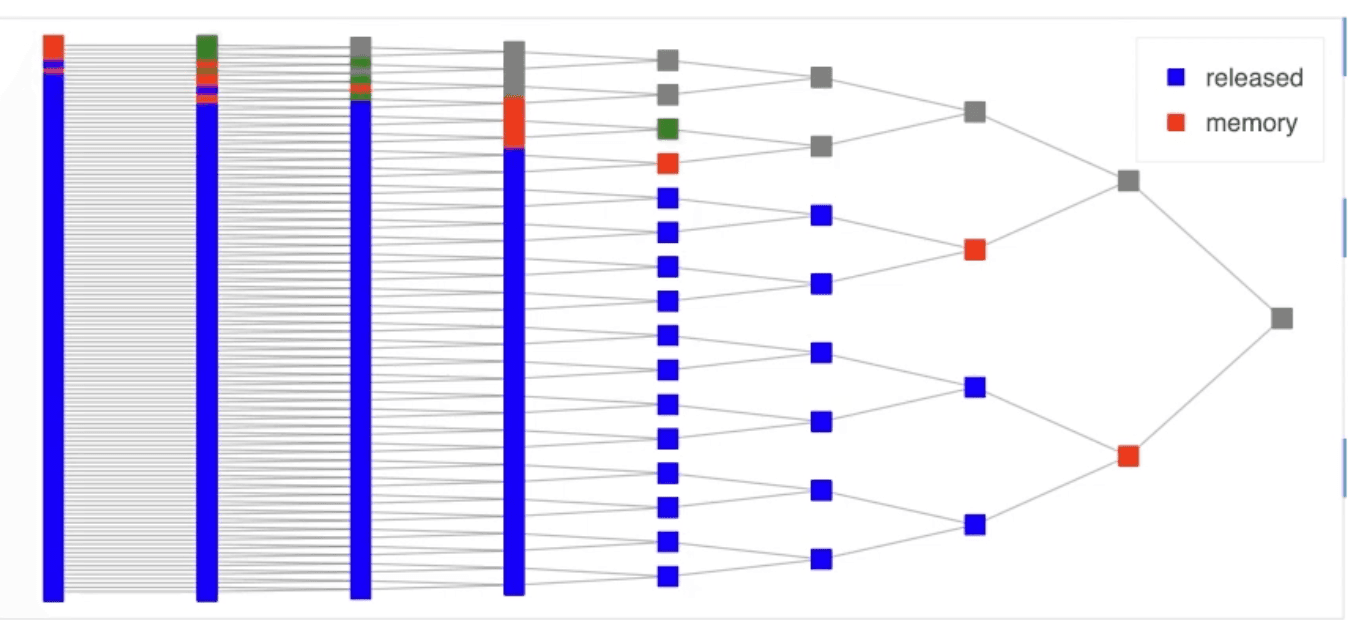
Dask parallelizes Python analytics by breaking data into chunks and building a task graph of operations. It's like giving Pandas and NumPy superpowers for data too big for RAM. The footgun: its lazy evaluation means you must explicitly call .compute().
SURF: A Faster, Patented Alternative to SIFT
SURF is a faster, more robust alternative to SIFT for finding key points in an image. It's used for real-time object recognition or stitching images where SIFT is too slow. Beware: its core algorithms are patented, limiting commercial use without a license.
Model Signature: The API Contract for Your ML Model
A model signature is an API contract for your ML model, defining the exact shape and types of its inputs, outputs, and parameters. It's used by platforms like MLflow to validate requests and enable safe deployments. Forgetting it will block model registration.
Chain-of-Thought Prompting: Making LLMs 'Show Their Work'
Chain-of-Thought (CoT) prompting gets better answers from LLMs by asking them to 'show their work.' It's best for complex reasoning like math problems or logic puzzles where breaking the problem down helps.

R & Python Interoperability with Reticulate
Reticulate embeds a Python session inside R, letting you use Python libraries as if they were native R objects. Use it when a team uses both languages or you need a Python library in an R workflow.
ORB: Fast, Free Feature Detection for Computer Vision
ORB combines the speedy FAST keypoint detector with a rotation-aware BRIEF descriptor. It offers a fast, royalty-free alternative to SIFT for finding and describing unique points in an image, even when the object is rotated.
Hydra: Composable Configuration for Complex Apps
Hydra treats configuration like LEGOs. Instead of one monolithic file, you compose small, reusable config pieces for each run. It's ideal for ML experiments where you override settings from the command line.
Local Binary Patterns (LBP) for Texture Classification
LBP is a 'visual descriptor' that summarizes an image's texture into a feature set for a machine to read. It's a powerful tool for texture classification, but its performance often improves significantly when combined with other descriptors like HOG.
FLANN Matcher for Feature Correspondence
OpenCV's FLANN matcher pairs query and train descriptors to find cross-image feature correspondences as an alternative to Brute-Force. Engineers often assume FLANN shares Brute-Force's normType and crossCheck parameters, causing silent configuration errors…
Least-to-Most Prompting: Solving Hard Problems Incrementally
Least-to-most prompting guides an LLM by breaking a hard problem into a sequence of simpler steps. It excels at complex math or logic where chain-of-thought fails, solving each subproblem using the answer to the previous one.
Web Scraping: Automating Data Collection from Websites
Web scraping is an automated copy-paste for websites. A bot browses sites and extracts specific data, like prices or articles, into a structured format. The main footgun is assuming scraping cleans the data or grants you rights to use it.
Model Lineage: The Git History for Your AI
Think of model lineage as the git log for your AI, tracking every input from data to code that created it. It's essential for reproducing models, debugging failures, and satisfying regulatory audits.
Self-Consistency: Majority Rules for LLM Reasoning
Self-consistency makes an LLM solve a problem multiple ways, then picks the most common answer. It's like asking a committee of experts for their reasoning and taking a vote. This boosts accuracy on complex math and logic puzzles.

Epipolar Geometry: Finding 3D Points from 2D Images
Epipolar geometry finds a 3D point from two 2D views by constraining the search. Instead of scanning the whole second image for a match, you only look along a single line. It's key for 3D reconstruction. The footgun is assuming perfect pinhole cameras.
PMML: The 'Save File' for Machine Learning Models
PMML is like a universal "save file" for ML models, using XML to describe everything needed for prediction: features, preprocessing, and model structure. It enables training in Python and deploying in Java. The footgun: verbose files and partial tool support.
Tree of Thoughts: LLM Reasoning Beyond a Single Path
Tree of Thoughts (ToT) lets an LLM explore multiple reasoning paths at once, like a human brainstorming. It generates several 'thoughts' and pursues the most promising ones. This is crucial for planning tasks where one wrong turn fails.
We are hiring for this. Every open role lists the topics its interview covers, so you can prepare for the real thing rather than guessing.
See open roles