Interview questions in AI & ML, page 11
How does Mask R-CNN do instance segmentation?
Faster R-CNN backbone plus RPN, then RoIAlign and a parallel mask head predicting per-class binary masks.

How would you implement shadow deployment and which metrics justify promotion?
Tests zero-impact validation when feedback loops are broken. Mirror traffic to a shadow variant, log predictions, and compare latency, errors, and drift against SLAs. Red flag: calling it A/B testing or claiming live business metrics from unserved responses.
What is GAN mode collapse, its causes, and two mitigations?
Define mode collapse as diversity loss to few modes; cite discriminator imbalance and lenient JS loss; give two fixes: WGAN and mini-batch discrimination.

How would you monitor data quality for a C-level dashboard pipeline?
Designing production data observability for executive dashboards. A strong answer maps freshness SLAs, completeness checks, and distribution drift detection to business impact.
How to improve coarse segmentation boundaries?
Skip connections and higher-resolution features, boundary-aware losses, and point-based or CRF refinement.
What infrastructure is needed for a Continuous Training pipeline?
Tests event-driven ML system design beyond CI/CD. Strong answers name orchestrators, feature stores, model registries, and validation gates, mapping triggers to retraining and promotion. Red flag: conflating CT with CI/CD or skipping model validation.

How does text guide Stable Diffusion via U-Net cross-attention?
Tests whether you know text embeddings condition the U-Net through cross-attention. Good answers explain that image features query text keys and values at every layer. Red flag: claiming the prompt is concatenated to the image latent.
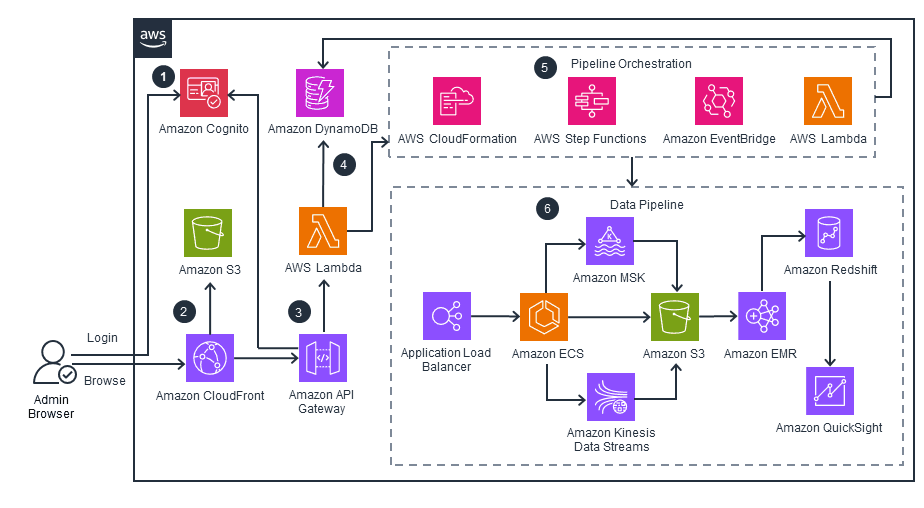
Design a clickstream pipeline from ingestion to data warehouse
Tests data pipeline design under load: buffering, idempotent transform, and warehouse modeling. A strong answer orders ingestion via Kinesis or MSK, Spark EMR sessionization, and Redshift star schemas. Red flag: no buffer and direct warehouse writes.
Fairness and robustness gates in CI/CD
Sliced fairness metrics across subgroups, robustness checks via perturbation and adversarial sets, all compared to thresholds that fail the build.
Evaluating image generation: FID and IS
FID compares feature distributions of real and generated images, lower is better; Inception Score rewards confident, diverse classes but ignores real data.
Explain panoptic segmentation and Panoptic Quality
Panoptic assigns every pixel a class and instance id over things and stuff; PQ factors into SQ, average IoU of matches, times RQ, an F1 over matched segments.
First steps to identify and handle missing values
Tests systematic diagnosis before imputation. Strong answers visualize nulls, classify MCAR/MAR/MNAR, and contrast mean imputation with KNN, weighing bias versus complexity.
DDIM: faster diffusion sampling
DDIM defines a non-Markovian deterministic process sharing DDPM's training, letting you skip steps and sample in far fewer iterations.
Adapting ViT for dense semantic segmentation
Reassemble patch tokens into a 2D feature map, add a decoder, and handle low resolution plus quadratic attention cost.

How would you design safe, automatic schema evolution in CI?
Tests whether you separate schema evolution from semantic validation. Strong answer: versioned data contracts allowing additive enums, unknown-category model buckets, and automated contract negotiation. Red flag: manual allow-lists or disabling validation.
CI/CD for microservice-based ML systems
Independent per-service pipelines, contract testing to protect interfaces and schemas, and incremental deploys (canary, blue-green); manage data and model contracts, not just code.
Diffusion-based image inpainting design
At each denoising step keep the known region by replacing it with the noised original, let the model generate only the masked area, condition on prompt and mask.
Sparse vs dense optical flow and Lucas-Kanade
Sparse flow tracks selected feature points, dense flow computes a vector per pixel; Lucas-Kanade solves brightness constancy in a local window assuming constant motion.
Temporal consistency in video diffusion
Add temporal layers, such as temporal attention or 3D convolutions across frames, so the model attends across time and frames denoise jointly rather than independently.
Design a tracking-by-detection tracker
Detect per frame, then associate boxes across frames by IoU or appearance using Hungarian matching, maintaining track ids.
We are hiring for this. Every open role lists the topics its interview covers, so you can prepare for the real thing rather than guessing.
See open roles