Interview questions in AI & ML, page 14
How FID is calculated versus Inception Score
FID fits Gaussians to Inception features of real and fake images then measures Frechet distance; it uses real references and detects mode collapse.
Cross-attention for visual question answering
In cross-attention queries come from one modality and keys/values from the other, e.g. text queries attend over image features so the question selects relevant regions.
Design a multi-model serving architecture for infrequently used models
Tests sparse-traffic cost efficiency via shared compute and dynamic loading. Strong answers: LRU cache on fast storage, scale-to-zero with async preload, pinned hot models, per-model quotas.

What is cross-validation and why is it more robust than a holdout split?
A single split is noisy and wastes data; k-fold rotates each fold as test, averages scores, and trains on all data.
How to evaluate a RAG system end to end
Measure retrieval (recall, precision, MRR, NDCG) and generation (faithfulness, answer relevance) separately, plus end-to-end correctness.
Why ViTs need positional embeddings
Self-attention is permutation invariant so patch order is lost; positional embeddings restore spatial location. CNNs encode position implicitly via the fixed convolution grid.

Differences between monitoring a traditional REST API and a production ML model
Contrast latency/errors with ML signals like data drift and training-serving skew against baselines, noting ground truth delays.

High ROC-AUC but low PR-AUC: what does this imply?
Tests if ROC-AUC hides imbalance while PR-AUC exposes it. Severe imbalance dilutes FPR across many negatives, inflating ROC-AUC, but precision crashes. Critical for rare positives with costly false positives. Praising the model on ROC-AUC alone fails.
Detecting data drift on a continuous feature
Data drift is when serving feature distributions shift from training; detect with a Kolmogorov-Smirnov test comparing distributions; a small p-value signals drift to alert on.
How MMLU works and the contamination problem
MMLU is multiple-choice across 57 subjects scored by accuracy; contamination means test items leaked into pretraining, inflating scores.
Core principles of a Neural Radiance Field
An MLP maps a 3D point plus view direction to color and density; novel views render by casting rays, sampling points, querying the MLP, and volume-integrating along each ray.
K-Means vs DBSCAN: which for geospatial hotspots?
Tests matching algorithmic assumptions to data structure. K-Means needs K and assumes spheres; DBSCAN discovers arbitrary density shapes and labels noise. Choose DBSCAN for geospatial hotspots because density is irregular.
Reference-free evaluation for open-ended dialogue
ROUGE punishes valid paraphrases; use reference-free LLM-as-judge or learned scorers rating coherence, relevance, and groundedness.
Interpreting a black-box gradient boosting model
Global tools like permutation importance or aggregated SHAP rank overall feature influence; local tools like per-instance SHAP or LIME explain one prediction; SHAP unifies both via additive…
Pure ViT vs hybrid CNN-Transformer for medical segmentation
Pure ViT captures global context but is data hungry and weak on local detail; hybrid CNN-Transformer gets local features cheaply plus global attention, ideal for scarce…

Design a system to monitor a real-time prediction service for feature drift
Async feature logging, distribution comparison via PSI/KS against training baseline, and threshold-based anomaly alerts.
Setting up an LLM-as-a-judge evaluation
Define rubric, prefer pairwise comparison, randomize order, calibrate against humans; control position, verbosity, and self-preference bias.
Attention in diffusion U-Nets for text conditioning
Self-attention mixes spatial features at low-res blocks; cross-attention has image queries attend to text-token keys/values; placed inside transformer blocks.
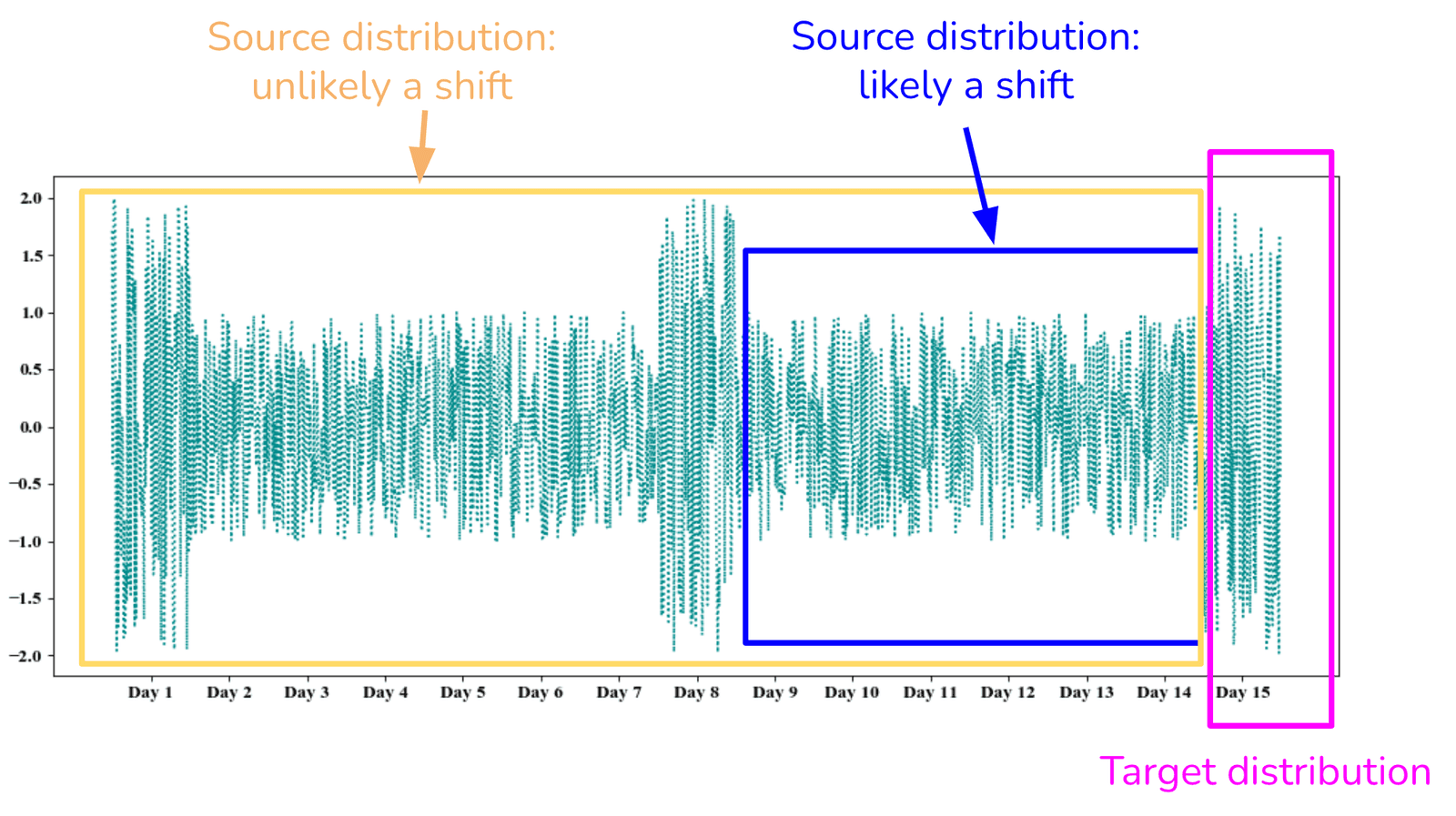
Model output distribution shifts. What are root causes and next steps?
This tests covariate vs label shift vs concept drift when outputs shift. A strong answer checks features before labels, then feedback loops or staleness. A red flag is generic drift without separating P(X), P(Y), and P(Y|X).
How do you determine required sample size for an A/B test?
Tests statistical power and experimental design. Name four inputs: baseline conversion rate, minimum detectable effect, alpha (5%), and power (80%), then solve for N. Red flag: "test until significant" or fixed guesses like 1000 users without effect size.
We are hiring for this. Every open role lists the topics its interview covers, so you can prepare for the real thing rather than guessing.
See open roles