Interview questions in AI & ML, page 17
Core insight behind GPTQ and AWQ
Not all weights matter equally; GPTQ minimizes layer output error using second-order info, AWQ protects salient weight channels tied to large activations.
Semantic, instance, and panoptic segmentation
Semantic labels every pixel by class without separating objects; instance separates individual objects but may skip background; panoptic unifies both, labeling stuff and distinct thing instances.
What is a feature store and how does it prevent training-serving skew?
This tests training-serving consistency via centralized feature management. Covers offline batch storage, online serving, shared transformations, and alternatives like ad-hoc ETL. A red flag is calling it just a database and ignoring point-in-time correctness.

What is a word embedding and how does it beat one-hot encoding?
Tests dense semantic vectors versus sparse one-hot representations. A good answer defines embeddings as learned real-valued vectors where similar words are close, contrasts them with orthogonal one-hot vectors lacking similarity, and names Word2Vec or GloVe.
Rule-based versus model-based LLM guardrails
A guardrail is a programmatic check constraining LLM I/O; rule-based uses regex or blocklists, model-based uses a classifier like a moderation model to detect harmful content.
Designing a baseline Visual Question Answering model
Encode the image with a CNN, encode the question with an RNN or embedding, fuse the two vectors, and classify over a fixed answer vocabulary.

What trade-offs decide managed ML platforms versus open-source Kubernetes?
Weigh total cost plus hidden engineering headcount, lock-in vs flexibility, and audit feature gaps.
Describe Transformer architecture and why self-attention beats recurrence
This tests parallelization and long-range dependencies. A strong answer outlines the encoder-decoder stack with multi-head self-attention, contrasts O(1) sequential steps versus RNNs' O(n) unrolling, and warns that describing it as averaging misses key ideas.
Detecting RAG hallucinations with a confidence score
Decompose the answer into claims, verify each against retrieved context with NLI or an LLM judge, aggregate into a faithfulness confidence score, and flag unsupported claims.
Camera intrinsics, extrinsics, and the essential matrix
Intrinsics map camera coords to pixels, extrinsics are camera pose in the world; the essential matrix relates normalized points across two views, encoding relative rotation and translation up to scale…
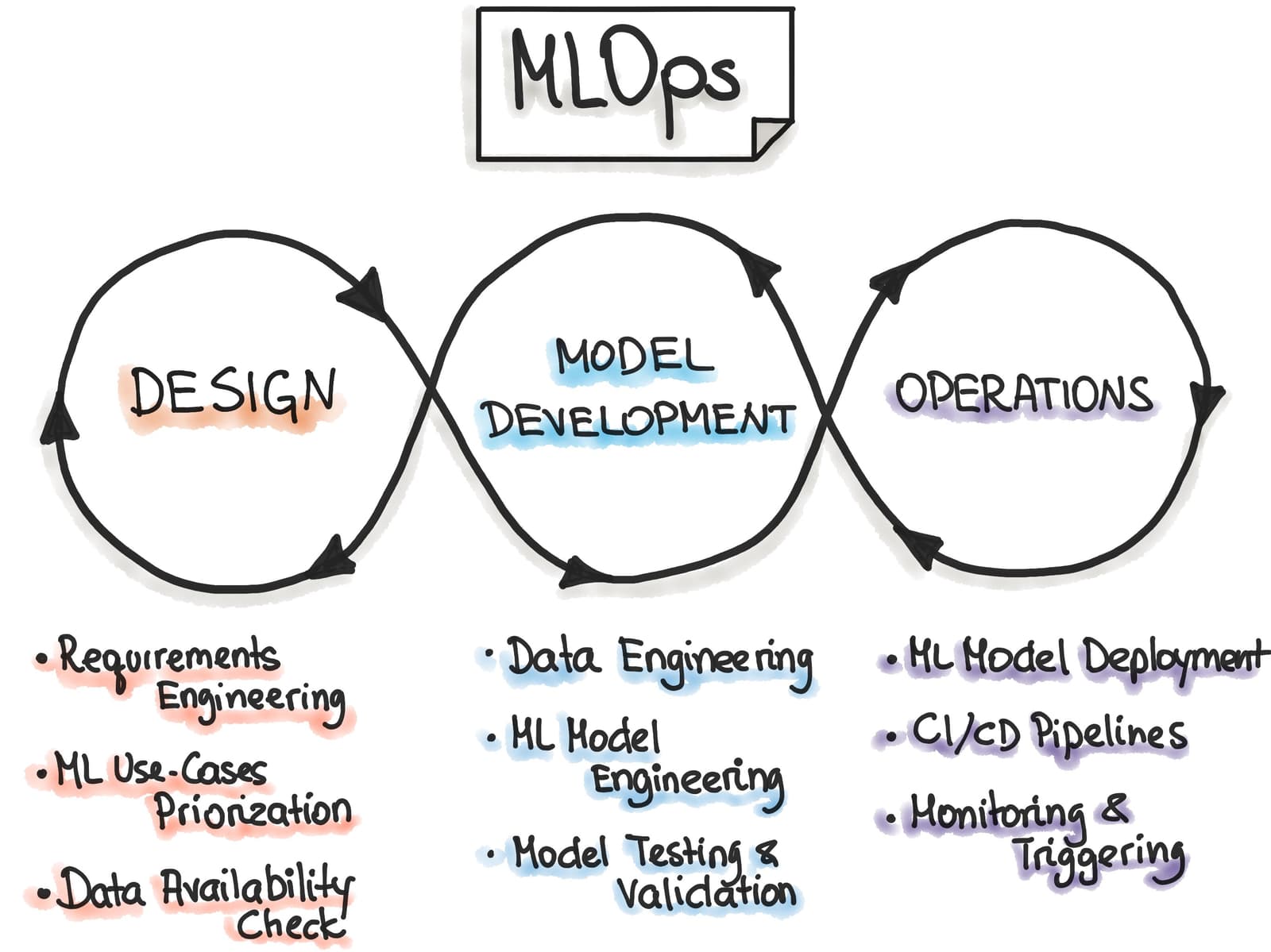
How would you design a reproducible ML training pipeline?
Tests if you can version ML's three moving parts: code, data, and environment. Good answers cover Git for code, DVC or lakehouse versioning for data, and Docker plus locked dependencies for environments.
How do you leverage and fine-tune BERT for niche classification?
Tests transfer learning with scarce labels. Outline: pick a domain-adjacent checkpoint, add a classification head, use learning rates near 2e-5 with early stopping, and stratify tiny validation splits.
Serving for online and batch predictions
A low-latency online path (synchronous, autoscaled, real-time features) and a high-throughput batch path (parallel, cost-optimized, large jobs) sharing one model artifact and feature definitions.
Direct versus indirect injection and agent defenses
Direct injection comes from the user prompt; indirect hides in third-party data the agent ingests like web pages.
RL components and how Q-learning works
Agent acts on the environment, observes state and reward, seeking to maximize cumulative discounted reward; Q-learning iteratively updates Q(s,a) toward reward plus discounted best…
NeRF limitations and advances for robotics
Original NeRF is slow to train and render, per-scene, static, and needs many calibrated views; address speed with explicit grids or Gaussian splatting, dynamics with time-conditioned fields, and scale with…
Differential privacy vs utility in LLM fine-tuning
Clipping plus calibrated noise per step, smaller epsilon means stronger privacy but degraded accuracy, tracking the privacy budget across epochs.
Formulating a multi-step robot manipulation task
Perception detects and localizes the mug, action space spans navigation and manipulation, and a reward shaped over subgoals (reach, grasp, transport, place) with sparse final success guides learning.

Design a multi-tenant ML platform with isolation, security, and cost attribution
Tests mapping tenancy to compute, network, and identity primitives. Strong answers compare hard vs soft isolation, use namespaces or node pools with network policies and IAM, and enforce chargeback via resource quotas and labels.
Walk me through a CNN's layers for image classification
Tests hierarchical feature extraction in CNNs. Answer: conv filters learn edges-to-objects with shared weights, pooling reduces dimensions and adds invariance, fully-connected layers classify.
We are hiring for this. Every open role lists the topics its interview covers, so you can prepare for the real thing rather than guessing.
See open roles