Interview questions in AI & ML, page 23
Concept drift vs data drift in production models
Data drift is a shift in input distribution P(X); concept drift is a shift in the relationship P(Y|X).
Why RAG persists despite million-token context windows
Cost and latency scale with context, attention degrades in the middle, and RAG adds freshness, access control, and citations.
Right to be forgotten and machine unlearning
Delete raw data everywhere, then remove influence via full retraining, SISA sharded retraining, or approximate unlearning; note cost and verification.
Deploying segmentation on edge devices
Pick efficient architectures, apply INT8 quantization, distill from a large teacher.
Why design ML pipeline steps to be idempotent?
Re-running a step with the same input yields the same result and no duplicate side effects; enables safe retries and backfills.
Self-attention and the Query, Key, Value matrices
Queries score against keys via scaled dot product, softmax yields weights, and those weight the values into the output.
k-anonymity and its limits against linkage attacks
Define k-anonymity via indistinguishable quasi-identifier groups, apply generalization and suppression, then show homogeneity or linkage attacks break it.
Adapting a 2D CNN for video action recognition
Run the 2D CNN per frame, pool features over time, optionally add two-stream or 3D conv.
How Transformers encode token position
Attention is permutation-invariant, so positional encodings (sinusoidal, learned, or rotary) are added or applied.
Differential privacy, epsilon, and noisy aggregates
Define DP as bounded output change when one record is added or removed, explain epsilon as the privacy-accuracy knob, add calibrated noise scaled to sensitivity.
Core components of visual SLAM
Tracking estimates per-frame pose, mapping builds and refines the 3D map, loop closure detects revisits and corrects drift.

Compare and contrast Apache Airflow versus Kubeflow Pipelines for ML orchestration
This tests matching orchestrators to ML constraints. A strong answer contrasts Airflow's task scheduling and backfills with Kubeflow's K8s-native GPU scaling, choosing based on team skills.
Cross-attention versus self-attention in encoder-decoder Transformers
Cross-attention draws Queries from the decoder and Keys/Values from the encoder, letting the decoder condition on the source.
Federated learning architecture, risks, and defenses
Devices train locally and send updates not data, a server aggregates; gradients still leak, enabling inversion or membership inference; defend with secure aggregation and DP.
The data association problem in SLAM
Matching observations to landmarks, why wrong matches corrupt the map, robust techniques like RANSAC and descriptor matching.
Design an ML workflow that masks PII from scientists
This tests privacy-preserving pipeline design and least-privilege access for ML teams. Propose automated de-identification before experimentation, restrict re-identification to production jobs, and enforce role-based access with audit logs.
Tokens and vocabulary-size tradeoffs
A token is a subword unit; larger vocab shortens sequences but bloats the embedding matrix, smaller vocab generalizes but lengthens sequences.
Risks of optimizing recommendations only for CTR
CTR-only invites clickbait, low satisfaction, and long-term churn; add counter-metrics like dwell time, satisfaction, retention, and diversity.
Cross-attention in transformer VQA models
Text queries attend over image regions, learning alignment that grounds words to visual content.
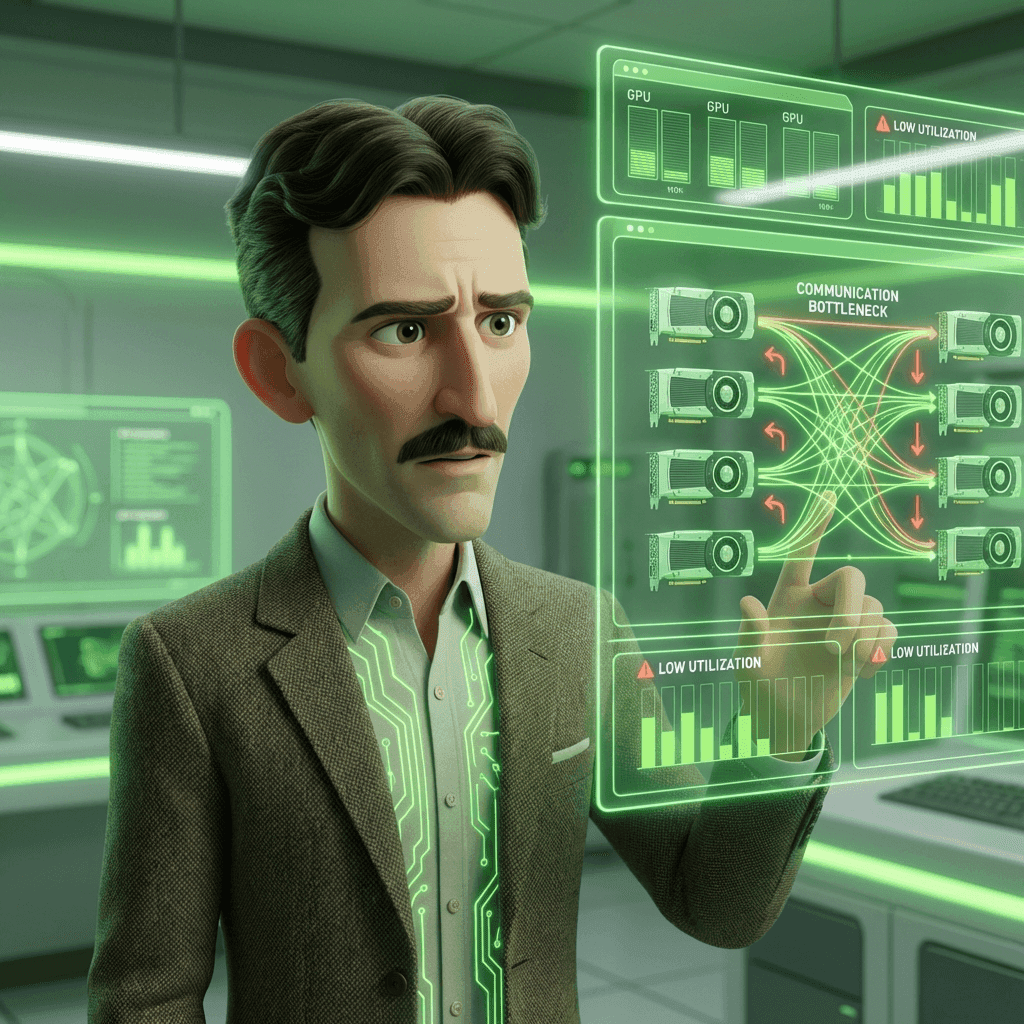
Low GPU utilization on multi-GPU instance: diagnose and right-size
Tests distributed bottleneck triage. Strong answers profile CPU/GPU/disk, compare gradient sync time to compute, validate per-GPU batch size, and check NVLink vs PCIe. Red flag: suggesting more GPUs before ruling out data starvation or all-reduce overhead.
We are hiring for this. Every open role lists the topics its interview covers, so you can prepare for the real thing rather than guessing.
See open roles