Easy everything in AI & ML, page 3
Sparse vs dense optical flow and Lucas-Kanade
Sparse flow tracks selected feature points, dense flow computes a vector per pixel; Lucas-Kanade solves brightness constancy in a local window assuming constant motion.
Semantic versus instance segmentation
Semantic segmentation labels each pixel by class but merges objects of the same class; instance segmentation also separates individual objects.
Mean Average Precision in object detection
AP is the area under the precision-recall curve per class; mAP averages AP over classes, and COCO also averages over IoU thresholds.
Intersection over Union for detection
IoU is the area of overlap divided by the area of union of predicted and ground-truth boxes; a threshold decides true positives.
Image classification versus object detection
Classification assigns one label to the whole image; detection localizes and labels multiple objects with bounding boxes and class scores.
Why CNNs need nonlinear activations like ReLU
ReLU introduces nonlinearity letting stacked layers model complex functions; without it any stack collapses to a single linear map.
Max pooling versus strided convolution
Pooling downsamples and adds small translation invariance with no parameters; strided conv learns its downsampling but adds parameters.
How a convolutional layer works
Learnable kernels slide over the input computing dot products, with stride controlling step size and padding controlling output size.
Disparity and depth in stereo vision
Disparity is the horizontal shift of a point between left and right images; depth is inversely proportional to disparity given baseline and focal length.
Epipolar constraint for correspondence search
The match for p1 must lie on its epipolar line in the second image, reducing a 2D search to 1D; the relation is encoded by the fundamental matrix.
Image gradients, Sobel, and Canny
The gradient measures local intensity change in x and y; Sobel approximates it via convolution kernels; Canny uses gradient magnitude and direction plus non-max suppression and hysteresis.
Harris corner detector and corner stability
Harris finds points where intensity changes strongly in all directions using the structure tensor of gradients; corners are well localized in two directions, unlike edges.
RGB versus HSV color spaces
RGB mixes three light channels; HSV separates hue, saturation, value so color identity decouples from brightness.
Causal versus Masked Language Modeling
Pre-training learns general language from unlabeled text; CLM predicts the next token left-to-right, MLM predicts masked tokens using both sides.
Self-Attention versus Recurrent Architectures
Each token attends to all others via query-key-value, enabling parallelism and direct long-range links.
Vanishing Gradients and Why ReLU Helps
Saturating activations shrink gradients across layers, ReLU's flat-one derivative preserves them.

Most LLM Apps Need Workflows Not Agent Frameworks
Most LLM apps ship faster and more reliably as deterministic workflows than autonomous agents. Plain Python with structured outputs and local functions beats CrewAI and LangGraph for debugging. Map control flow in code before importing any agent framework.
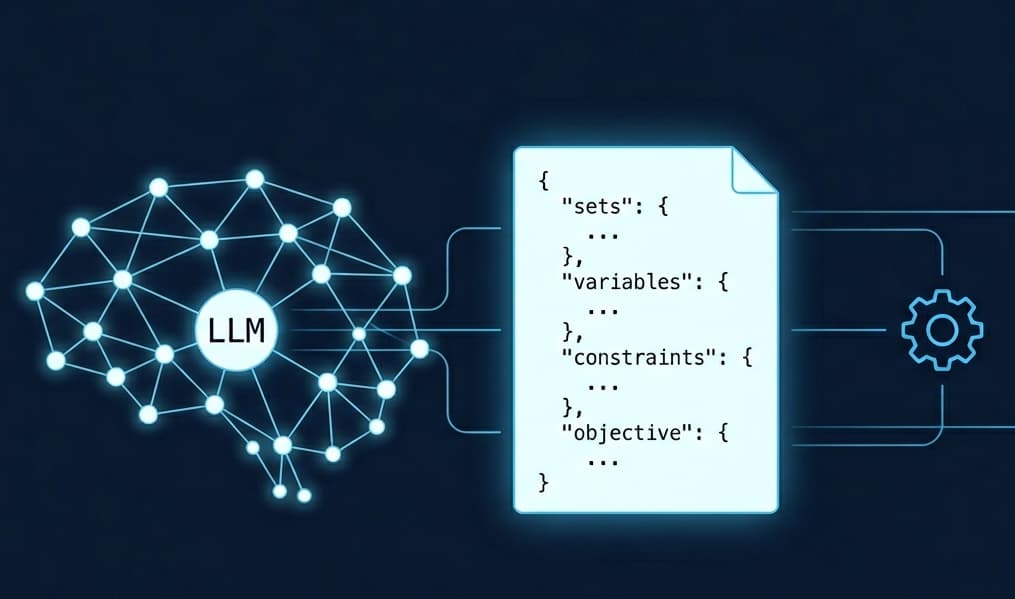
ORPilot JSON IR Ends Solver Lock-In
ORPilot's open-source IR captures optimization models as solver-agnostic JSON, letting teams swap solvers or update data without calling the LLM again. It separates model structure from solver syntax, making LLM-generated OR models reproducible in production.

Default Churn Thresholds Waste $86 per Customer
90% of 36 IBM Telco churn analyses use F1 and a 0.5 threshold, assuming equal costs for false positives and negatives. That is wrong by 13x, burning $86 per customer, or $8.6M at 100k subscribers. Swap accuracy for profit curves tied to LTV and CAC.

Describe a basic lifecycle policy to manage cloud storage costs
This tests cost optimization via tiered storage and automated expiration. Strong answers list transitions from Standard to IA to Glacier, then deletion after set days, plus retrieval costs. A red flag is using manual scripts instead of native lifecycle rules.
We are hiring for this. Every open role lists the topics its interview covers, so you can prepare for the real thing rather than guessing.
See open roles