Intermediate interview questions in Analytics & Metrics, page 9

Design a User Onboarding Funnel Analysis System
This tests translating a business need into a data model and query. First, define the cohort. Then, use CTEs to find the first timestamp for each event per user. Finally, count users at each step.
Calculate a 3-step user onboarding funnel with SQL
Tests your ability to translate a business need into a robust data query. A great answer clarifies funnel logic (attribution, timing), defines the user cohort, finds each user's first event for each step, and then calculates conversion.
Architecting multi-touch attribution
Ingest touchpoints, resolve to one identity, order into paths, apply a model; last-touch is trivial, time-decay needs the full path.

Architect a Multi-Touch Attribution System
Tests your grasp of data pipeline trade-offs under real-world signal loss. A great answer outlines the pipeline (ingest, store, model), contrasts last-touch (simple state) vs.
Architect a Multi-Touch Attribution System
This tests your grasp of modern data challenges like signal loss. A good answer discusses data ingestion, identity resolution, and model trade-offs. A red flag is focusing only on the algorithm and ignoring the data pipeline's fragility.
Client-Side vs. Server-Side Event Tracking
This tests your grasp of data integrity trade-offs. A great answer advocates for server-side tracking for critical events due to its reliability against ad blockers, using client-side only for supplementary UI events. A red flag is treating them as equal.
Client-side vs. Server-side Event Tracking: When and Why?
This tests your grasp of data reliability and security trade-offs. A good answer defines both, contrasts reliability (ad blockers) vs. implementation ease, and uses a critical event like "Payment Processed" to justify server-side's accuracy.
Investigating analytics vs database count gaps
Causes include ad-blocker loss, differing identity logic, timezone mismatches, filtering, and pipeline delay; investigate by aligning definitions and tracing one user.
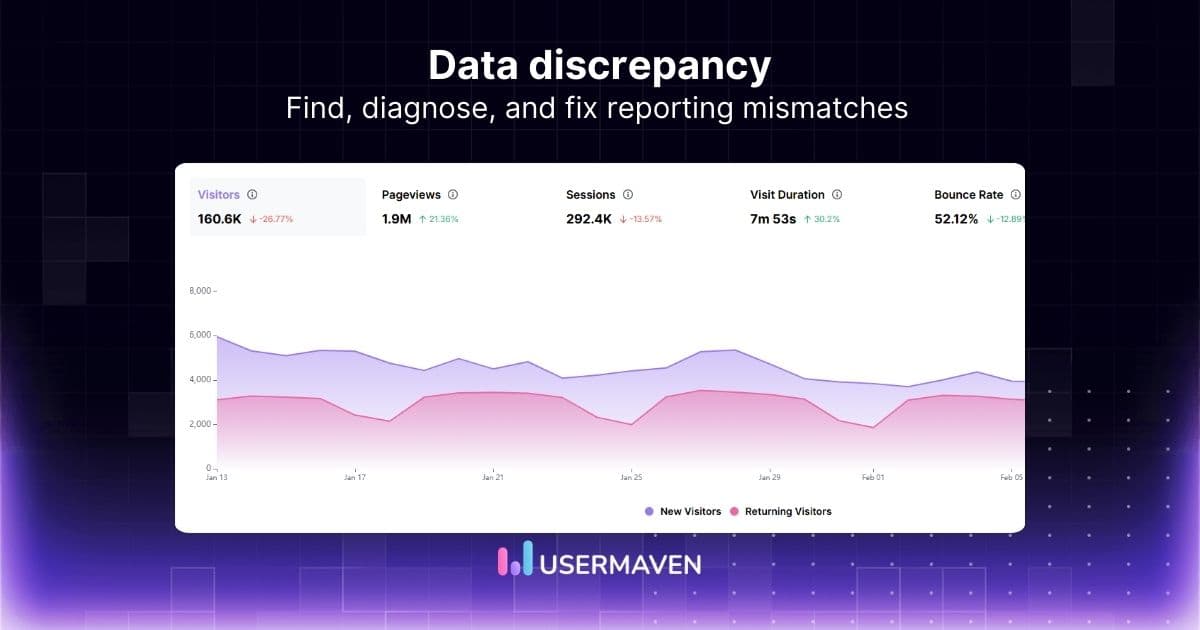
Why do our analytics and backend user counts not match?
This tests your ability to systematically debug data integrity issues. A great answer first defines the metric, then investigates tracking implementation, privacy blockers, and time zone settings. A red flag is blaming one tool without a structured plan.
Why don't analytics and backend user counts match?
This tests your systematic debugging and understanding that 'user' has different definitions. A good answer first defines 'user' in each system, then investigates tracking implementation, timing differences, and filtering.
Bundled analytics vs warehouse-native trade-offs
Warehouse-native gives one source of truth and SQL flexibility but shifts modeling, performance, and UX onto your team; bundled tools are turnkey but siloed.
Trade-offs: Bundled Analytics vs. a Warehouse-Native Stack?
This tests your grasp of modern data stack trade-offs: cost, data governance, and flexibility. Discuss the pros of warehouse-native (unified data, lower cost, security) vs. the cons (loss of specialized UI, implementation complexity).
Trade-offs: Bundled vs. Warehouse-Native Product Analytics
This tests your grasp of modern data stack architecture. A great answer weighs trade-offs in data control, cost, query flexibility, and team capabilities. A red flag is ignoring total cost of ownership and engineering overhead for a warehouse-native setup.
Building a conversion funnel in SQL
Count distinct users reaching each ordered step, compute step-over-step conversion; the biggest drop-off is the lowest consecutive ratio.
Build a SQL query for a multi-step conversion funnel
Tests your ability to translate a product question into robust SQL. A great answer uses CTEs or left joins to count users at each step, defining the attribution model (e.g., first-touch) and time windows. A red flag is a naive query that double-counts users.
How would you build a SQL query for a conversion funnel?
Tests your ability to translate a business need into a technical SQL solution. A good answer uses CTEs or LEFT JOINs to model sequential steps, counts users at each stage, and discusses attribution.
Client vs server tracking: pros, cons, examples
Client-side wins on UI context but loses data to blockers and tampering; server-side wins on reliability and trust but misses pure UI events.
Client-Side vs. Server-Side Event Tracking: Pros and Cons
Tests your grasp of data integrity trade-offs. A good answer defines both, contrasts reliability vs. implementation ease, and gives clear examples like 'payment_processed' (server) vs. 'button_click' (client). Red flag: Ignoring ad-blockers and data loss.
Client-Side vs. Server-Side Event Tracking
Tests your grasp of data integrity and architectural trade-offs. A great answer defines both, favors server-side for reliability (avoids ad-blockers), but notes client-side's richness for UI events. A red flag is presenting them as equal choices.
Calculating Daily Active Users in SQL
Need per-event user_id and timestamp and a clear active definition; count distinct user_id within the day in a fixed timezone.
We are hiring for this. Every open role lists the topics its interview covers, so you can prepare for the real thing rather than guessing.
See open roles