Interview questions in Design & UX, page 13
Bug report to deployed fix workflow
Triage and reproduce, write a failing test, fix it, pass CI gates and review, then patch-release and notify.
Are 1-5 satisfaction ratings continuous or discrete?
Tests knowledge of measurement scales. A strong answer calls 1-5 ratings discrete and ordinal, notes intervals may be unequal, and prefers medians or non-parametric tests over means unless equal spacing is defensible.
Why use button variants instead of separate components per state?
Tests Figma component set organization and scalability. Strong answers cite flexible property mixing, reduced combinatorial bloat, and cleaner dev handoff. Red flag: saying only "it's cleaner" without naming navigability or system integrity.
Design a personalized newsletter recommendation pipeline
Tests batch versus stream tradeoffs and send-time personalization constraints for millions of recipients. A strong answer covers event capture, 24-hour aggregation, lightweight rec generation, and template injection before send.
Confidence intervals versus p-values, explained simply
Define a CI as a plausible range for the true effect with its precision, contrast it with a binary p-value, and read [-1%, 7%] as inconclusive because it spans zero.
Essential docs for onboarding a new team
Getting-started guide, per-component API and usage docs, design guidelines and tokens, plus changelog and migration notes.
How would you use Auto Layout to build a responsive card?
Tests Figma Auto Layout direction, padding, and resizing rules. Answer: stack header, image, and text vertically with a fixed gap; set text to fill width and hug height; wrap in a scaling frame. Red flag: absolute positioning instead of structured Auto Layout.
Design a database schema for an ad A/B test
Tests separating high-volume events from slow-changing experiment metadata. Strong answer: distinct tables for variants, impressions, and clicks; clicks link to impressions; a user-assignment table avoids duplicating variant data per event.
Governance model for specialized contributions
Define a governance model, RFC and shared-need gate, tiered intake (core vs community), CI and CODEOWNERS review, then versioned release.
Programmatically create an ad via a marketing API
Authenticate, create a campaign with an objective, an ad set with budget and targeting, a creative with the copy, then the ad linking them.
How many users do we need to survey?
Tests pragmatism over guesswork. A strong answer asks if this is a census or sample, population size, whether stratified or multi-group designs apply, and cost, time, and power constraints. Red flag: blurting a number without probing scope, design, or budget.
How do you change a nested Button's state from a Card instance?
Tests knowledge of nested component properties in Figma. A strong answer adds a variant property to the nested Button inside the Card main component so its state appears in the Card instance panel.
Tracking design system adoption technically
Scan codebases for component imports via AST, compute adoption versus off-system usage, and aggregate into a dashboard over time.

What is the multiple comparisons problem in UX research?
This tests whether you know running many tests inflates false positives. Strong answers define family-wise error, give a UX example like comparing twenty metrics in one A/B test, and name a correction like Bonferroni.

Describe a workflow to sync Figma tokens to front-end code
Tests if you see tokens as version-controlled code. Strong answer: Tokens Studio pushes W3C DTCG JSON to Git; CI runs Style Dictionary to emit CSS or JS. Red flag: saying the artifact is a Figma file or manual spec sheet.

Design a simple templating system for ad copy generation
Tests separation of concerns and API design. A good answer: data model separate from template, placeholder syntax, graceful missing-value handling, and HTML escaping. Red flag: naive string concatenation without validation or extensibility.
Designing a UI consistency score
Combine signals like token vs hard-coded values, design-system vs off-system components, and override rates, then automate via AST scans and CI.

Explain statistical power and respond to extending a null A/B test
This tests statistical power and p-hacking judgment. A strong answer defines power as detecting a true effect, rejects extending the test to chase significance, and requires pre-registered sample sizes. Agreeing to run until it hits significance is a red flag.
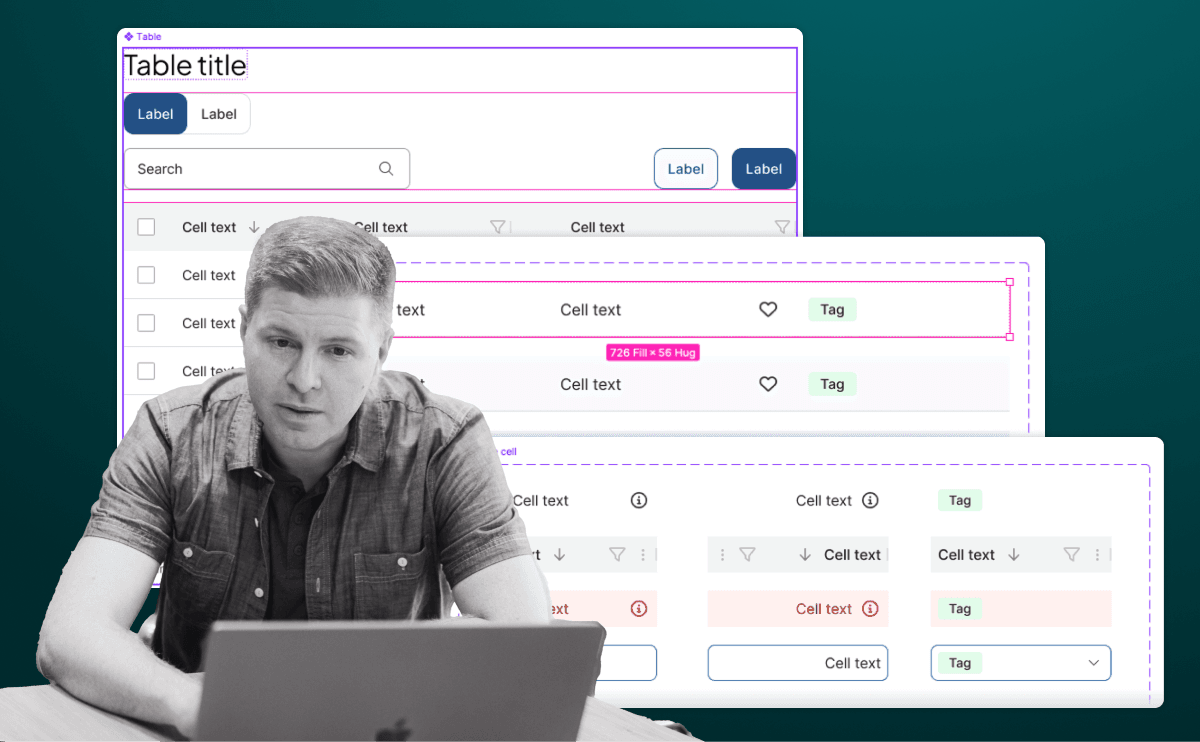
Design a flexible Table component in Figma with slots
Tests Figma Slots to avoid variant bloat. Answer: Cell variants; Row as a horizontal Slot with zero padding for dividers/hover; Table as a vertical Slot for rows plus a header Slot; componentize the configured row for bulk edits.
Outline the architecture of a Dynamic Creative Optimization system
Tests distributed system design for combinatorial ad optimization. A strong answer maps a creative asset service, combination engine, real-time ad server with A/B testing, performance feedback pipeline, and campaign config UI.
We are hiring for this. Every open role lists the topics its interview covers, so you can prepare for the real thing rather than guessing.
See open roles