Interview questions in Design & UX, page 19
Track scroll depth: Intersection Observer vs scroll events
Place sentinels at depth thresholds and fire once via Intersection Observer, off the main thread; scroll listeners fire constantly and need throttling.
Versioning and shipping design tokens via NPM
Semver, deprecate-before-delete with aliases, codemods and migration guides.

How would you quantify a critical UX issue to justify architectural work?
Tests translating UX findings into business metrics to prioritize engineering. Strong answers pair task-success rates with financial impact, benchmark against industry baselines, and frame the fix as risk mitigation.
How would you generate a functional palette from one brand color?
Tests systematic color scaling and accessibility. Strong answers use HSL/LCH lightness stops, enforce 4.5:1 text contrast, build 50-900 surface weights, and derive semantic hues independently. Red flag: manual hex tweaks without contrast checks.
Rolling out a breaking change to a shared Button
Major semver bump, deprecation period, codemod and migration guide, staged comms.

Design a centralized research repository for discoverable, actionable insights
Tests knowledge-management system design and metadata taxonomy. Strong answers separate raw artifacts, insights, and reports; build faceted search; and integrate with engineering workflows.
Discuss custom web font performance and loading strategies
Critical rendering path tradeoffs between speed and design fidelity. Strong answers match font-display to UX goals, combine preloading with subsetting, and quantify byte savings. Red flag: calling swap a free win while ignoring layout shift from reflow.

Outline a data pipeline for web events to a data warehouse
Tests end-to-end streaming design from web clients to warehouse. Strong answers list five stages: client capture, broker buffering, stream processing, object storage, and warehouse load. Red flag: proposing only batch cron jobs or ignoring schema registries.
Composite components versus layout primitives
Primitives give flexibility and composition, composites enforce consistency, choose by reuse and variation.

Propose a framework for measuring the impact of UX research
Propose HEART mapped to KPIs; cite task success, error rate, conversion lift, ticket drops; prove causality.
How would you architect a Figma-to-code icon system?
Tests design-to-code systems thinking. Strong answers cover Figma variables as source of truth, automated API exports into transformed versioned packages, and strict naming taxonomy. Red flag: manual SVG exports and developers editing assets by hand.

Design anonymous-to-authenticated user journey stitching for ROI
Tests identity resolution and privacy-compliant attribution. Strong answers cover first-party UUID stitching, consent-gated probabilistic matching, async CDP merge, and TTL deletion. Red flag: treating anonymous IDs as non-personal data or skipping consent.
Documenting accessibility per component
Per-component a11y sections, keyboard tables, ARIA roles and states, live examples.

How do you align research roadmaps and resolve tactical-strategic conflicts?
Map work to 3 horizons with user-need-outcome framing; protect 30% capacity for strategy; negotiate via visible scorecard.
Explain an 8-point grid and Figma spacing tokens setup
Tests your ability to systemize visual rhythm and encode it in Figma variables. Strong answers cite an 8pt base, define a 4/8/16/24/32/48/64 scale, and publish semantic tokens. Red flag: arbitrary values or manual nudging without variables.
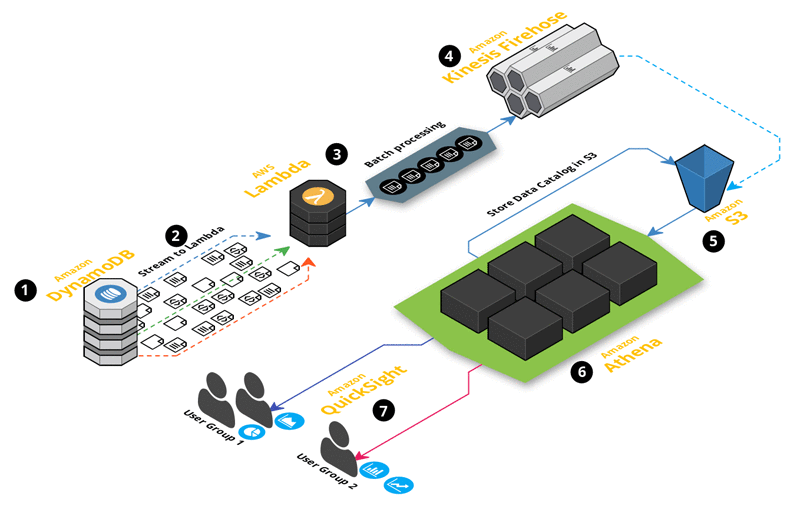
Design a real-time top-10 dashboard for a global news site
Stream ingestion, windowed aggregation, Redis top-N cache, and TTL eviction.
Multi-armed bandit vs A/B testing for headlines
Bandits shift traffic toward winners using updated per-arm reward state; A/B holds fixed splits until a fixed-horizon decision.
Architecting a federated documentation site
Docs-as-code with a manifest, CI publishing artifacts, a build that pulls and merges, unified deploy.

Compare embedded vs centralized research models and propose a hybrid
Tests org trade-offs between squad autonomy and research consistency. Strong answers contrast embedded speed with centralized standards, then propose a hybrid of embedded generalists and centralized specialists.
What is the difference between a column grid and a modular grid?
This tests layout hierarchy. Column grids divide space vertically for responsive marketing pages. Modular grids add horizontal rows to form rigid two-dimensional cells for dense dashboards. A red flag is calling grids purely decorative.
We are hiring for this. Every open role lists the topics its interview covers, so you can prepare for the real thing rather than guessing.
See open roles