Concepts in DevOps & Cloud, page 26
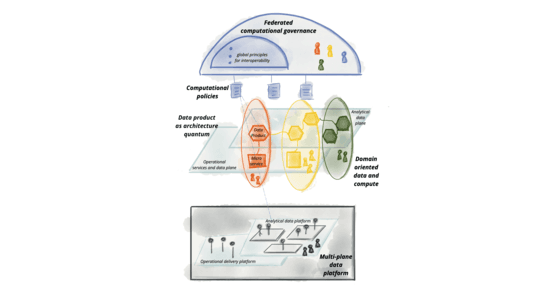
Data Mesh: From Central Data Lake to Distributed Ownership
Data Mesh decentralizes data ownership, moving it from a central team to the business domains that create it. This approach, like microservices for data, is for orgs where a monolithic data lake has become a bottleneck.
Baggage in Distributed Tracing
Baggage is key-value context propagated alongside a trace across service boundaries, so downstream services can read values set upstream. It enables cross-cutting context like tenant id, but it travels in headers on every hop, so overuse adds latency and leak…
Custom Resource Definitions (CRDs): Teach Kubernetes New Tricks
CRDs let you define your own resource types, teaching Kubernetes new nouns like Database or Backup. This is how operators manage complex apps declaratively. The footgun is that a CRD only defines the API; you still need a controller to act on the objects.
Data Virtualization: One Query, Many Sources
Data virtualization creates a single logical database from many physical sources without moving the data. It's used for real-time integration across silos like SQL, NoSQL, and APIs.
Kustomize: Template-Free Kubernetes Configs
Kustomize manages environment-specific Kubernetes configs by layering patches on a base YAML, avoiding complex templating. Use it to tweak deployments for dev, staging, or prod. The footgun: the kubectl version can lag, causing unexpected behavior.
Incident Timeline
An incident timeline is a chronological, timestamped record of what happened during an incident: detection, key events, actions taken, and resolution. It anchors the postmortem in facts, separates symptoms from causes, and reveals detection and response…
The Operator Pattern: A Robot SRE for Your App
The Operator pattern adds a custom, automated "robot SRE" to your Kubernetes cluster. It encodes human operational knowledge for a specific application, like a database, into software that handles complex tasks like upgrades, backups, and failovers…
Managed ML Platforms: Heroku for Machine Learning
A managed ML platform is like Heroku for machine learning, providing an integrated environment for the entire model lifecycle. Use it to build, train, and deploy models without managing servers, data pipelines, or inference endpoints yourself.
Flux CD: Git as the Source of Truth for Kubernetes
Flux CD makes Git your cluster's source of truth. It automatically syncs Kubernetes manifests from a repo to your cluster, ensuring the live state matches your config. This is for continuous delivery, not CI.
Runbooks
A runbook is a documented, step-by-step procedure for handling a specific operational task or known failure, such as responding to an alert. It captures expert knowledge so any on-call engineer can act quickly and consistently, reducing reliance on tribal…
kubectl Treats Custom Resources Like Native Ones
kubectl interacts with Custom Resources (CRs) using the same commands you know for built-in types like Pods. Once a CRD is installed, you can kubectl get, describe, and delete its objects.
AutoML: Automating the Machine Learning Workflow
AutoML automates the repetitive, trial-and-error parts of building a machine learning model, like picking the best algorithm and tuning its settings. Use it to quickly build baseline models or when your team lacks deep ML expertise.
The GitOps Reconciliation Loop
Think of it as a thermostat for your infrastructure. A GitOps agent continuously compares your live system's state against the desired state in Git. If it detects drift, it automatically corrects it.
War Room in Incident Response
A war room is a dedicated space, physical or virtual, where responders coordinate during a major incident. It centralizes communication and decision-making under a defined incident commander, cutting confusion and duplicated effort, but should be reserved for…
Operator SDK: Build Kubernetes Operators Faster
The Operator SDK is a developer toolkit that scaffolds the boilerplate for building, testing, and packaging Kubernetes Operators. Use it to automate complex application lifecycle management, like deploying a database cluster that can self-heal and perform…
Pre-trained AI Services: Renting Expertise, Not Building It
Pre-trained AI services are like renting an expert's brain via an API. Instead of training your own model, you call a service for tasks like speech-to-text or image analysis. The footgun is assuming a general model will master your specific industry jargon.
App of Apps Pattern: Manage Application Fleets, Not Individuals
The App of Apps pattern uses a single parent Argo CD application to declaratively manage a fleet of child applications. This is ideal for bootstrapping entire environments from one Git repo.
Incident Timeline Reconstruction
Timeline reconstruction is the after-the-fact process of merging evidence from logs, metrics, deploys, and chat into one accurate sequence of what happened.
Kubernetes Finalizers: The 'Do Not Delete Yet' Lock
A finalizer is a pre-deletion lock. It tells Kubernetes to block an object's deletion until a controller cleans up external resources, like a cloud database or storage bucket.
Cloud NLP Services: Pre-trained Language Models as an API
Cloud NLP services are like having a team of linguists on-demand via an API. Use them to instantly analyze text for sentiment, entities (people, places), or topics without building your own models.
We are hiring for this. Every open role lists the topics its interview covers, so you can prepare for the real thing rather than guessing.
See open roles