Advanced interview questions in DevOps & Cloud, page 6
Design automated cloud cost optimization
Target idle resources, oversized instances, orphaned storage, and commitment gaps; act via rightsizing and cleanup; safeguard with tagging, scoping, and approvals.
Canary a shared downstream microservice
Route a slice of traffic to the canary via mesh rules, propagate context, and use distributed tracing to measure impact on upstream callers across the full path.
How would you use a Kubernetes Admission Controller as CI/CD security gate?
Tests pre-deployment enforcement via admission webhooks. Strong answers: ValidatingAdmissionWebhooks blocking bad manifests, Pod Security Standards restricted profiles, and OPA/Gatekeeper for image signatures. Red flag: confusing with RBAC or runtime scanning.
Pinning exclusive CPU cores to a pod
Set kubelet CPU Manager policy to static, make the pod Guaranteed QoS with integer CPU limits equal to requests, so it gets exclusive dedicated cores.
tolerationSeconds and graceful eviction on NoExecute
TolerationSeconds is how long a tolerating pod may stay after the taint applies; once it elapses eviction starts, then terminationGracePeriodSeconds governs the SIGTERM-to-SIGKILL window.
Topology spread constraints versus pod anti-affinity
Spread constraints balance pod counts per domain bounded by maxSkew, anti-affinity is all-or-nothing co-location avoidance, and maxSkew caps the difference between fullest and emptiest…
Savings Plans vs Reserved Instances for mixed compute
Compute Savings Plans cover EC2, Fargate, and Lambda flexibly; EC2 Instance Plans and RIs trade flexibility for slightly deeper discounts.
Designing a multi-account cloud chargeback model
Account-per-team or mandatory cost-allocation tags enforced by SCPs and tag policies, plus a pipeline over the cost and usage report grouped by tag/account.
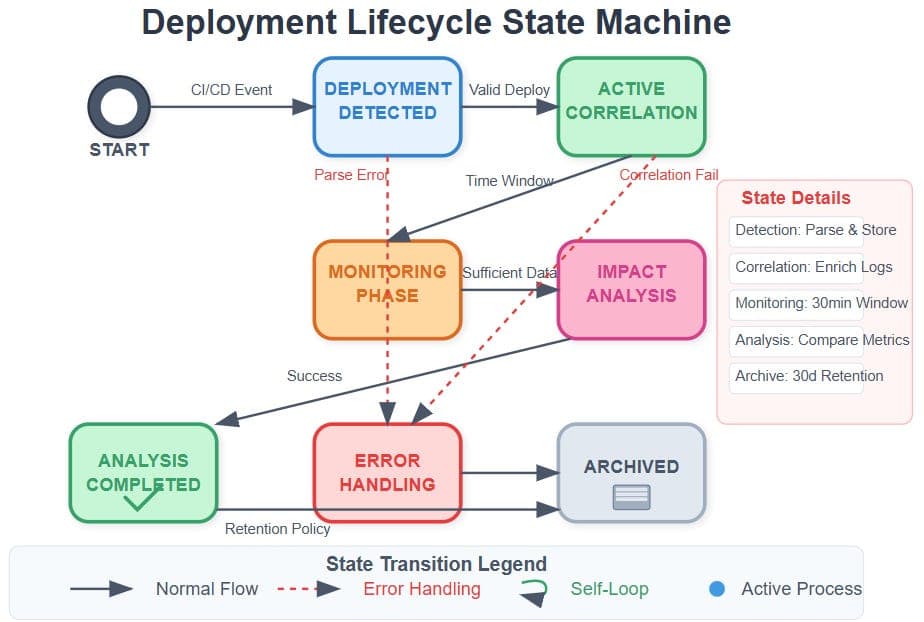
Design a system correlating CI/CD deployments with observability metrics
Tests event-driven correlation and temporal join patterns across distributed data. Strong answers outline: async deploy event ingestion, time-windowed metric joins with version tags, and handling clock skew.
Why tail latency (p99) matters
Averages hide the worst experiences, and fan-out amplifies tails so most requests touch a slow path; causes include GC pauses, queueing, contention, and noisy neighbors.
Resilient stateful batch on Spot Instances
Externalize state and checkpoint to durable storage, react to interruption and rebalance notices to drain gracefully, diversify instance pools.
What statistical methods automate canary-baseline comparison and handle noise?
Tests statistical rigor in automated canary analysis. Strong answers use non-parametric tests, multi-metric aggregation with effect-size gates, MAD-based outlier rejection, and smoothing windows.
When horizontal scaling is the wrong fix
Adding instances fails when the bottleneck is a shared resource like one database, a lock, or a queue, so more instances just add contention; investigate where time is actually spent.

How do you unify real-time CI/CD health across hundreds of microservices?
Canonical event schema over an event bus; domain-level SLI views; federated ownership with golden paths.
Binding a ClusterRole with a RoleBinding
A RoleBinding referencing a ClusterRole grants those rules only within the binding's namespace; reuse built-in roles like view per-team without duplicating definitions.
Multi-tenant isolation with a monitoring exception
Apply default-deny ingress per tenant namespace, allow same-namespace traffic, then add an ingress rule permitting the monitoring namespace via namespaceSelector on the metrics port.
Replication and consistency for active-active regions?
Choose per data class between synchronous (low RPO, higher latency) and async replication, address write conflicts, and reason via CAP and PACELC.
Design a chaos experiment for a payment dependency?
Define a measurable steady state, hypothesize it holds when payments fail, limit blast radius to a small traffic slice, and auto-abort on SLO breach.
The small files problem in data lakes
Too many tiny files inflate metadata and per-file overhead, slowing queries; caused by streaming micro-batches and over-partitioning; fix with compaction and table formats like Iceberg, Delta, or Hudi.
Reliability paved roads for an internal PaaS?
Built-in observability, safe deploys with health checks and rollback, sane timeouts/retries/limits, and SLO tooling.
We are hiring for this. Every open role lists the topics its interview covers, so you can prepare for the real thing rather than guessing.
See open roles