Interview questions in DevOps & Cloud, page 19
Savings Plans vs Reserved Instances for mixed compute
Compute Savings Plans cover EC2, Fargate, and Lambda flexibly; EC2 Instance Plans and RIs trade flexibility for slightly deeper discounts.
How would you instrument CI/CD to measure a DORA metric accurately?
Tests mapping DORA definitions to pipeline events. A strong answer picks one metric, defines exact boundaries from merge to production, and correlates deployments with incidents.
Front-end performance budgets
A performance budget is an enforced limit on metrics like Core Web Vitals and bundle size, checked in CI to fail builds that regress.
Role versus ClusterRole in RBAC
Role is namespaced, ClusterRole is cluster-wide and covers cluster-scoped resources, and you grant either via a RoleBinding (namespaced) or ClusterRoleBinding (cluster-wide) to a subject.
Designing a multi-account cloud chargeback model
Account-per-team or mandatory cost-allocation tags enforced by SCPs and tag policies, plus a pipeline over the cost and usage report grouped by tag/account.
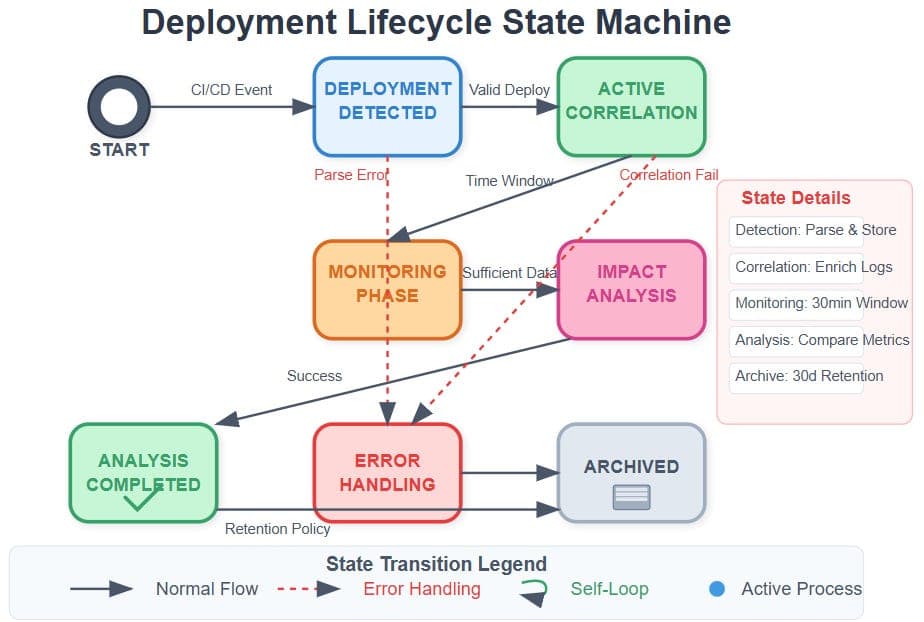
Design a system correlating CI/CD deployments with observability metrics
Tests event-driven correlation and temporal join patterns across distributed data. Strong answers outline: async deploy event ingestion, time-windowed metric joins with version tags, and handling clock skew.
Why tail latency (p99) matters
Averages hide the worst experiences, and fan-out amplifies tails so most requests touch a slow path; causes include GC pauses, queueing, contention, and noisy neighbors.
First NetworkPolicy flips a pod to default-deny
Once any policy selects a pod for a direction, that direction becomes default-deny and only explicitly allowed traffic passes; unselected pods stay open.
Resilient stateful batch on Spot Instances
Externalize state and checkpoint to durable storage, react to interruption and rebalance notices to drain gracefully, diversify instance pools.

What statistical methods automate canary-baseline comparison and handle noise?
Tests statistical rigor in automated canary analysis. Strong answers use non-parametric tests, multi-metric aggregation with effect-size gates, MAD-based outlier rejection, and smoothing windows.
When horizontal scaling is the wrong fix
Adding instances fails when the bottleneck is a shared resource like one database, a lock, or a queue, so more instances just add contention; investigate where time is actually spent.
Troubleshooting an RBAC forbidden error
Use kubectl auth can-i with --as impersonation to check the verb, inspect RoleBindings and ClusterRoleBindings, and read the role rules.
Data lake versus data warehouse
Lakes store raw, schema-on-read data of any type cheaply; warehouses store curated, schema-on-write structured data for fast SQL; choose a lake for varied raw data and ML.

How do you unify real-time CI/CD health across hundreds of microservices?
Canonical event schema over an event bus; domain-level SLI views; federated ownership with golden paths.
What telemetry must a new microservice ship with?
Metrics for trends like p99 latency and error rate, structured logs for per-request detail, traces for cross-service causality.
Namespace-scoped RBAC for a ServiceAccount
Create a Role in production granting create on deployments (apps group) and services (core group), then a RoleBinding tying that Role to the ServiceAccount.
ETL versus ELT in cloud data platforms
ETL transforms before loading into the target; ELT loads raw first then transforms in the warehouse, leveraging cheap storage and elastic compute.
Explain GitOps and how an agent knows when to apply changes
Tests declarative infrastructure and pull-based reconciliation. A strong answer says Git is the source of truth and the agent polls or watches for drift, then applies diffs. Red flag: calling a push-based CI pipeline GitOps.
What is an SLO and how do you define API availability?
SLO is a target on an SLI, availability SLI is good requests over valid requests, you need labeled request counts over a window.
Write a frontend-to-backend NetworkPolicy
Set podSelector to app=backend, policyTypes Ingress, one ingress rule with from podSelector app=frontend and ports TCP 8080; the implicit deny handles the rest.
We are hiring for this. Every open role lists the topics its interview covers, so you can prepare for the real thing rather than guessing.
See open roles