Interview questions in Mobile Dev, page 10
Re-rendering FlatList on external state change
FlatList is a PureComponent and only checks data and extraData by reference, so pass the external value via extraData and ensure renderItem reads current state.
Describe the iOS app lifecycle and SceneDelegate methods
Not running, inactive, active, background, suspended; SceneDelegate handles sceneDidBecomeActive, sceneWillResignActive, sceneDidEnterBackground, sceneWillEnterForeground.
How does const on a widget constructor impact build and reconciliation?
Tests widget canonicalization and reconciliation. Strong answers: const creates identical widget instances; Element.updateChild skips subtree rebuild when oldWidget == newWidget, saving elements and GC.

Describe the Android Activity lifecycle and callback order
Away calls onPause then onStop; back calls onRestart, onStart, onResume; onCreate only runs after destruction.
Trace an Activity's lifecycle when a user navigates away and returns
This tests your understanding of resource management and state preservation, not just memorization. A great answer traces onPause -> onStop when leaving, and onRestart -> onStart -> onResume when returning, explaining what happens in each.
Describe the Android Activity lifecycle when navigating away and back
Tests understanding of resource management via lifecycle callbacks. A good answer traces onPause -> onStop -> onRestart -> onStart -> onResume, explaining what work happens in each.
Implementing infinite scroll with FlatList
Use onEndReached with onEndReachedThreshold to fetch the next page, append results, and show a footer loader; guard with a loading flag to prevent duplicate fetches.
Explain UIKit MVC and the Massive View Controller problem
Model holds data, View displays it, Controller mediates between them; the view controller accretes networking, parsing, and logic into a Massive View Controller.

In a Row, how do you space children evenly across the width?
Set mainAxisAlignment to spaceEvenly; contrast with spaceBetween and spaceAround.
Activity rotation: what happens to EditText text?
Rotation destroys and recreates the Activity; EditText auto-saves text if it has an ID, else onSaveInstanceState or SavedStateHandle.
What happens to an Activity and its text on screen rotation?
Tests understanding of configuration changes and state preservation. A great answer explains the Activity is destroyed and recreated, EditText state is often saved automatically, but the robust solution is using a ViewModel with SavedStateHandle.
How do you save UI state during screen rotation?
Tests your grasp of the Activity lifecycle and state restoration. A great answer explains the destroy/recreate cycle, notes that EditText handles its own state via its ID, and contrasts the modern ViewModel + SavedStateHandle with the older…
Optimizing FlatList with variable item heights
Implement getItemLayout to return each item's length and cumulative offset so FlatList skips measurement and scrollToIndex works precisely; precompute heights per item type.
What is the difference between a started service and a bound service?
Started services run until stopped via startService with no caller interface; bound services expose an IBinder and destroy when all clients unbind.

How do AppDelegate and SceneDelegate responsibilities differ?
AppDelegate owns process events (launch, push); SceneDelegate owns per-window lifecycle and UI.
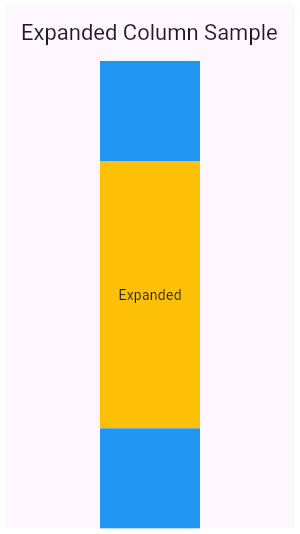
How do you split a Column 1/3 and 2/3 using Expanded?
Tests understanding of flex allocation in Flutter layouts. Strong answers wrap both containers in Expanded, assign flex values of 1 and 2, and note that Expanded forces children to fill the Column's main axis. Red flag: proposing fixed heights instead of flex.
Started vs. Bound Services: Differences and Use Cases
Tests Android component lifecycle and IPC knowledge. A good answer defines lifecycle control (start vs. bind), communication (one-way vs. two-way IBinder), and gives clear use cases. A red flag is assuming services run on a background thread by default.
Started vs. Bound Services: Differences and Use Cases
Tests your grasp of Android component lifecycles. A strong answer defines each by its lifecycle control (who starts/stops it) and communication pattern (fire-and-forget vs. client-server), then gives distinct use cases.
Preventing unnecessary FlatList item re-renders
Extract the row into a React.memo component, pass stable memoized callbacks and primitive props, and keep renderItem referentially stable so only changed items re-render.
How does a ViewModel survive configuration changes and what is its scope?
The framework retains ViewModels in a store scoped to an Activity or Fragment across config changes, clearing them only when the owner finishes for good.
We are hiring for this. Every open role lists the topics its interview covers, so you can prepare for the real thing rather than guessing.
See open roles