All bites
The whole library, newest first. Filter by what you are here for, or pick a topic if you already know.
4247 bites
Page 113
Dynamic Secrets: Temporary On-Demand Credentials
Dynamic secrets are temporary credentials minted on demand, not static passwords living in config files. A CI job requests a 15-minute database lease instead of a long-lived env var.
Container Image Security Scanning
A container image is a frozen filesystem; scanning unpacks layers to flag known CVEs before deployment. Run it in CI/CD after every build and continuously in production registries. Scanning only at build time misses new CVEs in running images.
IAST: Inside-Out Runtime Security Scanning
IAST is an inside-out security scanner: an agent in your running app watches data flow to catch vulnerabilities with few false positives. It runs during functional tests, giving precise line-of-code findings. If your tests skip a route, IAST stays blind to it.
Security Champions: Embedded Team Defense
A security champions program embeds trained developers inside teams to catch risks early. It scales AppSec without hiring a specialist for every squad. The footgun is treating champions as free labor instead of investing in their training and time.
Backstage: The Developer Portal Framework
Backstage is a framework for building a developer portal, not a ready-made dashboard. It centralizes ownership, docs, and tooling when microservice sprawl hides context. The footgun is treating it as a product you deploy without upkeep; the catalog rots.
Platform Orchestrator: Infrastructure's Travel Agent
A platform orchestrator is infrastructure's travel agent: describe an app and it provisions compute, databases, and caches across clouds automatically. It shines once teams outgrow per-service Terraform. Adopt it too early and it becomes a bottleneck.

MLOps vs. DevOps: More Than Just "DevOps for ML"
Think of MLOps as DevOps extended for machine learning. While DevOps automates code deployment, MLOps also handles the unique lifecycle of data and models, including retraining and monitoring for performance decay.
ML Experiment Tracking: Your Model's Lab Notebook
Think of it as a lab notebook for your models, logging every parameter and result. It's essential when tuning hyperparameters or comparing architectures, preventing you from losing track of what worked.
Data Versioning: Git for Your Datasets
Think of data versioning as Git for datasets. It tracks changes to your data, allowing you to reproduce ML experiments or roll back to a previous state. The footgun is using regular Git, which chokes on the large binary files common in ML.
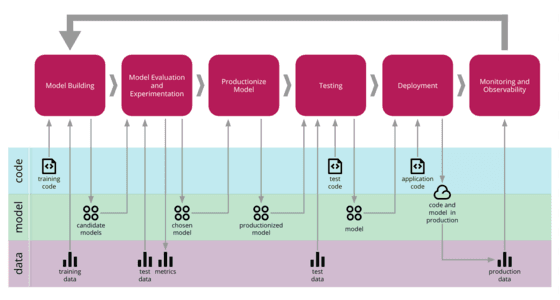
CD4ML: Automating ML from Data to Deployment
CD4ML extends CI/CD to manage ML's three axes of change: code, data, and models. It automates the entire lifecycle, enabling reliable updates for systems like sales forecasting.
Continuous Training: CI/CD for ML Models
Continuous Training (CT) is a CI/CD pipeline for models, not code. It automatically retrains and redeploys models to fight performance decay from changing data, a problem known as 'data drift'. The footgun is deploying a new model without validating it first.
Data Drift vs. Concept Drift: When Models Go Stale
Your ML model's accuracy decays when the real world no longer matches its training data. This is drift. It happens when user behavior changes (concept drift) or input data distributions shift (data drift).
ML Metadata: The Logging Layer for ML Pipelines
ML Metadata is the logging layer for your ML pipeline, tracking every dataset, hyperparameter, and model version. It's crucial for debugging failed runs by tracing a model back to its exact data.
Data Lake vs. Data Warehouse: Raw vs. Refined Data
A data lake is a vast pool of raw data; a data warehouse is a library of refined data ready for analysis. Lakes store everything for future ML or data science; warehouses power BI reporting on clean metrics.

ETL: Extract, Transform, Load
ETL moves data through three phases from sources to containers. It handles one or more inputs and outputs via software that automates the process on recurring schedules or in batches. The footgun is defaulting to manual runs when automation is typical.
Data Labeling: Teaching Machines What to See
Data labeling gives raw data meaning so a machine learning model can learn. It's used to prepare datasets for tasks like object detection in images or sentiment analysis in text. The footgun: low-quality labels directly limit your model's performance.
ELT: Load Raw Data, Transform in Place
ELT flips the data pipeline: load raw data first, then use the data warehouse's own power to transform it. It's used in ML feature pipelines. The footgun is assuming it's ETL; with ELT, the transformation logic is coupled to the warehouse's SQL engine.
Data Schema Evolution: Changing Your Data's Blueprint
Schema evolution is like updating a building's blueprint while it's occupied. You must change your data's structure without breaking apps or losing data. It's key for adding features that need new DB columns.
Great Expectations: Unit Tests for Your Data
Great Expectations brings unit testing to your data, letting you assert what a dataset should look like. It validates data within a pipeline, preventing bad data from corrupting models or reports.
DVC: Git for Data and ML Models
DVC extends Git to version large data files and models without bloating your repo. It stores small pointer files in Git that reference large files in cloud storage.