All bites
The whole library, newest first. Filter by what you are here for, or pick a topic if you already know.
4330 bites
Page 174
Handling Negative Feedback in a Sprint Review
This tests your grasp of the Sprint Review's purpose (inspection, not acceptance). A strong answer has the Product Owner lead a discussion on the feedback, which then informs new, prioritized Product Backlog Items, rather than blaming or committing to…
What action ensures a retrospective improvement is implemented?
Tests whether you treat adaptation as a deliverable. Propose making the top improvement a Sprint Backlog item with an owner and definition of done, then inspect it in the next retrospective. Vague agreements or more meetings without ownership are red flags.
How do you ensure retro action items are implemented?
Tests your ability to make process improvements concrete within Scrum. A great answer suggests adding the top improvement item from the retro directly into the next Sprint Backlog.
How do you ensure retro ideas become action?
This tests your ability to drive change by treating process improvements as formal work. A great answer suggests adding the top retro item to the next Sprint Backlog, making it visible, accountable, and part of the team's commitment.
How would you shift a Sprint Review from demo to working session?
Tests if you see the Sprint Review as empirical inspection and adaptation with stakeholders. Strong answers reframe it around the Sprint Goal and Increment, gather live feedback on the Product Backlog, and adapt ordering together.
How do you make a Sprint Review more than a demo?
Tests your understanding of Scrum's purpose beyond ceremony. A great answer outlines how an engineer can partner with the PO, structure the meeting for feedback, and ensure that feedback directly influences the backlog.
Shift a Sprint Review from a Demo to a Working Session
Tests your understanding of Sprint Review's purpose: inspection and adaptation. A great answer shows how an engineer can partner with the PO to frame the session around goals, solicit feedback on the Increment, and collaboratively update the Product Backlog.
How should the team address poor internal quality when stakeholders are happy?
Tests whether you protect transparency when stakeholders are happy but quality is poor. Answer: At Review, expose the increment's real state—low transparency causes risky decisions; at Retro, inspect why quality degraded and adapt the process.
How to Handle Poor Quality in a 'Successful' Sprint?
This tests your commitment to transparency and the Definition of Done. A great answer involves being honest about technical debt in the Sprint Review, then strengthening the DoD in the Retrospective. A red flag is hiding the problem from stakeholders.
How to Handle Poor Quality with Happy Stakeholders?
This tests your commitment to Scrum's Transparency pillar. A great answer involves being honest about unsustainable quality in the Sprint Review, proposing a plan (e.g., 20% capacity for tech debt), then using the Retrospective to fix the root cause.
Describe the Red-Green-Refactor cycle in TDD. What is each step's purpose?
This checks if you understand TDD as a design discipline, not just testing. A strong answer maps Red to a failing test defining the interface, Green to minimal passing code, and Refactor to cleaning both codebases without changing behavior.
Describe the Red-Green-Refactor cycle in Test-Driven Development
This tests your grasp of TDD's core loop and its design benefits. Outline the cycle: Red (failing test), Green (minimal code to pass), and Refactor (clean up). Mention creating a test list first. A red flag is ignoring the critical Refactor step.
Describe the TDD Red-Green-Refactor cycle
This tests your grasp of TDD's core loop and its design implications. A good answer defines Red (failing test), Green (minimal code to pass), and Refactor (improve structure).
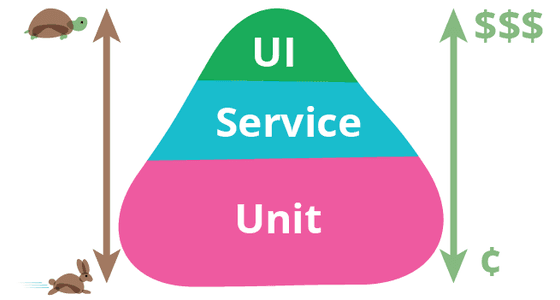
Explain the Test Pyramid and how it guides testing strategy
Favor fast unit tests, a middle service layer, and few UI tests as second defense.
Explain the Test Pyramid and how it guides your strategy.
Tests your grasp of balanced automated testing. Define the pyramid's layers (Unit, Service, UI), explain trade-offs like speed and cost, then apply it to a new service. A red flag is describing the layers without explaining the 'why' behind the shape.
Explain the Test Pyramid and its strategic use
Tests your grasp of balanced testing trade-offs. A good answer defines the Unit, Service, and UI layers, explains the cost/speed rationale, and applies it to a feature strategy. A red flag is describing the pyramid but not its strategic 'why'.
How do you balance emergent design with long-term architectural vision?
Tests reconciling emergent design with intentional architecture. Strong answers cite the architectural runway: just-enough infrastructure ahead via enablers, extended by teams incrementally. Red flag: claiming architecture is fully upfront or purely organic.
Balancing Emergent Design with Long-Term Architectural Vision
This tests your ability to balance agile practice with large-scale system needs. Explain how an "Architectural Runway," built with "Enablers," reconciles emergent design with intentional architecture for near-term features.
Balancing Emergent Design with Long-Term Architectural Vision
This tests your grasp of scaling Agile. A strong answer defines emergent design and intentional architecture, explaining how an 'Architectural Runway' provides the technical foundation to balance them. A red flag is treating this as an 'either/or' choice.

Describe essential CI/CD stages for a containerized app and critical quality gates
This tests your ability to design a commit-to-prod pipeline with quality controls. A strong answer covers: build and unit tests, vulnerability scanning, staging deployment with integration tests, and production rollout with rollback.