All bites
The whole library, newest first. Filter by what you are here for, or pick a topic if you already know.
8668 bites
Page 147

ETL vs ELT: when to prefer each for ML?
Tests architecture tradeoffs. Contrast ETL's pre-load transformation with ELT's in-warehouse transformation, map structured legacy to ETL and raw lakes to ELT, and cite ML iteration needs. Red flag: calling one better ignoring compute placement or volume.

Design ingestion for clickstream and batch product metadata
Use a data lake for raw data, a feature store for joins, columnar formats for batch, and row formats for events.

How do you guarantee identical feature engineering for training and real-time inference?
Tests unifying feature engineering across batch and online paths to eliminate skew. Answer: shared transformation libraries, versioned feature stores, and logged feature validation. Red flag: separate training and serving code without a single source of truth.
Design a robust automated testing strategy for ML models before production
Statistical offline thresholds, shadow-canary launches, input drift detection, and rollbacks tied to KPIs.
Design an MLOps platform for a mid-sized company: components and build-vs-buy trade-offs
Tests pragmatic scoping and build-vs-buy reasoning. Strong answers rank data estate, feature store, registry, CI/CD/CT, and monitoring above exotic serving, buying commodity and building differentiators. Red flag: custom orchestrators or missing governance.
What production metrics and auto-thresholds trigger model retraining?
This tests production monitoring maturity. A strong answer covers technical drift metrics, business KPIs tied to model decisions, and automated thresholds that page or trigger CI/CD retraining.
Explain ML pipelines and typical CI/CD/CT components
Tests if you separate code CI/CD from model CT and grasp ML automation. Cover source control, build, tests, deploy for code; data validation, training, evaluation, promotion for CT. Red flag: treating ML like software CI/CD and ignoring data or registry gates.
Why version code, data, and models in MLOps?
Tests immutable lineage across code, data, and models. Strong answers cover content-addressed data, git commits, a model registry linking both, and CI triggers on any change. Red flag: saying git alone handles data and models.
What are the primary differences between traditional DevOps and MLOps?
Tests if you know MLOps extends CI/CD to data and probabilistic assets. Contrast code artifacts with models and datasets. Distinguish commit triggers from drift or retraining triggers. Red flag: treating models as static binaries and ignoring data lineage.
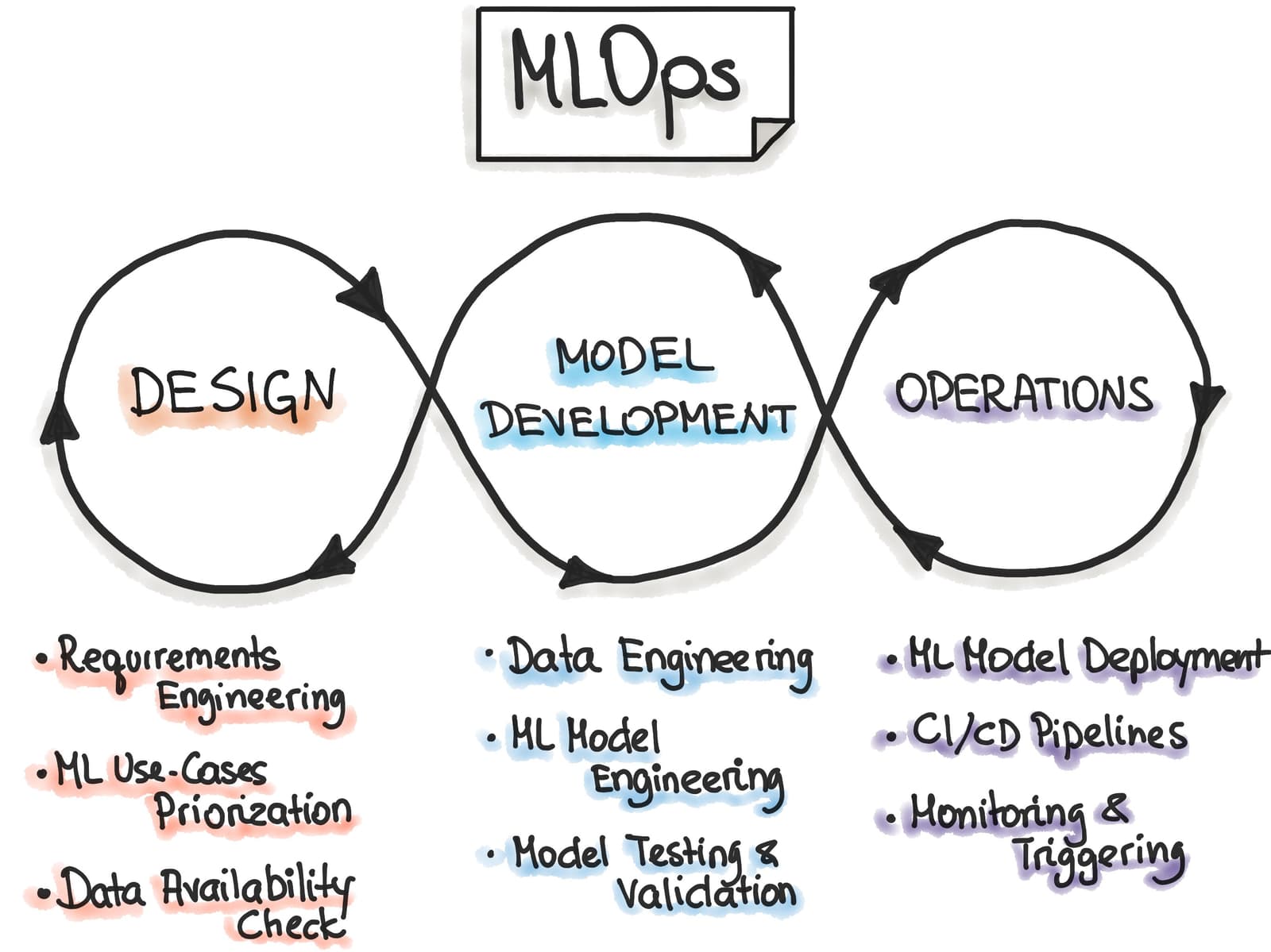
Describe the key stages of a typical ML lifecycle
It tests end-to-end systems thinking beyond notebook prototyping. Strong answers list: problem framing, data processing, model development, deployment, and monitoring with retraining. A red flag is skipping data validation or post-deployment observability.
Model Risk Management: The Immune System for Production Models
Model Risk Management treats every deployed model as a liability that can silently decay. Banks use it to stop bad predictions from becoming bad decisions. The footgun is treating validation as a one-time checkbox instead of continuous governance.
Centralized vs Decentralized ML Platforms
A centralized ML platform trades team autonomy for standardization, while decentralized platforms embed ML tooling inside product teams. Centralized suites drown in ticket queues; decentralized ones duplicate cost and security holes without strong governance.
Dynamic Fan-out/Fan-in Pipelines
Dynamic fan-out/fan-in spawns parallel tasks from runtime data, then gathers results. Use it when input counts vary, like processing a daily changing set of files. The footgun is a fan-in task that hangs waiting for branches lost to partial failure.
Parameterization: One Pipeline, Any Environment
Externalize every path, hyperparameter, and compute setting so one pipeline runs unchanged across dev, staging, and production. This enables reproducible experiments and safe CI/CD. The footgun is branch-per-environment repos that silently diverge.
Adversarial Validation: Detect Drift with a Classifier
Adversarial validation reframes drift detection as a classification problem: train a model to separate training rows from production rows. If it can tell them apart, your feature distributions have shifted.
Inference Health Checks: Traffic Gates, Not Heartbeats
An inference server's health check is a traffic gate, not a heartbeat. Kubernetes uses it to route requests only after the model is loaded. The footgun is probing the root path, which stays green even when the model has crashed or the GPU is wedged.
Right-Size Inference and Stop Paying for Idle GPUs
Instance right-sizing matches inference to the smallest hardware that serves it without choking. It matters when GPU endpoints idle at 10% utilization. The footgun is copying your training spec into production; inference rarely needs that memory or multi-GPU.
Why GPUs Dominate Neural Network Training
A GPU is a freight train, a CPU a race car: deep learning moves identical math across huge batches. GPUs win on transformers and CNNs. The footgun is using them for tiny models, where data transfer overhead eats the gains.
Docker Image vs. Container: Blueprint vs. Runtime
A Docker image is a read-only blueprint; a container is a live instance with a writable layer. You build an image once in CI and run many containers from it in production. The footgun is mutating a running container without updating the image recipe.
MLflow Models Standardize Deployment Packaging
MLflow Models wrap artifacts into a standard package so one pipeline serves sklearn or PyTorch without new deployment code. Teams ship experiments to REST endpoints without Dockerfiles per model. Missing dependency logging lets model load but fail to predict.