All bites
The whole library, newest first. Filter by what you are here for, or pick a topic if you already know.
8668 bites
Page 207

How do you spike a story to de-risk it and define deliverables?
Whether you see spikes as time-boxed research, not feature work. Propose a fixed duration, define the specific question, deliver a decision record or prototype, and revise the story estimate. Never treat a spike as production code or skip the time box.
What is the primary difference between Sprint Review and Sprint Retrospective?
Tests separation of product feedback from process improvement. Review: stakeholders inspect the Increment and adapt the backlog. Retrospective: Scrum Team only inspects its process and plans improvements. Red flag: calling either a status report or demo.
Why do teams use story points instead of hours or days?
Define against a baseline; explain they absorb uncertainty so velocity stabilizes for planning.
Explain backlog refinement: purpose, participants, and outcomes
Tests if you treat refinement as team-wide prep, not a solo PO task. Strong answers cite the full team and stakeholders, with outcomes being ready stories and estimates. Red flag: saying only the PO and Scrum Master attend or that it replaces sprint planning.
Two senior developers clash on implementation, derailing sprint planning. Your role?
Park or timebox the debate, reframe positions into shared interests with structured dialogue, and drive to a decision or spike.
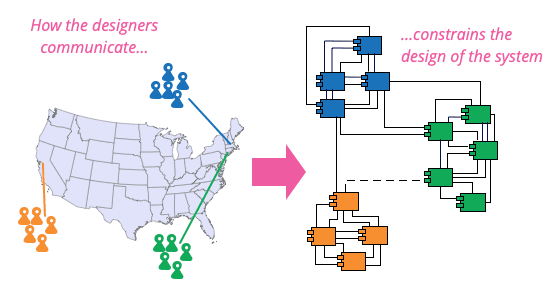
How would you apply Conway's Law to design team structures for microservices?
Map bounded contexts to cross-functional teams; use APIs as contracts; split by decoupling boundary.
Why is velocity as a primary KPI destructive, and what's better?
This tests if you see velocity as a planning gauge, not a performance metric. A strong answer notes points are subjective, cites Goldratt on gaming, and proposes team-driven improvement instead. A red flag is claiming velocity works if averaged over time.

Compare SAFe and LeSS from an engineer's view
Tests whether you see scaling frameworks as workflow design choices. Answers contrast SAFe's PI planning and RTE-managed dependencies with LeSS's single Sprint planning and team-driven resolution. Red flag: calling them interchangeable without citing autonomy.
Describe the difference between feature and component teams
Tests your grasp of how team structure affects value flow. A strong answer contrasts vertical slices with component ownership, noting feature teams shorten feedback while component teams create handoffs. Red flag: treating either as universally better.
How should an EM facilitate reviews in a self-organizing team?
Tests separating feedback from pay, replacing individual ratings with systemic coaching. Cover: framing reviews as career development, biweekly 1:1s for meta-coaching, team raise pools, and obstacle removal. Red flag: stack ranking or hero worship.
How can developers support the Product Owner in backlog refinement?
Developers surface risks, sizing, and dependencies; co-create trade-offs; and split items early.

Decompose a monolith for scaled agile teams
Tests aligning architecture to team boundaries during incremental monolith decomposition. Cover: bounded contexts with isolated data and sagas, backward-compatible versioned APIs, and replacing shared libraries with duplicated code or versioned SDKs.
Describe a SAFe rule that hinders agility and how to mitigate it
Cite one rigid workflow pattern, show how it delays feedback, then propose a lighter cross-team substitute.

How would you estimate a cross-cutting initiative in PI Planning?
Tests decomposition of cross-cutting work into team enablers with visible dependencies. Good answer: teams estimate own slices in normalized points, map dependencies on the ART board, and reserve IP buffer.
What is a Scrum of Scrums purpose and what technical info is shared?
Multi-team sync for blockers, dependencies, API changes, integration risks; not a status meeting.
How would you apply Little's Law to optimize Kanban WIP limits?
Tests whether you can operationalize queueing theory in Kanban. A strong answer cites L equals lambda times W, fixes throughput, then solves for a WIP limit that yields a target cycle time.
What does a widening CFD Code Review band indicate?
Tests CFD literacy: a widening Code Review band shows WIP accumulation and a bottleneck. Great answers cite WIP limits, swarming, and policy fixes before hiring. Red flag: mistaking inventory growth for increased throughput.
Design an Upstream Kanban process for product ideas before development
Tests your grasp of pre-commitment demand shaping. A strong answer maps an option-discovery board, defines the commitment point and triage policies, and ties early filtering to reduced downstream variability.

CFD Testing band widens: what does it indicate and what experiments?
This tests flow metric literacy. A widening Testing band means arrivals exceed departures; propose experiments like smaller batches, automation, or dev-test swarming, then measure cycle time. Red flag: blaming testers or demanding headcount without data.

How would you implement Classes of Service in Kanban?
Tests whether you segment work by risk and cost of delay. A strong answer defines explicit policies, visualizes classes with color or lanes, and reserves WIP capacity per class. Red flag: using classes as simple priorities without capacity rules.