All bites
The whole library, newest first. Filter by what you are here for, or pick a topic if you already know.
8668 bites
Page 239
Explain a backlog refinement meeting's purpose, participants, and outcomes
Tests understanding of a core Scrum ceremony. A good answer defines the goal (clarifying future work), names participants (Dev Team, PO), and lists outcomes (estimated stories).

How do you facilitate a heated technical disagreement between two seniors?
Tests your ability to de-escalate conflict and guide a team to a data-driven decision. Acknowledge the issue, separate the people from the problem, use a structured process, and focus on shared goals. A red flag is immediately picking a side or escalating.
Trade-offs: Product-Oriented vs. Project-Oriented Teams
This tests your understanding of how team structure and funding models impact long-term software quality. A great answer contrasts temporary, scope-funded project teams with durable, problem-funded product teams, highlighting the latter's benefits for…
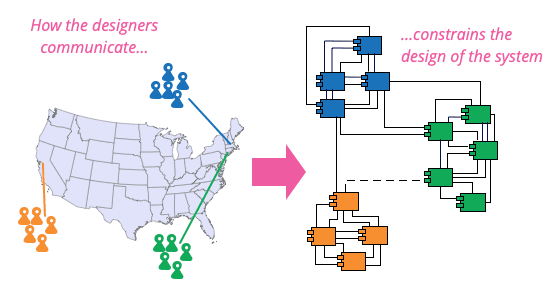
How to apply Conway's Law to design team structures?
Tests if you can use Conway's Law proactively (the 'Inverse Conway Maneuver'). Outline: define the target architecture, then align small, autonomous teams to its components. A red flag is seeing the law only as a constraint, not a tool for intentional design.
Why is tracking team velocity as a KPI dysfunctional?
Tests if you know velocity is for planning, not performance. Explain it's easily gamed and measures output, not outcome. Propose metrics focused on value delivery and process improvement like cycle time.

SAFe vs. LeSS: Planning, Dependencies, and Autonomy
This tests your grasp of how org structure affects engineering work. Contrast SAFe's top-down, prescriptive nature (central PI planning) with LeSS's bottom-up, team-centric model (direct dependency management). A red flag is reciting buzzwords without context.
Feature Teams vs. Component Teams: Pros and Cons
This tests your grasp of how team structure affects value delivery. A great answer defines feature (vertical slice, end-to-end) and component (horizontal, specialized) teams, then contrasts their trade-offs: speed vs. deep expertise.
How to manage performance reviews in self-organizing agile teams?
This tests your servant leadership mindset. Reframe "performance management" as "career development," use frequent 1-on-1s for coaching and obstacle removal, and separate compensation from feedback. Red flag: focusing on individual metrics or stack ranking.
How can developers support the Product Owner in backlog refinement?
Tests your proactivity and partnership beyond just executing tasks. A great answer covers proactive technical analysis, suggesting ways to split stories for incremental value, and helping the PO quantify impact.

Decomposing a monolith for scaled agile teams
Tests your grasp of domain-driven design and data consistency in a microservice migration. A good answer identifies bounded contexts, defines versioned APIs, and uses event-based patterns for data.
How can a SAFe rule hinder agility, and how would you mitigate it?
Tests your ability to pragmatically adapt process. First, name a specific SAFe rule and a scenario where it fails. Then, propose a mitigation that still achieves the rule's original goal, like alignment. A red flag is just complaining about bureaucracy.

Estimating large, cross-team initiatives in PI Planning
Tests your ability to facilitate collaborative estimation. Break the initiative into features for teams to estimate, then use an ART board to map dependencies. A red flag is providing a single, top-down number without team input.
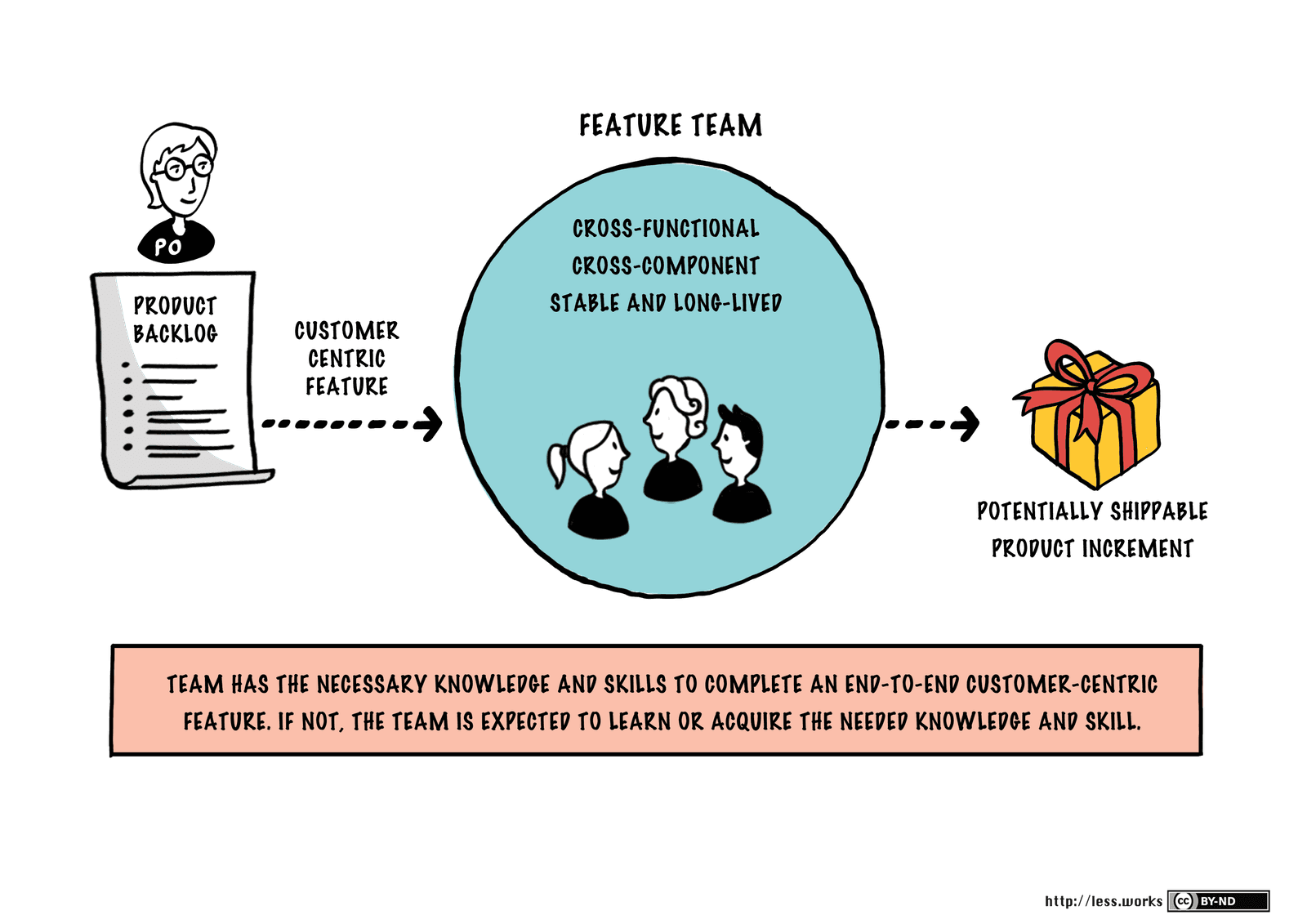
Technical Prerequisites for LeSS Feature Teams
This tests your grasp of the engineering practices that enable agile scaling. A great answer covers continuous integration for shared ownership, robust test automation, and a loosely coupled architecture. A red flag is focusing only on Scrum ceremonies.
Purpose of a Shared Definition of Done for Multiple Teams
This tests your ability to maintain quality and transparency across multiple teams. Explain that a shared Definition of Done ensures a consistent quality standard for a usable, integrated Increment, impacting testing by requiring integration and end-to-end…
What is a Scrum of Scrums and what's shared there?
This tests your understanding of scaling Agile. A good answer defines it as a coordination meeting for multiple teams, focusing on sharing inter-team blockers, dependencies, and integration points, not just status.
Apply Little's Law to a Kanban system to optimize flow
Tests applying queuing theory to software delivery. Define Little's Law as WIP = Throughput × Cycle Time. Explain how reducing WIP limits directly shortens cycle time for a stable throughput.
CFD 'Code Review' band is widening. What does it mean?
This tests your ability to interpret a CFD and propose actions. A widening 'Code Review' band means work enters faster than it leaves. Diagnose the bottleneck (e.g., review quality, reviewer availability), then propose solutions.
Investigating Variable Sprint Velocity
This tests your ability to diagnose issues by connecting process metrics to technical health. A great answer hypothesizes technical causes (e.g., tech debt, flaky tests), identifies specific data for validation (e.g., cycle time, build logs), and avoids…
Design an Upstream Kanban for Product Ideas
Tests managing work before commitment. A good answer defines the commitment point, visualizes options on a board, and applies triage discipline to refine ideas. A red flag is describing a simple 'to-do' list without a structured filtering and decision process.

CFD shows a widening 'Testing' band. What does it mean?
This tests your ability to interpret process metrics and propose data-driven solutions. First, define the bottleneck: work enters testing faster than it leaves. Then, propose experiments to diagnose the cause before suggesting solutions.