All bites
The whole library, newest first. Filter by what you are here for, or pick a topic if you already know.
8667 bites
Page 360
Third Normal Form (3NF): Nothing But The Key
Third Normal Form (3NF) dictates that every non-key column must describe 'nothing but the key.' This prevents transitive dependencies, where one non-key column determines another.
Functional Dependency: The Rules Behind Your Data
A functional dependency is a rule: if you know column A, you uniquely know column B. It's the logic behind primary keys and is used for database normalization to prevent data duplication.
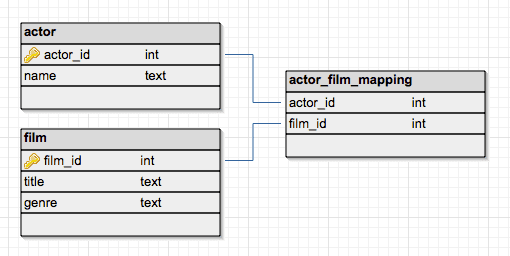
Junction Table: Connecting Many to Many
A junction table is a bridge between two other tables, enabling a many-to-many relationship. It's used to connect students to classes or tags to articles. The common footgun is forgetting a unique constraint, allowing duplicate connections.
First Normal Form (1NF): No Nested Data
First Normal Form (1NF) means every table cell holds one single value, not a list. It's the first rule of relational databases, stopping you from storing comma-separated strings. The footgun is stuffing multiple values into one field, which breaks SQL queries.

Entity-Relationship Diagrams: A Blueprint for Your Data
An Entity-Relationship Diagram (ERD) is a blueprint for a database, showing what you're storing and how it connects. It's used before writing code to design a relational database schema. The main footgun is designing the model to match the UI, not the data.
Boyce-Codd Normal Form (BCNF): Stricter Than 3NF
BCNF is a database design rule stricter than 3NF, ensuring no attribute is determined by anything but a superkey. It's used to eliminate all data redundancies from functional dependencies, but can force trade-offs with dependency preservation.
Codd's 12 Rules: The Relational Database Litmus Test
Codd's 12 Rules are a litmus test for whether a database is truly "relational." They demand that all data and operations be managed purely through the relational model, not through lower-level system access.
Relational Algebra: The Math Behind SQL Queries
Relational algebra is the formal logic behind SQL, treating tables as mathematical sets. It provides a grammar for operations like joins and filters, allowing a database to translate your declarative query into a precise, optimizable execution plan.
Transaction Isolation Levels: The Concurrency vs. Correctness Dial
Think of isolation levels as a database dial trading transaction correctness for raw concurrency. You tune this when balancing performance against the risk of data anomalies. The footgun: the default level isn't always the safest; you must know its guarantees.
Database Views: A Saved Query That Acts Like a Table
A database view is a saved query you interact with like a real table. It simplifies complex joins for applications or restricts data access for security, showing only specific rows or columns.
Database Index: The Phonebook for Your Data
An index is like a book's index, letting you jump to the right row without scanning the whole table. It's essential for columns used in WHERE clauses, but over-indexing slows writes since every index must be updated on data changes.
Foreign Keys: The Glue of Relational Databases
A foreign key is a pointer from one table to another, linking related data like a user to their posts. It enforces referential integrity, ensuring a post can't exist without a valid user. The footgun is forgetting this blocks deletions of referenced records.
Database Normalization: Tidy Tables, Less Redundancy
Database normalization organizes data into smaller, related tables to eliminate redundancy, like separating addresses from orders. It's the standard for transactional (OLTP) systems where data integrity is critical.
ACID: The Four Guarantees of Database Transactions
ACID is a contract for database transactions: all-or-nothing guarantees for data validity, even during crashes. It's critical for relational databases in finance or e-commerce. The footgun is assuming all databases offer this; many NoSQL systems don't.
The Relational Model: Data as Simple Tables
The relational model organizes data into simple tables (relations) of rows (tuples), forming the foundation of SQL databases. It's used for structured data where consistency is critical, like in banking.
Primary Keys: The Unique ID for Every Row
A primary key is like a social security number for a database row, uniquely identifying it. It's used to reliably fetch records and link related data across tables. The footgun is using a natural key, like an email address, that might change over time.
DBMS: The Software That Runs Your Database
A DBMS is the software engine that manages a database, separating your app from raw data files. You use it to query, update, and administer data, like with PostgreSQL or MySQL. The common footgun is confusing the DBMS with the database itself.
The Big Idea: Your Presentation's Single-Sentence Core
The "Big Idea" is a single sentence distilling your presentation's core message. It must state your point of view and what's at stake, telling your audience what to know and what to do.

How a SQL SELECT Query Actually Runs
A SQL SELECT query runs in a different order than you write it. It first builds the dataset with FROM/JOINs and filters it with WHERE, only then computing the final columns in SELECT. This is crucial for debugging.
Data Sonification: Hearing Your Data's Story
Data sonification is data visualization for your ears, mapping data points to sound properties like pitch or volume. It helps find patterns in complex datasets, like network traffic, where visuals fail.