Planning Poker: Avoid Groupthink in Estimates
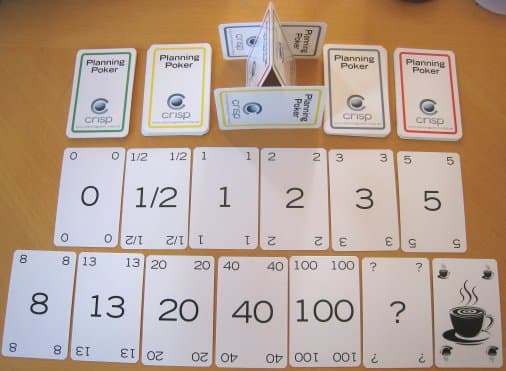
Planning poker avoids groupthink in effort estimation. Team members reveal estimates simultaneously using cards, preventing the first number spoken from anchoring everyone else. It's used in Agile to size up tasks.
The mental model
Planning poker is a technique to get honest group estimates by preventing one person's opinion from influencing everyone else. It forces independent thought first by having everyone reveal their estimate simultaneously, turning estimation from a potential argument into a structured conversation about differing assumptions.
How it works
The process is simple and gamified. First, a moderator explains a feature or user story. Second, each team member privately chooses a card with a number that represents their estimate of the effort required. Third, everyone reveals their cards at the same time. If the numbers are similar, the team can quickly agree on a final estimate. If the numbers vary widely, the individuals with the highest and lowest estimates explain their reasoning. This discussion is the most valuable part, as it uncovers hidden complexities or misunderstandings. The team then repeats the estimation process until they reach a consensus.
When to use it
Use planning poker in Agile and Scrum frameworks to estimate the effort for backlog items like new features, improvements, or complex bug fixes. It is most effective when a task is complex enough that different team members might have unique insights into the work required. The process builds a shared understanding of the task across the entire team.
When not to use it
Avoid using planning poker for trivial, well-understood tasks, as it would be an unnecessary ceremony. It is also not a tool for precise time-boxing down to the hour; it estimates relative effort or complexity. The goal is consensus and shared understanding, not to pressure people into agreeing with the majority.
One canonical example
A team needs to estimate a "user profile update" feature. After the feature is described, a junior developer picks a '3' card, seeing it as a simple form. A senior backend developer picks an '8', thinking about database migrations and API versioning. A QA engineer picks a '13', considering the need to test how profile changes affect active sessions. The simultaneous reveal shows a wide gap. The discussion that follows educates the whole team on the full scope of the work, leading them to re-vote and converge on an '8'.
Interview question
What is the main reason Planning Poker requires team members to reveal their estimates simultaneously?
- a.To ensure that the most experienced team member's estimate is given priority.
- b.To prevent any single individual's initial estimate from influencing others' independent judgment.Correct
- c.To accelerate the overall estimation process for all types of project tasks.
- d.To quickly identify and eliminate estimates that are significantly different from the majority.
Why? this is the answer
The card explicitly states that simultaneous reveal "prevents one person's opinion from influencing everyone else" and "forces independent thought first," directly addressing groupthink. Option D is a tempting distractor, but the process aims to discuss and understand differing estimates, not simply eliminate them, to uncover hidden complexities.
Just read this? Test yourself on what you have been reading.
Read the original → en.wikipedia.org
You just looked this up. Could you explain it out loud?
That is the part interviews actually test. Tezvyn takes questions like this one and gives you what the interviewer is really checking, the answer that lands, and the mistake that ends the conversation, in the four minutes before your next meeting.
The iPhone app is on the way
We are building it. Until it lands, nothing here is held back from you: every interview card, your saved cards, streaks and the job board all work in Safari, plus hundreds of free practice quizzes of thirty questions each. Sign in and it all carries over to the app the day it arrives.
Want it as an icon? Tap Share at the bottom of Safari, then Add to Home Screen. It opens full screen and the cards you have read stay available offline.
We are hiring for this. Open roles that interview on agile — each one lists the topics its interview covers.
See open roles