Search
Find a bite, explore a topic or look for a role.
Results for “Python”
Bites 291
Explain a model registry's purpose and what to store per version
Tests if you treat the registry as a governance bridge between training and production, not just storage. Strong answers cite versioned artifacts, lineage, metrics, dependencies, and approval gates. Red flag: calling it a file dump or experiment tracker.
How do you configure Docker for host GPU access and CUDA libraries?
This tests GPU passthrough via the NVIDIA Container Toolkit. Strong answers use nvidia/cuda base images matching the host driver, pass GPUs with --gpus all, and avoid installing drivers inside the container.
Design a centralized model registry for a large enterprise
Tests ML artifact governance at scale. Strong answers cover immutable versioned artifacts with dependency manifests, a framework-agnostic API, and pluggable deployment targets. Red flag: treating models as opaque files without environment reproducibility.
Reproduce a six-month-old model using experiment tracking
Trace code commit, dataset version, feature pipeline, hyperparameters, dependency manifest, and random seeds through a model registry.

Compare and contrast Apache Airflow versus Kubeflow Pipelines for ML orchestration
This tests matching orchestrators to ML constraints. A strong answer contrasts Airflow's task scheduling and backfills with Kubeflow's K8s-native GPU scaling, choosing based on team skills.

How do you ensure ML experiment reproducibility beyond random seeds?
Tests system-level reproducibility through data versioning, environment capture, and pipeline automation. Strong answers cover versioned datasets, containerized dependencies, and immutable experiment logs.

What is the wrong and right way to manage ML database secrets?
This tests secret management hygiene for ML pipelines. A strong answer rejects hardcoded secrets and env vars, then proposes AWS Secrets Manager with IAM retrieval, TLS, caching, and rotation. A red flag is suggesting .env files, ConfigMaps, or CLI arguments.
Why was this customer denied: global or local explanation?
This tests matching questions to explanation scope. Global methods show overall behavior; local methods explain one prediction. Specific denials need local methods like SHAP. A red flag is using global summaries like permutation importance or PDPs for a case.
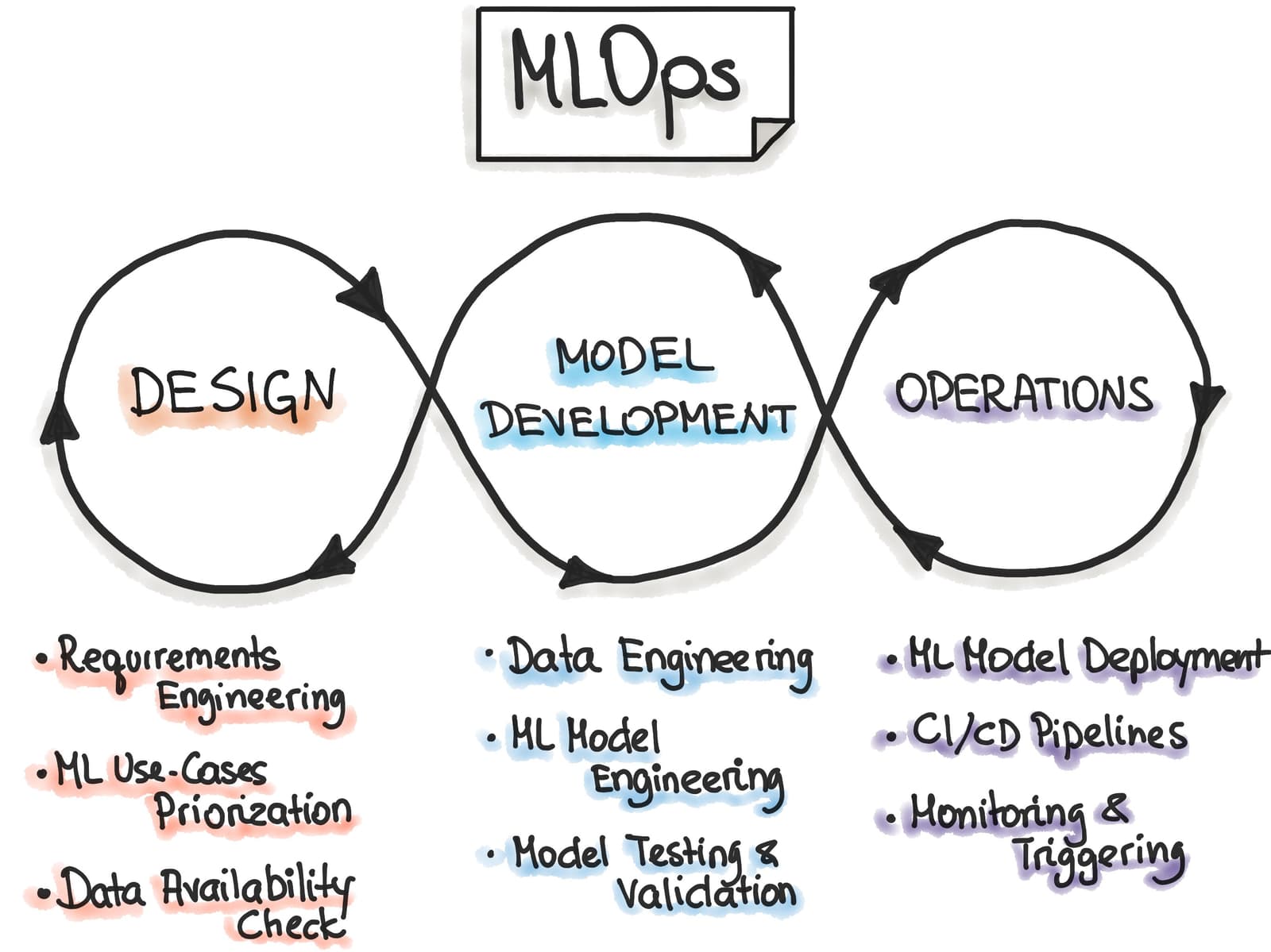
How would you design a reproducible ML training pipeline?
Tests if you can version ML's three moving parts: code, data, and environment. Good answers cover Git for code, DVC or lakehouse versioning for data, and Docker plus locked dependencies for environments.
What is a feature store and how does it prevent training-serving skew?
This tests training-serving consistency via centralized feature management. Covers offline batch storage, online serving, shared transformations, and alternatives like ad-hoc ETL. A red flag is calling it just a database and ignoring point-in-time correctness.
Deploy a trained model as a containerized REST API
This tests practical MLOps fluency. A strong answer covers loading the artifact, wrapping it in a web server, building a Dockerfile, and exposing health and predict endpoints. Red flag: conflating training with serving or omitting resource limits.

How would you design safe, automatic schema evolution in CI?
Tests whether you separate schema evolution from semantic validation. Strong answer: versioned data contracts allowing additive enums, unknown-category model buckets, and automated contract negotiation. Red flag: manual allow-lists or disabling validation.
What automated tests belong in CI before deploying a classification model?
Name data schema checks, performance regression vs baseline, bias audits, and artifact integrity.

Design on-demand containerized dev environments for data scientists
Tests multi-tenant notebook infrastructure design. Cover a Notebook Controller, curated Jupyter and VS Code images, namespace isolation with RBAC, resource quotas, and persistent storage. Red flag: a single shared VM without tenancy or idle shutdown.
Strategies to reduce a 5GB ML Docker image size
Tests multi-stage build hygiene and ML bloat reduction. Strong answers use multi-stage builds, strip CUDA dev libs, use slim bases, and collapse cache cleanup into one RUN. Red flag: rm -rf in a separate RUN step, which still bloats the layer.
Describe two secure methods for providing secrets to a running container
Mention runtime mounts like Docker secrets, orchestrator secret injection, and cloud IAM patterns.
How do you version and distribute Docker dev environments consistently?
Tests immutable dev environment distribution. Strong answers cover: versioned Dockerfiles in Git, immutable image tags pushed to a registry, and enforcing identical pulls for CI and developers. Red flag: using the "latest" tag or local Dockerfile rebuilds.
How do you build dev and production Docker images from one source?
Mastery of Docker multi-stage builds for isolating dev and production dependencies. Use a base stage, a dev target with linters and tests, and a lean production target copying only the build artifact.
How do you structure a Dockerfile to leverage layer caching for dependencies?
Tests Docker layer invalidation and cache-aware instruction ordering. Copy requirements.txt and run pip install before source code so deps cache independently. Red flag: copying everything at once or installing deps after code, busting cache every build.

Argue for declarative or imperative feature platforms with trade-offs
This tests whether you weigh control flow against data flow. A strong answer argues from org maturity: declarative systems abstract DAG topology, while imperative ones offer Spark control at the cost of manual idempotency. Red flag: ignoring org culture.