More in Backend Dev — page 47
Rust's Two String Types: String vs. &str
Think of `String` as an owned, growable text buffer on the heap, while `&str` is a borrowed, fixed-size view into string data. This distinction is key to Rust's memory safety. Functions often take `&str` to flexibly accept both types.
Rust Slices (&[T]): Views Without Ownership
A Rust slice is a borrowed view into a contiguous sequence of data, like an array or Vec, without taking ownership. Use it to write functions that operate on parts of a collection efficiently. The footgun: a slice cannot outlive the data it points to.
Rust HashMap: Fast, Secure Key-Value Storage
A Rust `HashMap` is like a dictionary, mapping unique keys to values for fast lookups. Use it for caching or frequency counting. The footgun: never modify a key after insertion, as changing its hash will break the map's internal logic.
Rust Vectors: Your Go-To Growable List
A `Vec<T>` is Rust's smart, growable array. It automatically gets more memory when full, keeping items together for fast access. Use it for lists of unknown size. The footgun: frequent reallocations can be slow if you don't pre-allocate capacity.
Go Maps: Your Built-in Hash Table
Go maps are the language's built-in hash tables for fast key-value lookups. Use `make(map[K]V)` to initialize one before writing. The biggest footgun is writing to a `nil` map, which causes a runtime panic. Always initialize your maps first.
Using Box<T> for Heap Allocation in Rust
Rust's `Box<T>` is a smart pointer that moves data from the stack to the heap. It's essential for creating recursive types, like linked lists, whose size would otherwise be infinite. The main footgun is in FFI: never wrap a C-allocated pointer in a `Box`.
Rust's Turbofish (`::<>`): When the Compiler Needs Help
The turbofish (`::<>`) is your tool to resolve ambiguity when Rust's compiler can't infer a type or trait. Use it when a type implements multiple traits with same-named methods, forcing the compiler to pick the one you specify.
Rust's Variable Shadowing: Re-binding, Not Mutating
Shadowing lets you declare a new variable with the same name, making the old one inaccessible. It's used to transform a value, like changing its type, without making it mutable. The footgun is confusing shadowing (`let x = ...`) with reassignment (`x = ...`).
Go Pointers: Memory Addresses, Not Math
Go pointers are street addresses for data. Instead of copying a large struct, you pass its memory address. This lets functions modify the original value and is critical for performance.
Go's `defer`: Guaranteed Cleanup
Go's `defer` statement guarantees cleanup by running a function call just before the parent function returns. It's perfect for closing files or unlocking mutexes right where you acquire them. The footgun: multiple defers run in last-in, first-out order.
Go Slices: A Window into an Array
Think of a Go slice not as a list, but as a lightweight window into an underlying array. It's used everywhere for managing sequences of data. The footgun: since slices can share memory, modifying one can unexpectedly alter another.
Go vs. Rust: Variable Mutability by Default
Rust variables are immutable by default; Go's are mutable. Rust forces you to opt-in to changeability with `mut` for compile-time safety. Go prioritizes convenience, trusting the developer.
Zero-Cost Abstractions: Pay at Compile Time, Not Runtime
Zero-cost abstractions let you write high-level code that compiles to the same machine code as low-level optimizations. This is key in Rust for safe APIs without runtime overhead.
Rust's Two Error Types: Recoverable vs. Unrecoverable
Rust splits errors into two camps: recoverable (`Result`) and unrecoverable (`panic!`). This compile-time distinction forces you to handle expected failures, like a missing file, while crashing on programmer bugs, like an out-of-bounds access.
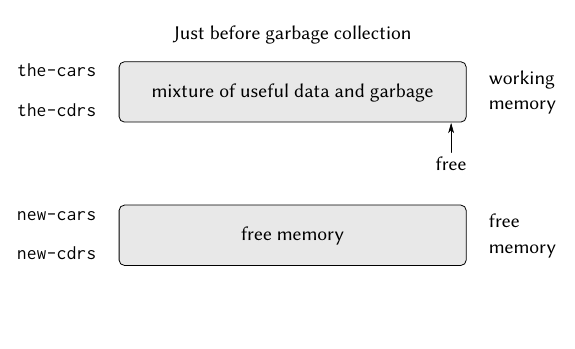
Go's Garbage Collector: The Concurrent Cleaner
Go's garbage collector is a concurrent cleaning crew, freeing memory while your program runs. It automatically reclaims unused memory, preventing leaks without manual `free()` calls. The footgun is assuming it's free; excessive allocations create GC pressure.
Rust Traits: Defining Shared Behavior
Rust traits are like contracts that guarantee a type has certain methods, similar to interfaces. This lets you write functions that operate on any type with that behavior, like a `summarize` method for both articles and posts.
Rust's Borrow Checker: Memory Safety at Compile Time
Rust's borrow checker is a compiler-time accountant that prevents memory bugs by enforcing ownership rules. It ensures you never access invalid data or have conflicting writes. The main footgun is assuming references are mutable by default; they aren't.
Rust Ownership: Memory Safety Without a Garbage Collector
Rust's ownership model ensures memory safety without a garbage collector. Think of data as having one owner; when the owner goes out of scope, the data is dropped.
Go Interfaces: Describe Behavior, Not Data
Go interfaces define behavior, not data. A type satisfies an interface implicitly by implementing its methods, without an `implements` keyword. This enables writing flexible functions, like `io.Writer` handling files or HTTP responses.
Goroutines
A goroutine is a lightweight function managed by Go's own runtime scheduler rather than the operating system, letting a single program run hundreds of thousands of concurrent tasks cheaply instead of the handful an OS thread model allows.