Intermediate interview questions in Design & UX, page 3
Design a content versioning system with history and revert
Versions table with article_id, version_num, content_snapshot, timestamp; APIs for createVersion, getHistory, restoreVersion.

Design architecture for multi-channel article distribution from a single source of truth
Tests separation of content and presentation via headless CMS. Strong answers cite a central structured CMS, content API, channel-specific rendering layers, and webhook push. Red flag: manual duplication or direct database sharing without API abstraction.

What two techniques mitigate professional-tester bias in screener design?
Swap guessable questions for behavioral ones about real tasks, and add exclusion criteria to block web-savvy professional testers.
How would you technically approach building a related articles feature?
Tests decomposition of a content recommender into data, similarity, and serving layers. Strong answers use TF-IDF, embeddings, or tag overlap with caching and cold-start fallbacks.
Build a compliant participant recruitment database
Capture granular, timestamped consent with lawful basis; minimize, encrypt, and retention-limit storage; and build self-service deletion that cascades.
Designing a Modal with controlled open state
Parent owns isOpen and onClose, portal renders content with focus trap, children for static content, render prop when content needs modal state.

Describe a workflow to automate a 50-person diary study
Tests operational UX research automation and API integration. A strong answer maps a pipeline of calendar APIs, email triggers, and reminder bots with no-show fallbacks. Red flag: manual spreadsheets or survey tools lacking scheduling logic.
How do Hug, Fill, and Fixed resizing behaviors interact?
This tests constraint-based size propagation. Define Hug as shrink-wrapping, Fill as stretching to the parent, and Fixed as explicit; note a Hug parent expands for Fixed or Hug children, but Fill needs a defined parent size.
Profile card with nested Auto Layout sizing
Outer vertical frame set to fixed width and hug height, an inner horizontal frame for avatar and name, and a bio text set to fill width and auto-height so the card grows down.
Decoupling Form state from its Field components
Form holds values, errors, and status in context, Fields self-register and read/write via a hook, validation composes per field.

Propose a strategy for finding and vetting low-incidence participants
This tests sourcing creativity and screening rigor for rare populations. A strong answer proposes niche outreach, snowball referrals, behavioral screeners, and anti-fraud checks. A red flag is simply boosting spend on generic panels or relying on coworkers.
The slots pattern for a PageLayout component
Slots are named insertion points so a layout owns structure while consumers fill header, sidebar, and main, via named props or compound subcomponents.
When would you use absolute position in an Auto Layout frame?
Absolute position lets badges float without pushing siblings; standard flow stacks sequentially and prevents overlap.
Explain TF-IDF and its use in SEO analysis
Term frequency times inverse document frequency surfaces distinctive terms; comparing a draft to top-ranking pages reveals missing topical terms.
Design a system to suggest internal links for new articles
This tests large-scale retrieval design. A strong answer uses an offline embedding index for candidate retrieval and a real-time ranker scoring topical overlap and anchor fit. Red flag: scanning the full corpus per request or omitting index architecture.
Auto-generating component API docs from source
Extract types via react-docgen-typescript, surface in Storybook ArgsTable, enrich with JSDoc.
How would you use NLP to analyze top articles for semantic themes?
This tests practical NLP pipeline design for SEO. A strong answer covers preprocessing, NER with spaCy or BERT, topic modeling with LDA or BERTopic, and semantic similarity via embeddings.
Documenting component anti-patterns and don'ts
Paired do/don't examples, explain the why, enforce with lint rules.
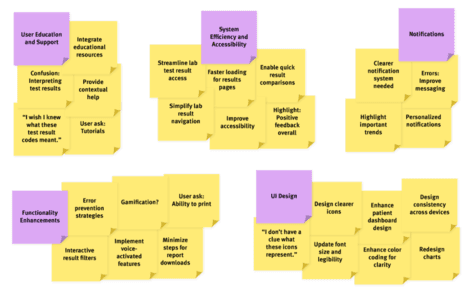
Translate qualitative insights into user stories and requirements
Clusters themes by frequency/severity, reframes pain points as user stories with clear AC, maps to technical spikes, prioritizes by impact.
What is the most efficient way to update a brand color globally?
This tests Figma variables versus styles for design system maintenance. Store the brand color as a variable, apply it across components, and edit the value once for global propagation. Red flag: manual updates or using a color style for a single raw value.
We are hiring for this. Every open role lists the topics its interview covers, so you can prepare for the real thing rather than guessing.
See open roles