Easy interview questions in MLOps & Infrastructure
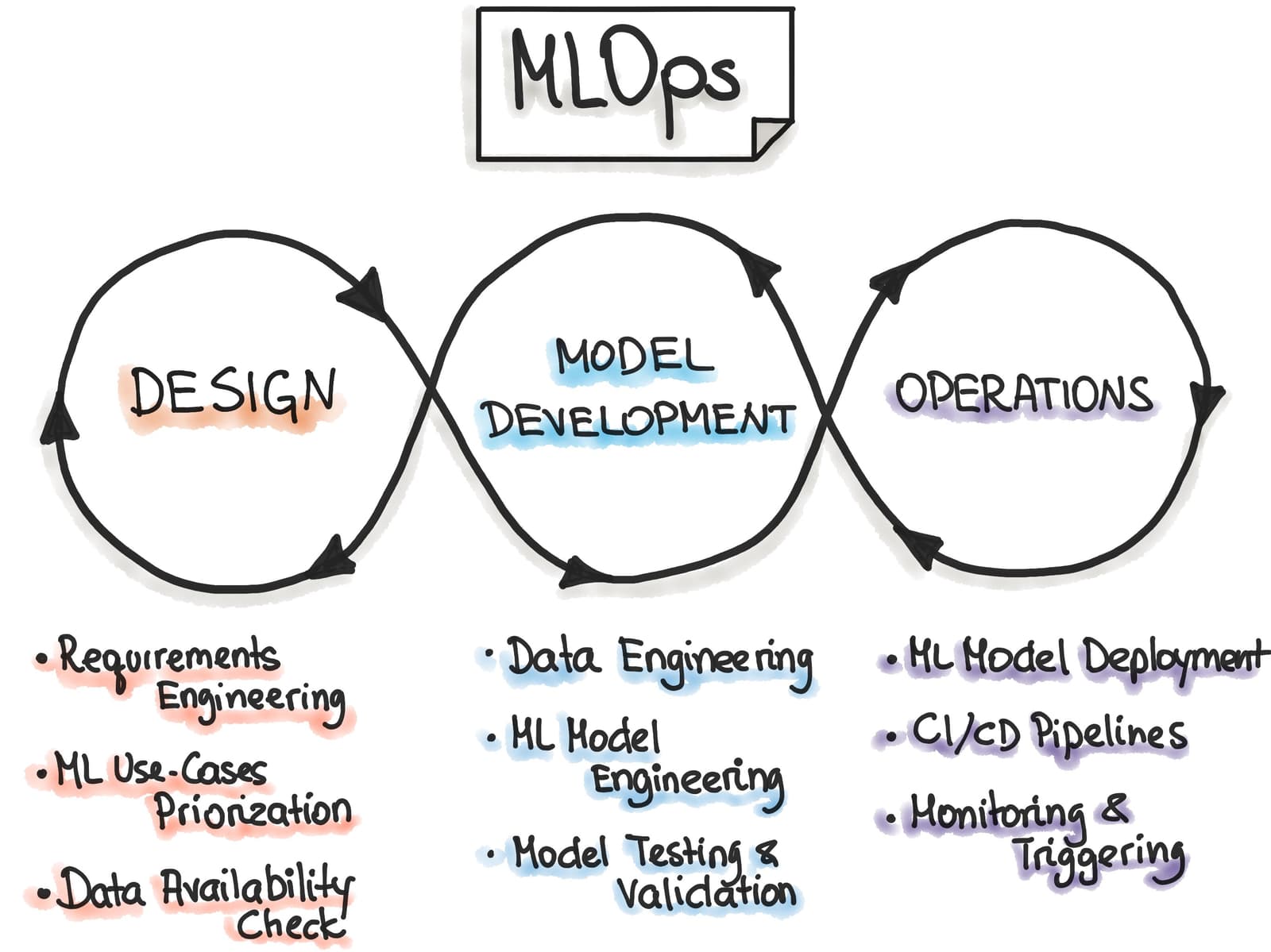
Describe the key stages of a typical ML lifecycle
It tests end-to-end systems thinking beyond notebook prototyping. Strong answers list: problem framing, data processing, model development, deployment, and monitoring with retraining. A red flag is skipping data validation or post-deployment observability.
What are the primary differences between traditional DevOps and MLOps?
Tests if you know MLOps extends CI/CD to data and probabilistic assets. Contrast code artifacts with models and datasets. Distinguish commit triggers from drift or retraining triggers. Red flag: treating models as static binaries and ignoring data lineage.

Design ingestion for clickstream and batch product metadata
Use a data lake for raw data, a feature store for joins, columnar formats for batch, and row formats for events.

ETL vs ELT: when to prefer each for ML?
Tests architecture tradeoffs. Contrast ETL's pre-load transformation with ELT's in-warehouse transformation, map structured legacy to ETL and raw lakes to ELT, and cite ML iteration needs. Red flag: calling one better ignoring compute placement or volume.
What data validation strategy prevents new categories from breaking your encoder?
Lock categorical domains in a schema, reject unseen categories before encoding, and use an OOV bucket as fallback.

What problems does a Feature Store solve in ML systems?
Tests understanding of feature store value beyond storage. Great answers cover: feature reuse across teams, managed transformation pipelines, and online/offline consistency to prevent training-serving skew. Red flag: calling it simply a database or cache.

Online vs offline feature store architecture and use cases
This tests latency trade-offs between real-time and batch infrastructure. Contrast fast online lookups against batch offline stores; fraud detection maps to online and model training to offline. Red flag: treating them as interchangeable and ignoring latency.
Walk me through essential Dockerfile commands for a reproducible Python ML environment
Tests your ability to containerize Python ML scripts reproducibly. A strong answer covers FROM with a pinned slim image, WORKDIR, COPY for requirements and code, RUN pip install, and CMD or ENTRYPOINT.
How do you structure a Dockerfile to leverage layer caching for dependencies?
Tests Docker layer invalidation and cache-aware instruction ordering. Copy requirements.txt and run pip install before source code so deps cache independently. Red flag: copying everything at once or installing deps after code, busting cache every build.
How do you containerize a Python training script for GPU cloud VMs?
This tests reproducible GPU containerization. A strong answer uses an NVIDIA CUDA base image, installs Python dependencies at build time, copies the training script, and runs with --gpus.

Difference between data and model parallelism, and when to prefer each
Tests split axis: data parallelism replicates model and shards data; model parallelism shards model across devices. Use data parallelism for throughput; model parallelism when layers exceed GPU memory.
Key differences between traditional and ML CI/CD pipelines?
Contrast code deploys with data versioning, model registries, and retraining; note holdout eval.
What automated tests belong in CI before deploying a classification model?
Name data schema checks, performance regression vs baseline, bias audits, and artifact integrity.
What is a model registry's purpose in CI/CD4ML and its CI/CD interaction?
Tests if you see the model registry as the bridge between experiments and production, not just storage. A strong answer explains how CI publishes validated artifacts and CD consumes versioned models. Red flag: calling it a passive file dump without versioning.
Describe the difference between online and batch inference.
Online serves single requests in ms on live endpoints; batch processes data offline with elastic compute.

Describe the difference between online and batch inference.
Online uses autoscaling APIs for millisecond-to-second latency; batch uses scheduled compute for minute-to-hour latency.
Deploy a trained model as a containerized REST API
This tests practical MLOps fluency. A strong answer covers loading the artifact, wrapping it in a web server, building a Dockerfile, and exposing health and predict endpoints. Red flag: conflating training with serving or omitting resource limits.
Differences between monitoring a traditional REST API and a production ML model
Contrast latency/errors with ML signals like data drift and training-serving skew against baselines, noting ground truth delays.
Detecting data drift on a continuous feature
Data drift is when serving feature distributions shift from training; detect with a Kolmogorov-Smirnov test comparing distributions; a small p-value signals drift to alert on.
Stages of an end-to-end ML pipeline
Ingest, validate, preprocess and feature engineer, train, evaluate against a baseline, then register and package for deployment, with gates between stages.
We are hiring for this. Every open role lists the topics its interview covers, so you can prepare for the real thing rather than guessing.
See open roles