Intermediate interview questions in Product Management, page 14
Investigating Variable Sprint Velocity: Technical Root Causes
This tests your ability to diagnose team issues with data, not anecdotes. Propose technical hypotheses like flaky tests or merge conflicts and link them to metrics like CI/CD failure rates or PR cycle time. A red flag is blaming individuals or poor estimation.
Investigating Variable Sprint Velocity
This tests your ability to diagnose issues by connecting process metrics to technical health. A great answer hypothesizes technical causes (e.g., tech debt, flaky tests), identifies specific data for validation (e.g., cycle time, build logs), and avoids…
.avif&w=1600&q=75)
What pre-launch tools prevent support ticket escalations to engineering?
Tests proactive operational design versus reactive firefighting. Great answers include real-time health dashboards, automated ticket triage with user context, self-service runbooks, and escalation guardrails with pre-populated logs.
What does a widening CFD Code Review band indicate?
Tests CFD literacy: a widening Code Review band shows WIP accumulation and a bottleneck. Great answers cite WIP limits, swarming, and policy fixes before hiring. Red flag: mistaking inventory growth for increased throughput.
Diagnosing a Widening Code Review Band in a CFD
This tests data interpretation and problem-solving. A great answer defines the bottleneck, hypothesizes causes (capacity, PR size), proposes diagnostics, then offers solutions. A red flag is blaming individuals or jumping to a single, unverified solution.
CFD 'Code Review' band is widening. What does it mean?
This tests your ability to interpret a CFD and propose actions. A widening 'Code Review' band means work enters faster than it leaves. Diagnose the bottleneck (e.g., review quality, reviewer availability), then propose solutions.
How would you instrument and query P95 API latency by region?
This tests white-box latency instrumentation and safe cardinality for percentile aggregation. Strong answer: emit histograms by region, query P95 with histogram_quantile or a log percentile, and keep trace IDs in logs only.
How would you measure P95 latency by geographic region?
Tests your ability to translate a business need into a concrete observability implementation. A good answer involves instrumenting the API with a histogram metric, adding a region label via GeoIP, and querying with histogram_quantile.
How would you measure P95 latency by geographic region?
Tests your ability to design a practical metrics pipeline, considering instrumentation, data types (metrics vs. logs), and aggregation. Instrument the API with a histogram metric and a region label, then query using histogram_quantile.
Purpose of a shared Definition of Done for multi-team products
This tests empirical transparency across teams building one Increment. A shared DoD forces cross-team integration and testing before Sprint end. Letting teams keep separate DoDs hides integration debt and breaks transparency.
What is the purpose of a shared 'Definition of Done'?
Tests your ability to ensure quality and transparency across multiple teams. A shared 'Definition of Done' is a formal description of quality for the integrated Increment. It ensures all work is combinable and shippable.
Purpose of a Shared Definition of Done for Multiple Teams
This tests your ability to maintain quality and transparency across multiple teams. Explain that a shared Definition of Done ensures a consistent quality standard for a usable, integrated Increment, impacting testing by requiring integration and end-to-end…
Platform team metrics versus product team metrics
Measure adoption, reliability SLOs, integration time, and self-service ratio over user engagement.
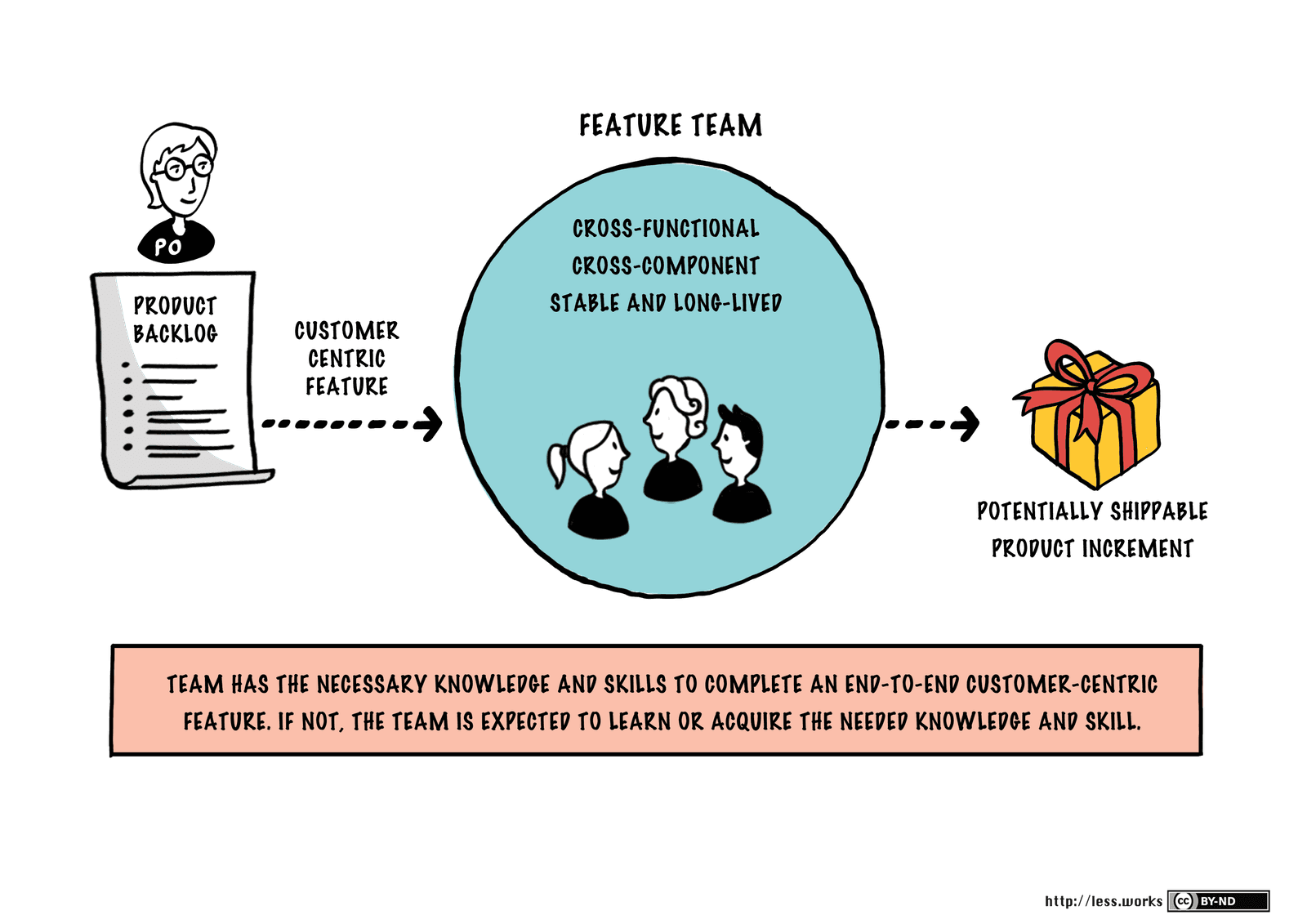
What codebase and CI/CD prerequisites enable LeSS feature teams?
Tests technical enablers for LeSS feature teams. Strong answers cover sub-10-minute CI, trunk-based development, comprehensive test automation, and decoupled architecture. Red flag: claiming coordination replaces shared ownership and continuous integration.
Technical Prerequisites for LeSS Feature Teams
Tests if you can link agile structure to technical architecture. A great answer covers codebase design for shared ownership, a fast CI pipeline for frequent integration, and a robust automated testing strategy.
Technical Prerequisites for LeSS Feature Teams
This tests your grasp of the engineering practices that enable agile scaling. A great answer covers continuous integration for shared ownership, robust test automation, and a loosely coupled architecture. A red flag is focusing only on Scrum ceremonies.
Design a cross-product feature flag strategy for coordinated release
This tests distributed coordination across service boundaries. A strong answer proposes a unified namespace, central config with local caches, and one user-scoped gate evaluated consistently in both products.

How would you estimate a cross-cutting initiative in PI Planning?
Tests decomposition of cross-cutting work into team enablers with visible dependencies. Good answer: teams estimate own slices in normalized points, map dependencies on the ART board, and reserve IP buffer.
Estimating Cross-Team Initiatives in PI Planning
This tests your ability to lead multi-team estimation. A good answer covers decomposing work, bottom-up team estimates, mapping dependencies, and synthesizing a risk-assessed plan. A red flag is a single top-down estimate that ignores team capacity.
Estimating large, cross-team initiatives in PI Planning
Tests your ability to facilitate collaborative estimation. Break the initiative into features for teams to estimate, then use an ART board to map dependencies. A red flag is providing a single, top-down number without team input.
We are hiring for this. Every open role lists the topics its interview covers, so you can prepare for the real thing rather than guessing.
See open roles