Interview questions in Product Management
How vision, strategy, and roadmap relate
Vision is the long-term aspiration, strategy is the chosen path to it, the roadmap is time-bound execution that delivers the strategy.

What counter metrics track health of weekly active users?
Tests whether you can spot growth-at-all-costs blind spots. A strong answer pairs WAU with 7-day retention, sessions per user, and error rate, mapping each to churn, shallow engagement, or bugginess.

How do you translate increase user engagement into a technical measurement plan?
Align with PM to define engagement, map touchpoints for events, pick a north star and guardrails, then draft technical schema.
How does 'Individuals and interactions' shape team structure and communication?
Say teams should be cross-functional and favor direct communication like pairing and standups over mandated tool workflows.
Translate 'increase engagement' into a technical measurement plan
This tests your ability to translate a vague business goal into a structured, measurable technical plan. Clarify the goal with the PM, define a primary metric and supporting metrics, then create an instrumentation spec.
Individuals & Interactions Over Processes & Tools: Explain This Value
Tests your grasp of Agile's core philosophy: empowering people over rigid systems. A great answer defines the principle, links it to cross-functional team structures, and champions direct communication over ticket-passing.
Translate 'increase engagement' into a technical measurement plan
This tests your ability to translate vague business goals into concrete metrics. First, clarify the goal with the PM. Then, propose specific, measurable proxy metrics (e.g., DAU/MAU, session length). Finally, outline the instrumentation plan.
Individuals and Interactions Over Processes and Tools
Tests if you can apply Agile's core human-centric value. A great answer defines the principle, then links it to concrete team structures (co-located, cross-functional) and communication methods (face-to-face). A red flag is dismissing all processes and tools.
What are the risks of a roadmap without product strategy?
Risks include building wrong things fast, orphaned features, and tradeoff paralysis.

How do you instrument a marketing funnel versus a product-led growth loop?
This tests if you distinguish linear attribution from compounding systems. A strong answer contrasts stage-tracking and CAC with viral-coefficient instrumentation, cycle-time velocity, plus identity resolution.
Pitfalls of using conversion rate as a checkout North Star?
Tests if you know over-optimizing conversion can degrade revenue quality or trust. Strong answers cite lower AOV or fraud risks, then list guardrails like refund rate, lifetime value, and checkout errors. Red flag: insisting conversion is the sole metric.
Primary goal of a retrospective and its tie to continuous improvement
State the goal is improving quality, tie it to Scrum's empirical pillars, and demand adaptations.
Pitfalls of 'Conversion Rate' as a North Star Metric
Tests your ability to see beyond a single metric. A good answer identifies how optimizing conversion can hurt revenue or UX, and proposes guardrails like Average Order Value, support tickets, and return rates.
Goal of a Retrospective and Continuous Improvement
Tests if you see process improvement as a core engineering duty. A great answer defines the retro's goal (inspect & adapt the process), its output (actionable items for the next Sprint), and its role as the engine of continuous improvement.
Pitfalls of 'Conversion Rate' as a North Star Metric
This tests your ability to see beyond a single metric and understand its second-order effects. A strong answer identifies pitfalls like lower AOV, then proposes counter-metrics (AOV, return rate) and guardrail metrics (page load time).
What is the goal of a sprint retrospective?
Tests if you see retrospectives as actionable process improvement, not just venting. A good answer defines the retro's purpose (inspecting the sprint's people, processes, tools) and explains how it creates concrete action items for the next sprint.
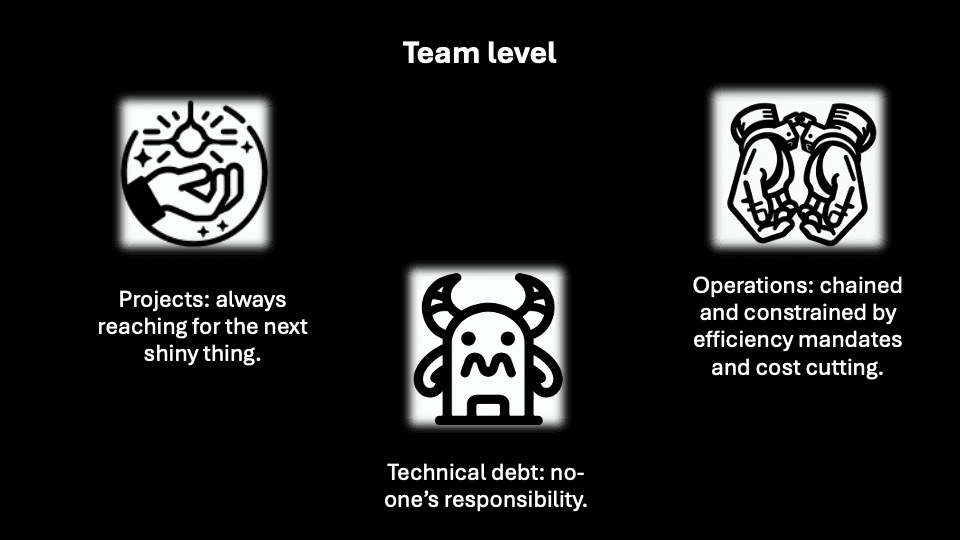
How would you frame a major refactoring proposal using product strategy?
Reframing tech debt as delivery risk, not engineering chore. Tie refactoring to velocity loss and firefighting; shift accountability from dev-vs-ops fights to product ownership.

What fields belong in an experiment tracking event?
Tests disciplined schema thinking over random fields. Strong answers cite a tracking plan with event and user properties, environment separation, and consistency. Red flag: dumping data without a schema or single source of truth.

How do you diagnose why a new feature's adoption is flat?
Tests structured analytics thinking across the adoption funnel. A strong answer maps discovery to habituation, segments cohorts, pairs behavior with feedback, and validates via experiments. Red flag: blaming UI without proving users know the feature exists.
How would you apply Agile simplicity when implementing a new feature?
Validate the smallest user-problem slice; defer gold-plating and custom abstractions; prefer existing tools.
We are hiring for this. Every open role lists the topics its interview covers, so you can prepare for the real thing rather than guessing.
See open roles