Interview questions in Product Management, page 29
Sprint velocity is highly variable. What technical root causes do you check?
Check scope stability via carryover, flow via cycle time, quality via rework, and estimation via point variance.

How do you technically implement an A/B test for onboarding flows?
Tests experiment pipeline design: deterministic user bucketing, an exposure event before rendering, and an event schema linking actions to variant_id. Red flag: re-randomizing per session or skipping exposure logs.

Walk me through a magic link login system and its security considerations
Tests auth architecture and threat modeling for passwordless flows. Strong answers map request-token-email-verify-session, then harden with short expiry, single-use tokens, rate limits, and device binding.

Describe two methods for generating prediction intervals or probabilistic forecasts
Tests uncertainty quantification for risk-adjusted decisions. Strong answers: (1) parametric intervals via forecast error variance and normal multipliers, (2) bootstrap residual resampling for empirical percentiles.
Describe two methods for generating prediction intervals
This tests your grasp of uncertainty quantification. A great answer contrasts an analytical method (assuming normal errors, using multipliers like 1.96 for 95%) with a simulation method (bootstrapping residuals).
Investigating Variable Sprint Velocity: Technical Root Causes
This tests your ability to diagnose team issues with data, not anecdotes. Propose technical hypotheses like flaky tests or merge conflicts and link them to metrics like CI/CD failure rates or PR cycle time. A red flag is blaming individuals or poor estimation.
Describe two methods for generating prediction intervals
This tests your understanding of forecast uncertainty. Describe two methods: 1) assuming normally distributed errors and using a standard deviation multiplier, and 2) bootstrapping residuals to simulate future paths.
Investigating Variable Sprint Velocity
This tests your ability to diagnose issues by connecting process metrics to technical health. A great answer hypothesizes technical causes (e.g., tech debt, flaky tests), identifies specific data for validation (e.g., cycle time, build logs), and avoids…
.avif&w=1600&q=75)
What pre-launch tools prevent support ticket escalations to engineering?
Tests proactive operational design versus reactive firefighting. Great answers include real-time health dashboards, automated ticket triage with user context, self-service runbooks, and escalation guardrails with pre-populated logs.

Design a multivariate experimentation platform with collision-free concurrent bucketing and cross-device consistency
Tests orthogonal layers and cross-session assignment persistence. Cover: deterministic hashing per layer, a user profile service for sticky bucketing, and stable ID resolution across devices. Red flag: random bucketing or local storage breaking consistency.
What event and data payload track Add to Cart actions?
This tests GA4 ecommerce schema design. Fire add_to_cart with items array containing item_id, price, currency, quantity; include user_id, user_segment, session_id, and timestamp. Red flag: generic button_click with DOM selectors instead of semantic data.
What does a widening CFD Code Review band indicate?
Tests CFD literacy: a widening Code Review band shows WIP accumulation and a bottleneck. Great answers cite WIP limits, swarming, and policy fixes before hiring. Red flag: mistaking inventory growth for increased throughput.
Describe the client-side event for an 'Add to Cart' button
Tests your knowledge of standard analytics schemas (like GA4) and designing payloads for business analysis. A great answer names the 'add_to_cart' event, details the 'items' array with product data, and mentions user/session context.
Diagnosing a Widening Code Review Band in a CFD
This tests data interpretation and problem-solving. A great answer defines the bottleneck, hypothesizes causes (capacity, PR size), proposes diagnostics, then offers solutions. A red flag is blaming individuals or jumping to a single, unverified solution.
Describe the client-side event for an 'Add to Cart' button
This tests your ability to design analytics events for future analysis. Name a standard event like add_to_cart and list item parameters (item_id, price, quantity).
CFD 'Code Review' band is widening. What does it mean?
This tests your ability to interpret a CFD and propose actions. A widening 'Code Review' band means work enters faster than it leaves. Diagnose the bottleneck (e.g., review quality, reviewer availability), then propose solutions.
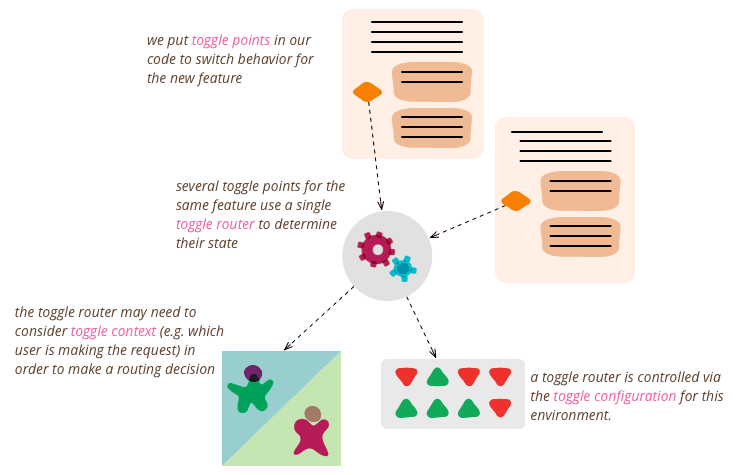
Describe an architecture that decouples business launch from code deployment
This tests feature-flag architecture separating deployment from release. Strong answers cover toggle categories and decision decoupling. They need lifecycle management to limit carrying cost. Red flag: treating flags as permanent or ignoring toggle debt.

Architect real-time usage-based billing for a PLG company
This tests event-driven metering, idempotent aggregation, and pricing decoupling at scale. A strong answer outlines real-time ingestion, stream processing for micro-events, a rules-based pricing engine, and dashboards with reconciliation.
How would you design UTM capture and attribution persistence?
Capture UTMs on landing, store in a first-party cookie with TTL, attach to events, and persist on conversion.
How would you apply Little's Law to optimize Kanban WIP limits?
Tests whether you can operationalize queueing theory in Kanban. A strong answer cites L equals lambda times W, fixes throughput, then solves for a WIP limit that yields a target cycle time.
We are hiring for this. Every open role lists the topics its interview covers, so you can prepare for the real thing rather than guessing.
See open roles