Intermediate everything in Product Management, page 9
Minto Pyramid Principle: Answer First
Start with the answer, then stack the proof beneath it. Use it when executives will cut you off if you don't reach the point in 30 seconds. The footgun is messy buckets: overlapping supporting arguments collapse the pyramid and make correct answers look…
The Platform Chicken-and-Egg Trap
A platform is worthless until both sides show up, yet neither arrives first without the other. Marketplaces and payment networks face this coordination trap. Growing both sides at once starves the platform because neither reaches critical mass.
Three Horizons: Core, Growth, Future
Three Horizons splits energy across core defense, scaling winners, future bets at once. Use it when your roadmap is only incremental tweaks with no long-term bets. The footgun is seeing horizons as sequential stages, not parallel portfolios needing fuel today.
Sales-Led Growth: High-Touch Revenue Motion
Sales-led growth uses human reps as the primary engine, not self-serve signup. It fits complex, high-price products with procurement hurdles. The footgun is hiring sellers before repeatable messaging exists, burning cash on custom pitches that never scale.
Now-Next-Later Roadmaps: Commitment Over Calendar Dates
Now-Next-Later buckets work by commitment, not dates, keeping priorities visible without false precision. Use it when teams need alignment more than Gantt charts. The fatal mistake is letting stakeholders map buckets to quarters, recreating the deadline trap.
Vision Storytelling: Turn Roadmaps Into Shared Futures
Vision storytelling makes strategy tangible by narrating the future your team is building. Use it when roadmaps explain what but not why. The footgun is confusing slogans for stories; without a user, conflict, and resolution, you get branding, not alignment.
Product Vision: The User's Future, Not Yours
A product vision is a shared picture of the future your product creates for users, not a feature list. It aligns distributed teams when data is ambiguous. Teams often mistake it for a mission statement or roadmap, producing vague slogans, not a useful filter.

MRR and ARR: Two Lenses on Recurring Revenue
MRR and ARR are two lenses on recurring revenue. MRR tracks short-term movement and immediate performance while ARR shows long-term scale. SaaS companies need both to guide present tactics and future strategy.
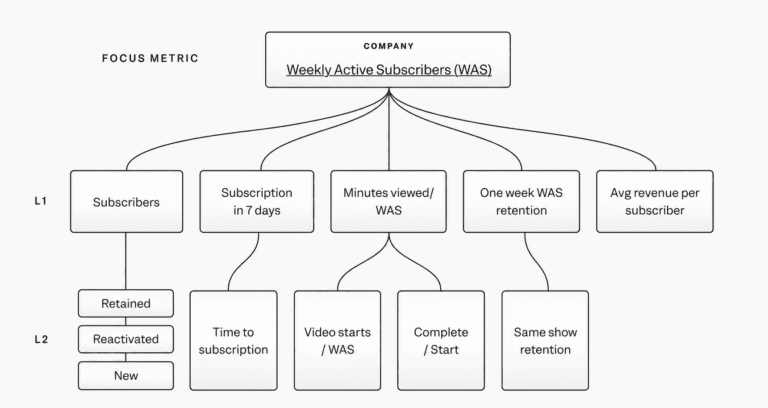
KPI Tree: Linking Product Changes to Business Outcomes
A KPI tree traces how changes ladder up to outcomes, giving metrics connective tissue. Build one when dashboards and experiments conflict and you need a defensible line from features to impact. Let it stay static and it becomes disconnected.

Explain the difference between statistical and practical significance
Define statistical vs practical significance; note large samples make tiny effects significant; give a real example.

Build a system to measure viral coefficient and attribute invites to signups
Tests if you can map K=i×c to logged events and resilient pipeline. Good answers define invite_sent, click, signup events with referral tokens; sketch stream joins; and flag cross-device and organic attribution gaps. Red flag: assuming perfect attribution.

Design a referral system: data models, APIs, attribution, self-referral prevention
Tests data modeling with fraud guardrails and idempotent rewards. Cover: Users with nullable referred_by, ReferralEvents state table, async ledger attribution, and device-fingerprint self-referral blocks. Red flag: bare integer credit with no audit trail.
Describe cluster or switchback randomization for network-effect A/B tests.
Tests SUTVA violation, cluster-switchback tradeoffs. Outline: cluster (geo, teams) or switchback (time slices) isolation; cover pipeline changes, 10x inflation, and correlated error. Red flag: user-level randomization with post-hoc fixes or ignoring spillover.

How do you prevent concurrent onboarding and navigation experiments from polluting results?
This tests experiment isolation via layer-based traffic allocation. A strong answer covers hashing users into independent layers with one variant per layer, and assigning each experiment to a distinct layer.

How do you systematically manage and pay down experiment debt?
Tests sustainable velocity through experiment lifecycle hygiene. Strong answers cover isolated experiment directories, TTLs on feature flags, and recurring cleanup sprints. Red flag: banning experiments or treating all experiment code as permanent.

What experiment artifacts and metrics do you present to decide shipping?
This tests structured experiment discipline. A strong answer covers the pre-approved design doc, scorecard results for primary goal and guardrail metrics plus secondary breakdowns versus the hypothesis, and duration context.
Compare PostgreSQL versus a columnar warehouse for raw event data
Contrast row vs column storage, compression, and scan speed; note Postgres suits OLTP and point lookups while columnar stores excel at aggregations.
Should we build or buy an A/B testing platform?
This tests build-vs-buy judgment for experimentation infrastructure. Strong answers cover build for warehouse metrics and cache control; buy for proven stats and front-end speed. Red flag: answering with cost alone or assuming in-house is always superior.

Design an assignment service for an experimentation platform
This tests deterministic hashing and independence in randomization. A strong answer lists user ID, experiment salt, and allocations; uses salted hash for consistency; and warns that separate exposure and bucket hashes with mod can cause sample ratio mismatch.

How would you incorporate external events into a time-series forecast?
This tests exogenous regressor design. A strong answer proposes binary or continuous regressors for holidays and campaigns in Prophet or ARIMA, then validates lift via backtesting. A red flag is dropping outlier days or applying post-hoc manual adjustments.
We are hiring for this. Every open role lists the topics its interview covers, so you can prepare for the real thing rather than guessing.
See open roles