Advanced everything in UX Research
Phased research strategy to de-risk market entry
Foundational market and behavior research, then localized usability and infrastructure validation, then iterative post-launch measurement, each feeding l10n, infra, and feature work.
Spec met but user problem unsolved: facilitating the fix
Frame requirements as the shared imperfect proxy, present evidence not opinions, and reframe as a joint discovery to refine.
NLP pipeline to theme and tag research transcripts
Chunk and embed transcripts, cluster or LLM-tag for themes, run sentiment with aspect awareness, and keep a human in the loop.
Data Visualization for Qualitative Data
Visualizing qualitative data turns coded themes, quotes, and patterns from interviews into affinity maps, theme matrices, and journey artifacts. It makes non-numeric findings scannable and persuasive without distorting nuance into false precision through…

Outline operational and cultural changes for proactive UX research in engineering
Embed UXRs in roadmapping, build shared repositories, reward insight-driven pivots, teach generative literacy.
Compare embedded vs centralized research models and propose a hybrid
Tests org trade-offs between squad autonomy and research consistency. Strong answers contrast embedded speed with centralized standards, then propose a hybrid of embedded generalists and centralized specialists.
Design a globally compliant, low-latency research backend architecture
Partition by region with local storage, ingest at the edge, aggregate anonymized metrics cross-border.

How does continuous discovery change the researcher's role with engineering?
Tests whether you view researchers as trio enablers rather than study owners. A strong answer covers shifting from running studies to coaching engineers on interviews and assumption testing via shadowing and paired sessions.
How do you use research to build a case for architectural investment?
Quantify churn, tie UX debt to revenue, propose phased rollout, anchor to strategy.
What metrics and models link onboarding to long-term retention?
Track activation-to-D90 metrics; use Cox/AFT or diff-in-diff; control censoring.

Explain statistical power and respond to extending a null A/B test
This tests statistical power and p-hacking judgment. A strong answer defines power as detecting a true effect, rejects extending the test to chase significance, and requires pre-registered sample sizes. Agreeing to run until it hits significance is a red flag.
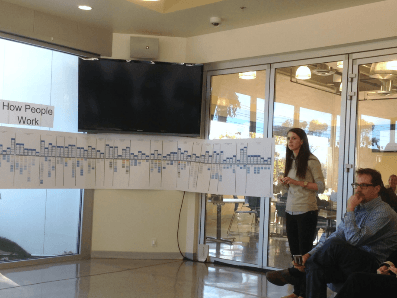
What analytical frameworks structure synthesis beyond thematic analysis?
Tests if you model problems structurally, not just code themes. Strong answers pair mental models to map user goals with JTBD to prioritize unmet needs by importance and satisfaction. Red flag: naming frameworks without explaining how they reshape synthesis.

How do you challenge assumptions and mitigate confirmation bias during synthesis?
Tests structural defenses against confirmation bias, not vague mindfulness. Strong answers name concrete protocols like hypothesis reversal, separate raw evidence from interpretation, and triangulate with logs.

How do you trace data points to journey map stages?
Tests auditable evidence chains for technical buy-in. Answer covers a traceability matrix linking quotes to stages and pain points, plus validation sessions where engineers inspect source data. Red flag: presenting the map as intuition without source docs.
Detect a three-action user sequence in real-time at scale
Tests stream processing and stateful pattern matching on unbounded data. A strong design uses a CEP engine with keyed event-time windows, pushes alerts via WebSocket, and trades state-memory for latency.

How do you architect an automated performance and accessibility testing pipeline?
This tests operationalizing quality gates via automation, not manual checks. A strong answer covers Lighthouse CI in CI/CD, fail thresholds for CWV and WCAG, and a triage workflow assigning regressions to owners.
How would you triage 50+ UX issues against new features in agile?
Matrix the 50 issues by severity and effort; reserve 15-20% sprint capacity for debt; socialize compound cost.

How do you adapt contextual inquiry for internal API and tool design?
This tests applying ethnographic methods to API design by observing engineers at work, surfacing invisible habits, and mapping findings to endpoint granularity and docs. A red flag is treating internal users as unlike external customers or using only surveys.
What lightweight generative research reveals why users drop off a funnel?
Tests bridging analytics to qualitative insight fast. Outline: run 5-8 micro-interviews at the exact drop-off step; probe confidence and expectations; map findings to technical fixes.

Advocate for generative research over a complex feature request?
Tests mapping research methods to product risk. Strong answers reframe the feature as an unvalidated problem, cite qualitative behavioral methods like field studies, and translate unknowns into scope and opportunity cost.
We are hiring for this. Every open role lists the topics its interview covers, so you can prepare for the real thing rather than guessing.
See open roles