Advanced everything in Agile & Scrum, page 4
How to handle a PO defining the technical implementation?
This tests your understanding of Scrum roles and ability to influence stakeholders. A great answer seeks to understand the PO's "why," presents alternatives with data, and reinforces shared goals and responsibilities. A red flag is being confrontational.
Scrum Empiricism: Retro and Definition of Done
This tests your grasp of Scrum theory beyond mechanics. A great answer links the Definition of Done to transparency, the Retrospective to inspection, and the Retro's output to adaptation. A red flag is confusing the Sprint Review with the Retrospective.
How does the Sprint container enable empiricism and protect developers?
This tests your grasp of the Sprint's structural role in Scrum. A good answer defines the Sprint as a fixed-length container for all events, explains how this cadence enables empiricism, and how the Sprint Goal protects developers.

How would you implement an Andon Cord for a software team?
Tests your grasp of CI/CD, quality, and team culture. A great answer defines a trigger (broken main build), a technical block (stop merges), and a cultural response (team swarms). A red flag is scheduling the fix or blaming an individual.

How would you identify and elevate a team's primary constraint?
This tests your systems thinking beyond local optimization. A great answer follows the 5 Focusing Steps: Identify, Exploit, Subordinate, Elevate, Repeat. A red flag is jumping to 'hire more people' before exploiting the existing constraint and subordinating…
AI Turns Specs Into a Programming Language
Spec-Driven Development (SDD) reframes specs as a higher-level programming language for AI agents, not just pre-coding docs. This shifts engineering work from implementation details to defining intent and constraints.
Use AI to Fix Your OKRs, Not Write Them
Use AI to refine your OKRs by creating a custom 'coach' prompt based on expert advice. This avoids leaking company strategy to public LLMs and makes even secure, weaker enterprise models useful for strategic alignment.
Scrum.org's 8-Step Plan for AI-Native Teams
Scrum.org has outlined an 8-step framework to guide teams in becoming 'AI-native.' This structured approach aims to embed AI into all aspects of Scrum, shifting focus from production to evaluation and from 'Definition of Done' to 'Definition of Value'.

Make Agile Planning a Shared Problem
Chaotic sprints and messy backlogs often result from planning being treated as a solo task. This siloed approach leads to overcommitment and erodes stakeholder trust, making agile feel unreliable.

Mountain Goat Software Ends Public Agile, Scrum Classes
Mountain Goat Software is ending its public Agile/Scrum courses to focus on private team training. This removes a key option for individual certification, forcing engineers to find alternatives or convince managers to book a more costly private session for…
Basecamp 5 Overhauls UI, Debuts New Rails Editor
Basecamp 5 ships a new "Lexxy" editor with tables and markdown, a permanent sidebar, and full keyboard navigation. The editor, built on Meta's Lexical, will become the default for Action Text in Rails, making this a preview for Rails developers.
DHH Slams 'Luddite' AI Bans in Open Source
Open source projects like Zig and NetBSD are banning AI-assisted code. DHH calls this a 'modern Luddite movement' that betrays the core OSS mission of democratizing software, arguing it's about protecting status, not ensuring quality.
DHH: Rails & Kamal Came From Solving 'Interesting Problems'
DHH credits 37signals' success for the freedom to solve 'interesting problems,' which led to Ruby on Rails and Kamal. This founder-led R&D model shows how personal motivation can create strategic tools, bypassing committee-driven roadmaps for high-leverage…
Jira's Rovo AI Aims to Deflect 60% of Tickets
Atlassian's Rovo agents in Jira Service Management aim to deflect up to 60% of repetitive service tickets. The agents intercept requests in Slack or the help portal, providing instant answers from your docs, freeing up support staff for complex engineering…
Study: Disclosing AI use makes you seem 10x lazier
A study of ~1,000 workers found disclosing AI use makes you seem 10x lazier. Even with identical output, peers were 24% less likely to recommend you for key projects. While 94% use AI, the stigma means silence is often the safest career strategy.
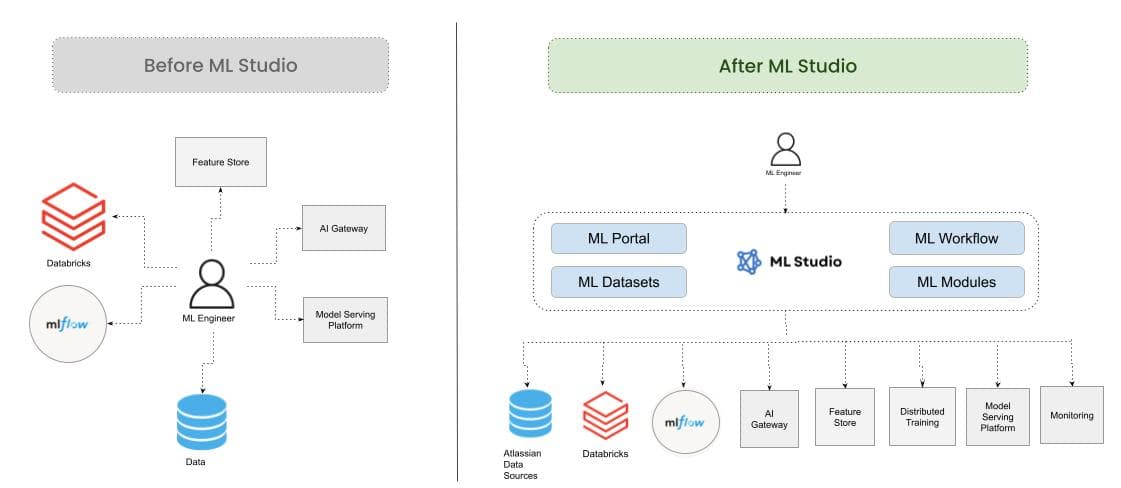
Atlassian Details its ML Studio Platform Design
Atlassian's ML Studio platform powers thousands of daily workflows for millions of Rovo users. It solves enterprise scaling issues with reusable modules, column-level data governance, and unified orchestration, offering a blueprint for building compliant…
Trade-offs: Product-Oriented vs. Project-Oriented Teams
This tests your understanding of how team structure and funding models impact long-term software quality. A great answer contrasts temporary, scope-funded project teams with durable, problem-funded product teams, highlighting the latter's benefits for…
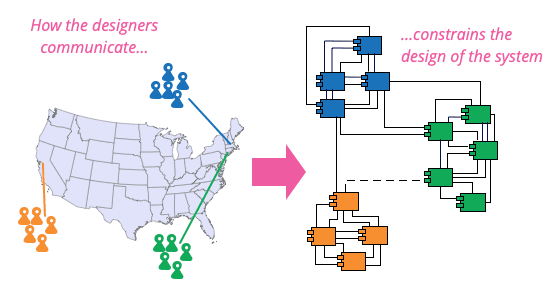
How to apply Conway's Law to design team structures?
Tests if you can use Conway's Law proactively (the 'Inverse Conway Maneuver'). Outline: define the target architecture, then align small, autonomous teams to its components. A red flag is seeing the law only as a constraint, not a tool for intentional design.
How to manage performance reviews in self-organizing agile teams?
This tests your servant leadership mindset. Reframe "performance management" as "career development," use frequent 1-on-1s for coaching and obstacle removal, and separate compensation from feedback. Red flag: focusing on individual metrics or stack ranking.

Decomposing a monolith for scaled agile teams
Tests your grasp of domain-driven design and data consistency in a microservice migration. A good answer identifies bounded contexts, defines versioned APIs, and uses event-based patterns for data.
We are hiring for this. Every open role lists the topics its interview covers, so you can prepare for the real thing rather than guessing.
See open roles