Advanced concepts in AI & ML, page 2
Laplacian of Gaussian (LoG) for Blob Detection
LoG finds blobs by blurring an image then finding points of maximum curvature, like finding the top of a hill by looking where the slope changes fastest. It's used in medical imaging and astronomy. The footgun: the blur size dictates the blob size you can.
LLM Scaling Laws: Match Parameters to Tokens
For a fixed compute budget, model size and training data must grow equally. When choosing between a larger model or more tokens for the same FLOPs, more data usually wins. The footgun is scaling parameters alone, which undertrains the model and wastes compute.
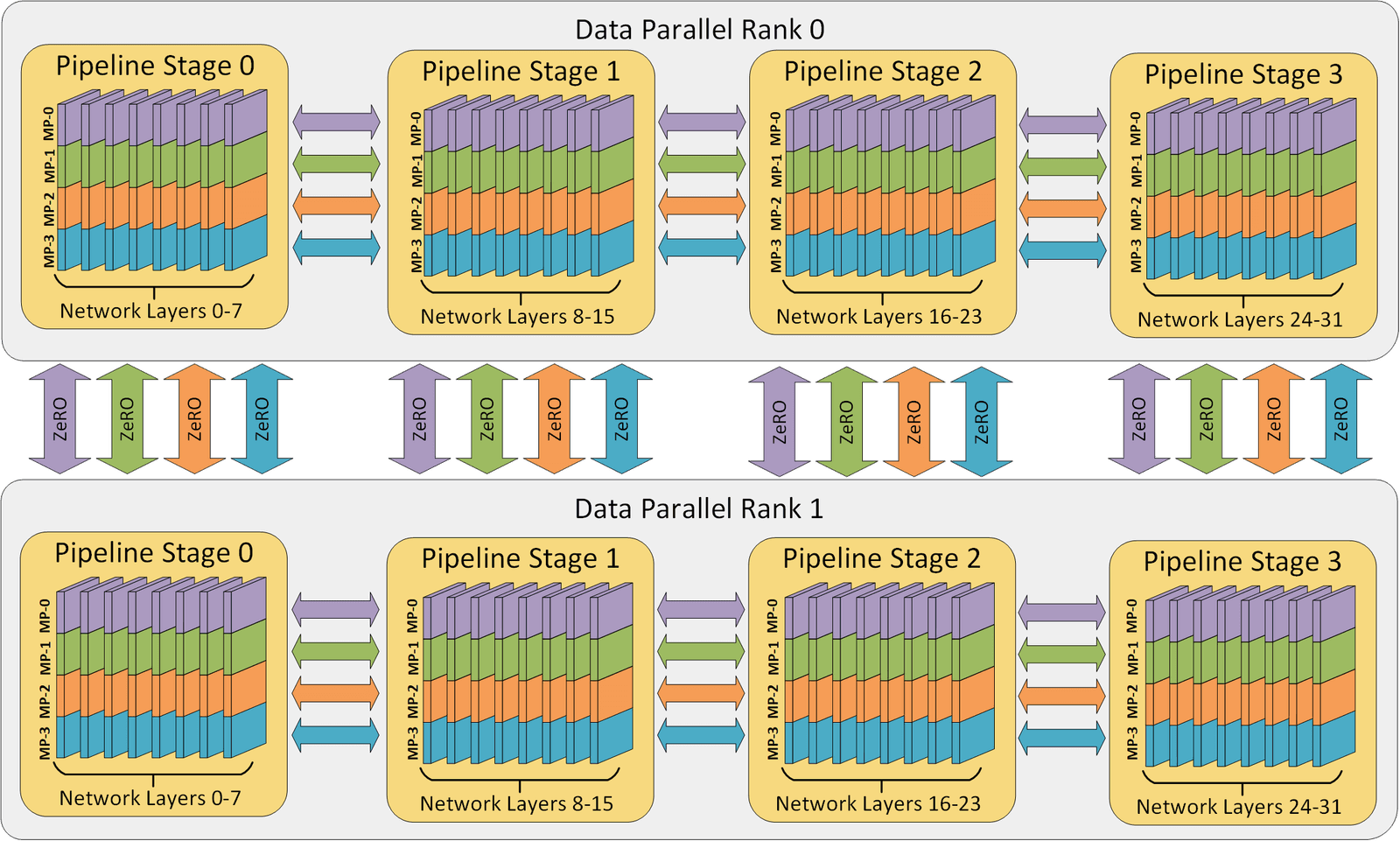
Pipeline Parallelism: An Assembly Line for Your Model
Think of training a huge model like an assembly line. Pipeline parallelism splits a model's layers into stages across multiple GPUs, allowing you to train models too large for one device.

Tensor Parallelism: Split Layers, Not Just Models
Tensor Parallelism splits a single large model layer, like a weight matrix, across multiple GPUs to run in parallel. This is crucial for inference with models whose layers exceed a single GPU's VRAM.
Point-in-Time Correctness: Avoiding Data Leakage in ML
A point-in-time correct join is a time-traveling lookup for ML features, grabbing the most recent values known *at the time of an event*. It's vital when building training data from feature tables that update at different rates to prevent data leakage.

Feature Governance: Taming Your ML Inputs
Feature governance treats ML inputs like code, enforcing consistency from training to production. It's a central system of record for what data your models see. This prevents training-serving skew.
Entity Embeddings: Smart Maps for Categorical Data
Entity embeddings turn categorical data like user IDs into dense vectors, creating a "map" where similar items are neighbors. This is used in neural networks to handle high-cardinality features efficiently, avoiding the memory bloat of one-hot encoding.
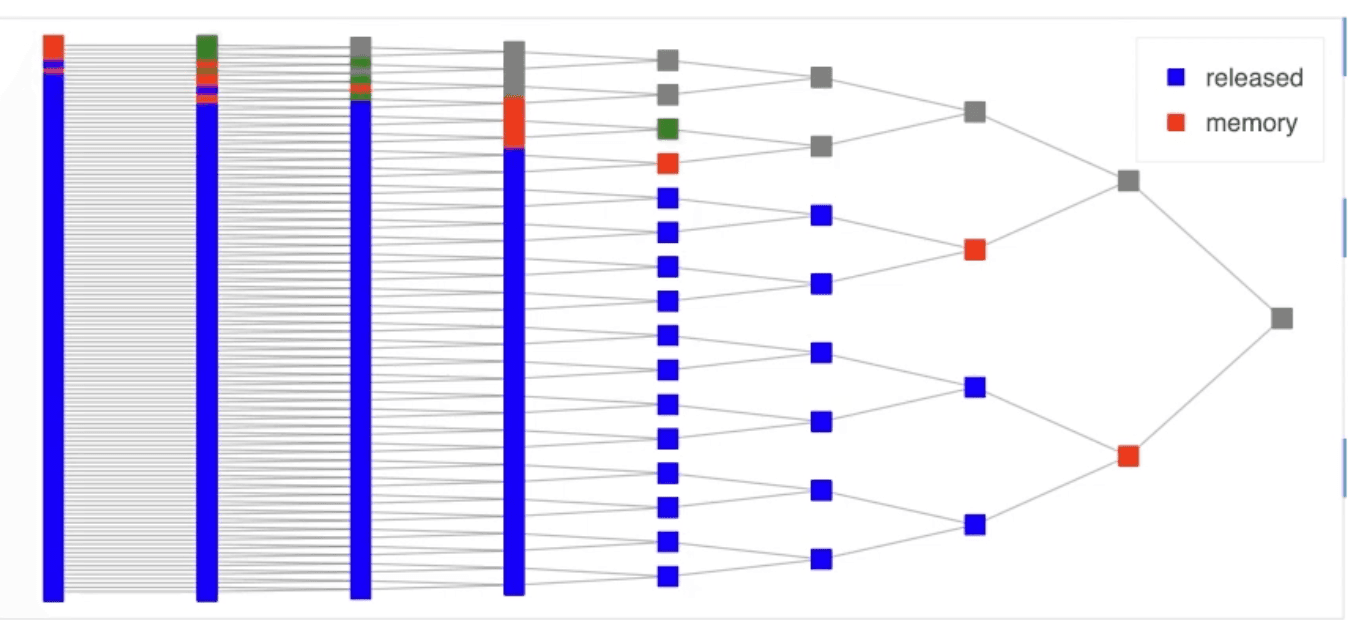
Dask: Parallel Computing with Familiar APIs
Dask parallelizes Python analytics by breaking data into chunks and building a task graph of operations. It's like giving Pandas and NumPy superpowers for data too big for RAM. The footgun: its lazy evaluation means you must explicitly call .compute().
SURF: A Faster, Patented Alternative to SIFT
SURF is a faster, more robust alternative to SIFT for finding key points in an image. It's used for real-time object recognition or stitching images where SIFT is too slow. Beware: its core algorithms are patented, limiting commercial use without a license.

R & Python Interoperability with Reticulate
Reticulate embeds a Python session inside R, letting you use Python libraries as if they were native R objects. Use it when a team uses both languages or you need a Python library in an R workflow.
ORB: Fast, Free Feature Detection for Computer Vision
ORB combines the speedy FAST keypoint detector with a rotation-aware BRIEF descriptor. It offers a fast, royalty-free alternative to SIFT for finding and describing unique points in an image, even when the object is rotated.
Local Binary Patterns (LBP) for Texture Classification
LBP is a 'visual descriptor' that summarizes an image's texture into a feature set for a machine to read. It's a powerful tool for texture classification, but its performance often improves significantly when combined with other descriptors like HOG.
FLANN Matcher for Feature Correspondence
OpenCV's FLANN matcher pairs query and train descriptors to find cross-image feature correspondences as an alternative to Brute-Force. Engineers often assume FLANN shares Brute-Force's normType and crossCheck parameters, causing silent configuration errors…
Least-to-Most Prompting: Solving Hard Problems Incrementally
Least-to-most prompting guides an LLM by breaking a hard problem into a sequence of simpler steps. It excels at complex math or logic where chain-of-thought fails, solving each subproblem using the answer to the previous one.
Model Lineage: The Git History for Your AI
Think of model lineage as the git log for your AI, tracking every input from data to code that created it. It's essential for reproducing models, debugging failures, and satisfying regulatory audits.
Self-Consistency: Majority Rules for LLM Reasoning
Self-consistency makes an LLM solve a problem multiple ways, then picks the most common answer. It's like asking a committee of experts for their reasoning and taking a vote. This boosts accuracy on complex math and logic puzzles.
PMML: The 'Save File' for Machine Learning Models
PMML is like a universal "save file" for ML models, using XML to describe everything needed for prediction: features, preprocessing, and model structure. It enables training in Python and deploying in Java. The footgun: verbose files and partial tool support.
Tree of Thoughts: LLM Reasoning Beyond a Single Path
Tree of Thoughts (ToT) lets an LLM explore multiple reasoning paths at once, like a human brainstorming. It generates several 'thoughts' and pursues the most promising ones. This is crucial for planning tasks where one wrong turn fails.

ReAct: Teaching LLMs to Think, Act, and Observe
ReAct teaches an LLM to solve problems by interleaving thought, action, and observation. This is key for agents that search the web or query APIs to answer questions with external data.
Multi-stage Docker Builds: Lean Images, Fast Deploys
Build your app in one container stage and run it in another, separate one. This keeps your final Docker image lean by shipping only the compiled artifact, not the entire build environment, compilers, and source code.
We are hiring for this. Every open role lists the topics its interview covers, so you can prepare for the real thing rather than guessing.
See open roles