Intermediate concepts in Computer Vision
Camera Resectioning: Finding a Camera's Pose in 3D Space
Camera resectioning is like a detective's trick: use a photo of known objects to find the exact 3D position and orientation of the camera. It's key for AR and robotics. The footgun is assuming this finds all camera flaws; it only finds pose, not lens.
Lens Distortion: Why Straight Lines Curve in Photos
Lens distortion makes straight lines appear curved in an image, a result of imperfect lens geometry. It's critical to correct in computer vision for tasks like 3D reconstruction, but is often ignored in regular photography.

HSL and HSV: Intuitive Ways to Represent RGB Color
HSL and HSV are not new colors, but new ways to organize RGB. Think of them as cylindrical coordinates for color, making it easier for humans to select shades. You see them in every color picker.
Color Depth: Bits Per Pixel vs. Bits Per Channel
Color depth is the number of bits storing a pixel's color, like a digital paint box's size. It's key for image formats and displays, affecting file size and fidelity. The footgun is confusing total bits per pixel (bpp) with bits per channel (bpc).
CIELAB Color Space: Measuring Color Beyond RGB
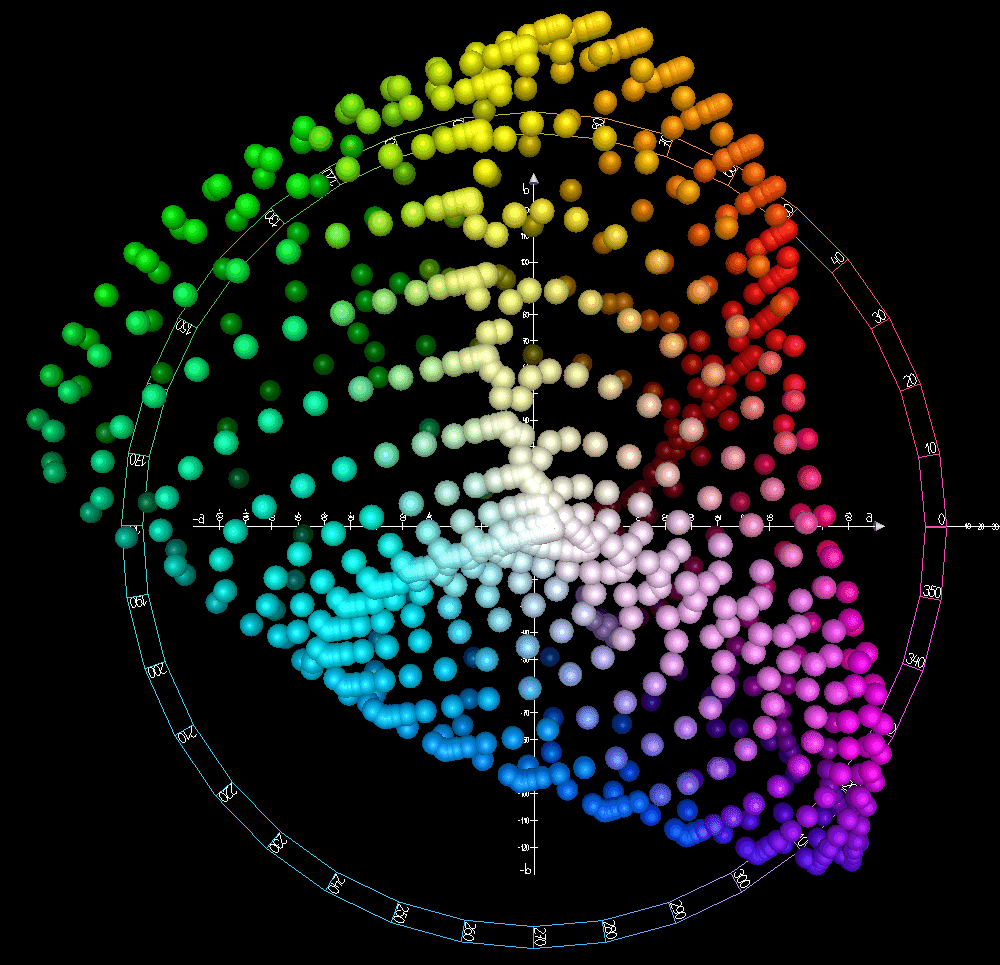
CIELAB models color not by how a screen displays it (like RGB), but by how a human perceives it: lightness, red/green, and yellow/blue. It's used in industry to measure and match colors precisely. The footgun is assuming it's perfectly 'perceptually uniform'.

Gaussian Blur: Smoothing Images with Weighted Averages
Gaussian blur smooths an image by replacing each pixel with a weighted average of its neighbors, where closer pixels matter more. It's used to reduce noise before edge detection or for UI effects. The footgun is over-blurring, which erases important features.
Median Filter: Smoothing Images Without Blurring Edges
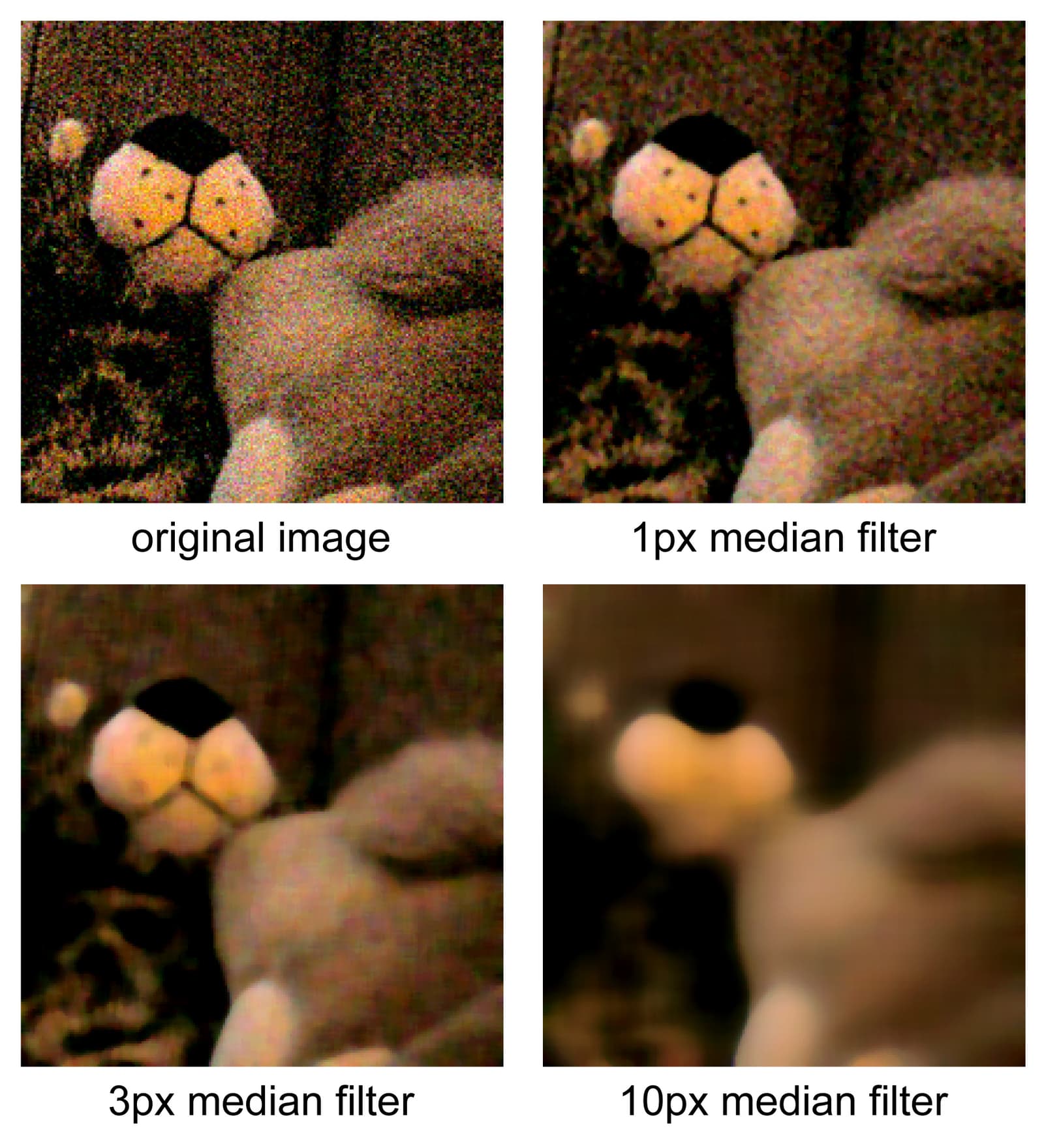
A median filter cleans image noise by replacing each pixel with the median value of its neighbors, ignoring outliers. It's used to remove "salt-and-pepper" noise before object detection.
The Sobel Operator: Fast, Cheap Edge Detection
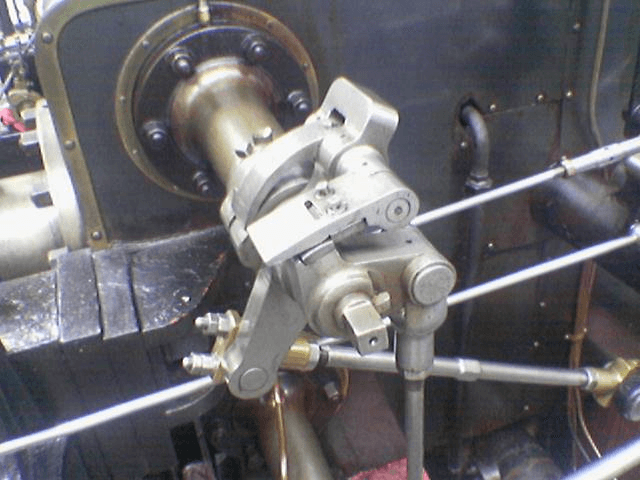
The Sobel operator finds image edges by measuring how fast pixel brightness changes horizontally and vertically. It's a fast, cheap first pass for edge detection in computer vision. The footgun is treating it as precise; it's a crude approximation.
Morphological Transformations: Shaping Images with Kernels
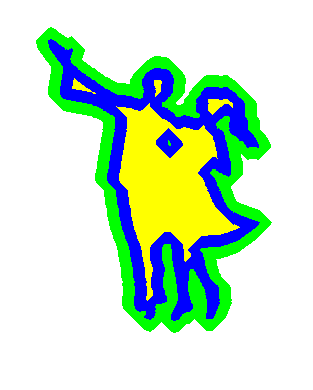
Think of it as sanding or stamping an image with a small shape (kernel) to modify object boundaries. It's used for noise removal or separating touching objects. The footgun: transformations alter object size, so you often need a second operation to compensate.
Scale-Space: Analyzing Images at Multiple Scales
Scale-space representation is like viewing an image from far away and up close simultaneously. It creates a stack of progressively blurred images to reveal structures at different sizes, which is key for robust feature detection.
Difference of Gaussians: Finding Edges by Subtracting Blurs
Difference of Gaussians (DoG) finds features by subtracting a heavily blurred image from a lightly blurred one, isolating details at a specific scale. It's used for fast blob and edge detection.
FAST: High-Speed Corner Detection for Real-Time Vision
FAST finds corners by checking if a pixel is significantly brighter or darker than a ring of its neighbors. This simple, high-speed test makes it perfect for real-time video processing.
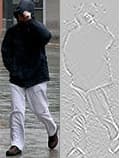
Histogram of Oriented Gradients (HOG)
HOG describes an object's shape by summarizing the directions of local intensity changes (gradients). It's a classic computer vision method for tasks like pedestrian detection where form matters more than color.
SIFT: Finding Image Features That Scale
SIFT finds key points in an image that are stable across changes in scale. It's used for object recognition or stitching panoramas by matching these features between images. The main footgun is assuming it's invariant to all changes, not just scale.
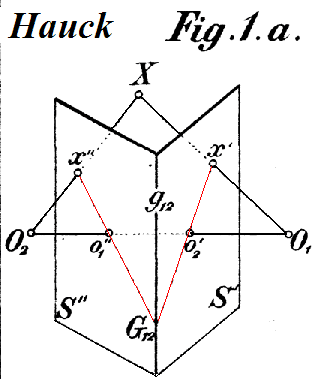
Homography: Mapping Flat Surfaces Between Images
A homography is a 3x3 matrix that maps points between two images of a flat surface. It's used for panorama stitching and perspective correction. The footgun: it only works for planes or pure camera rotation, failing on scenes with depth.
The Fundamental Matrix: Constraining 3D Search to a Line
The Fundamental Matrix reduces a 2D search for a point in a second image to a 1D search along a line. It's the geometric glue linking two uncalibrated camera views of the same scene, crucial for stereo vision and 3D reconstruction.
The Essential Matrix: Geometry for Stereo Vision
The Essential Matrix is a geometric bridge between two photos of the same scene, encoding the camera's relative motion. It's used in 3D reconstruction to find corresponding points; it tells you where a point from one image must lie in the other.
Triangulation: Finding 3D Points from 2D Images
Like your two eyes judging distance, triangulation finds a point's 3D location by seeing it from two different 2D camera views. It's key for 3D reconstruction and robotics.
Structure from Motion (SfM): Rebuilding 3D from 2D Photos
Structure from Motion (SfM) reconstructs a 3D scene from 2D images taken from different viewpoints, much like your brain perceives depth. It's used for creating 3D maps from drone footage. The main footgun is its failure on textureless or reflective surfaces.

ReLU: The 'On/Off' Switch for Neural Networks
ReLU acts as a simple on/off switch for neurons: positive inputs pass through, negative ones become zero. It's the default activation in deep learning, especially for vision tasks, as it's fast and helps gradients flow. The footgun: neurons can "die".
We are hiring for this. Every open role lists the topics its interview covers, so you can prepare for the real thing rather than guessing.
See open roles