Concepts in LLMs & Generative AI, page 3
Dense Passage Retrieval (DPR): Semantic Search for QA
DPR finds answers by meaning, not just keywords. It converts questions and documents into vectors and finds the closest matches, forming the core of Retrieval-Augmented Generation (RAG).

Hybrid Search: Combining Keyword and Vector Search
Hybrid search combines keyword precision with vector search's conceptual understanding in one query. It excels at retrieving relevant documents for RAG by finding both exact matches (like names) and similar ideas.
Context Stuffing: Giving LLMs Short-Term Memory
Context stuffing adds external documents to an LLM's prompt, giving it temporary, task-specific knowledge. Use it for one-off questions on specific docs, but beware: it fails when documents exceed the model's context window limit, causing truncated data.
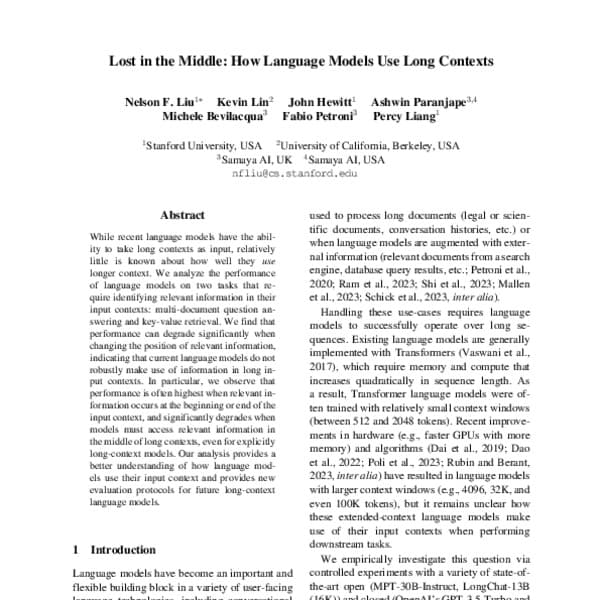
LLMs Get 'Lost in the Middle' of Long Contexts
LLMs struggle to find information buried in the middle of long prompts. Performance is highest when key facts are at the beginning or end of the context. This impacts multi-document QA and RAG.
Self-Querying Retriever: Let an LLM Write Its Own Filters
A self-querying retriever uses an LLM to turn a natural language question into a structured query with metadata filters. It lets users ask things like "Find documents about Python from before 2020," which a simple vector search can't do.
HyDE: Find Documents by Embedding a Fake Answer
Instead of embedding a short query, HyDE uses an LLM to generate a full, hypothetical answer document. This vector, representing an ideal answer, is then used to find similar real documents, improving zero-shot retrieval. The generated document is fictional.

Graph RAG: Answering Questions with Connected Facts
Graph RAG answers complex questions by exploring a map of connected facts (a knowledge graph) instead of just searching flat text. Use it for queries needing synthesis, like finding drugs for a disease made by companies in a specific country.
LLM Agents: Giving Models Tools and a Plan
An LLM agent can choose a tool, inspect its result, and decide what to do next. Retrieval supplies information; an agent may use it while carrying out a task. A separate planning or memory module is not mandatory.
Task Decomposition: Teaching LLMs to Plan
Task decomposition for an LLM agent is like writing a recipe: break a big goal into a checklist of small, executable steps. It's vital for complex requests like planning a trip, but a bad initial plan can cause cascading failures that doom the entire process.
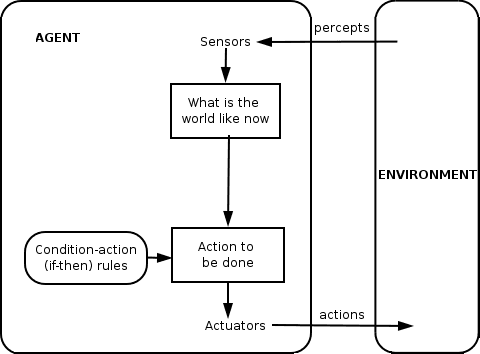
Multi-Agent Systems: A Team of AIs, Not a Monolith
Instead of one giant AI, a Multi-Agent System is a team of specialized AIs that collaborate on a complex problem. This appears in LLM-powered coding assistants and complex simulations.

Hierarchical AI Agents: The Org Chart for AI
Think of a corporate org chart for AI. A top-level agent breaks a big goal into smaller tasks and delegates them to specialized, lower-level agents. This is used for complex problems like automating software development. The main risk is coordination overhead.
Generative Inpainting: Filling in the Blanks with AI
Generative inpainting is like Photoshop's 'Content-Aware Fill' on steroids. It uses AI to reconstruct missing or unwanted parts of an image, perfect for removing objects or repairing old photos.

Text-to-Image Synthesis: From Prompt to Picture
Text-to-image models translate words into pixels by learning statistical links between text and images. They power creative tools like DALL-E but don't truly understand prompts, leading to errors in logic like counting or spatial arrangement.
Mode Collapse: When Your AI Gets Stuck in a Rut
Mode collapse is when a generative AI finds a “cheat” and produces the same few outputs over and over. This is a classic failure in GANs where the generator stops learning the full data distribution.
Fréchet Inception Distance (FID): Grading AI Art
FID grades AI-generated images by comparing their statistical "vibe" to real ones. It uses a pre-trained network (InceptionV3) to see if a batch of generated images has similar feature distributions to a real dataset. A lower score is better.
Latent Diffusion Models (LDM)
Latent diffusion models denoise in a compressed latent space instead of raw pixels. A pretrained autoencoder shrinks the image first and expands it back after, cutting compute enough to make text to image generation practical on consumer hardware.
Multimodal Models: Beyond Just Text
A multimodal model understands the world by connecting different data types, like images and text, instead of just one. It's how AI generates images from descriptions or answers questions about a photo. The footgun is assuming more data types always helps.
Speech-to-Text (ASR): Turning Spoken Words into Data
Speech-to-Text (ASR) is a digital stenographer, turning spoken language into machine-readable text. It's the engine behind voice assistants, automated call routing, and video captioning.
Joint Embedding Space: A Rosetta Stone for AI
A joint embedding space acts like a Rosetta Stone, mapping different data types—like images and text—to a shared coordinate system where similar concepts are close together. This powers text-to-image models and cross-modal search.
Multimodal Fusion: Combining Senses for AI
Multimodal fusion lets an AI combine data types like text, images, and audio into one understanding, much like a human brain. It's key for visual question answering or analyzing video sentiment.
We are hiring for this. Every open role lists the topics its interview covers, so you can prepare for the real thing rather than guessing.
See open roles