Easy everything in MLOps & Infrastructure, page 2

Difference between data and model parallelism, and when to prefer each
Tests split axis: data parallelism replicates model and shards data; model parallelism shards model across devices. Use data parallelism for throughput; model parallelism when layers exceed GPU memory.
How do you containerize a Python training script for GPU cloud VMs?
This tests reproducible GPU containerization. A strong answer uses an NVIDIA CUDA base image, installs Python dependencies at build time, copies the training script, and runs with --gpus.
How do you structure a Dockerfile to leverage layer caching for dependencies?
Tests Docker layer invalidation and cache-aware instruction ordering. Copy requirements.txt and run pip install before source code so deps cache independently. Red flag: copying everything at once or installing deps after code, busting cache every build.
Walk me through essential Dockerfile commands for a reproducible Python ML environment
Tests your ability to containerize Python ML scripts reproducibly. A strong answer covers FROM with a pinned slim image, WORKDIR, COPY for requirements and code, RUN pip install, and CMD or ENTRYPOINT.

Online vs offline feature store architecture and use cases
This tests latency trade-offs between real-time and batch infrastructure. Contrast fast online lookups against batch offline stores; fraud detection maps to online and model training to offline. Red flag: treating them as interchangeable and ignoring latency.

What problems does a Feature Store solve in ML systems?
Tests understanding of feature store value beyond storage. Great answers cover: feature reuse across teams, managed transformation pipelines, and online/offline consistency to prevent training-serving skew. Red flag: calling it simply a database or cache.
What data validation strategy prevents new categories from breaking your encoder?
Lock categorical domains in a schema, reject unseen categories before encoding, and use an OOV bucket as fallback.

ETL vs ELT: when to prefer each for ML?
Tests architecture tradeoffs. Contrast ETL's pre-load transformation with ELT's in-warehouse transformation, map structured legacy to ETL and raw lakes to ELT, and cite ML iteration needs. Red flag: calling one better ignoring compute placement or volume.

Design ingestion for clickstream and batch product metadata
Use a data lake for raw data, a feature store for joins, columnar formats for batch, and row formats for events.
What are the primary differences between traditional DevOps and MLOps?
Tests if you know MLOps extends CI/CD to data and probabilistic assets. Contrast code artifacts with models and datasets. Distinguish commit triggers from drift or retraining triggers. Red flag: treating models as static binaries and ignoring data lineage.
Describe the key stages of a typical ML lifecycle
It tests end-to-end systems thinking beyond notebook prototyping. Strong answers list: problem framing, data processing, model development, deployment, and monitoring with retraining. A red flag is skipping data validation or post-deployment observability.

ETL: Extract, Transform, Load
ETL moves data through three phases from sources to containers. It handles one or more inputs and outputs via software that automates the process on recurring schedules or in batches. The footgun is defaulting to manual runs when automation is typical.

Cloud Pricing: On-Demand, Reserved, and Spot Instances
Cloud pricing is like booking a flight. Pay full price for flexibility (On-Demand), get a discount for committing (Reserved), or bid on empty seats for a huge discount but risk getting bumped (Spot). This choice dictates your infrastructure cost.
Cloud Cost Allocation: Making Teams Own Their Spend
Cloud cost allocation answers "who pays for what?" by assigning every dollar of your cloud bill to a team or project. It uses metadata like tags and account structures to create showback reports.
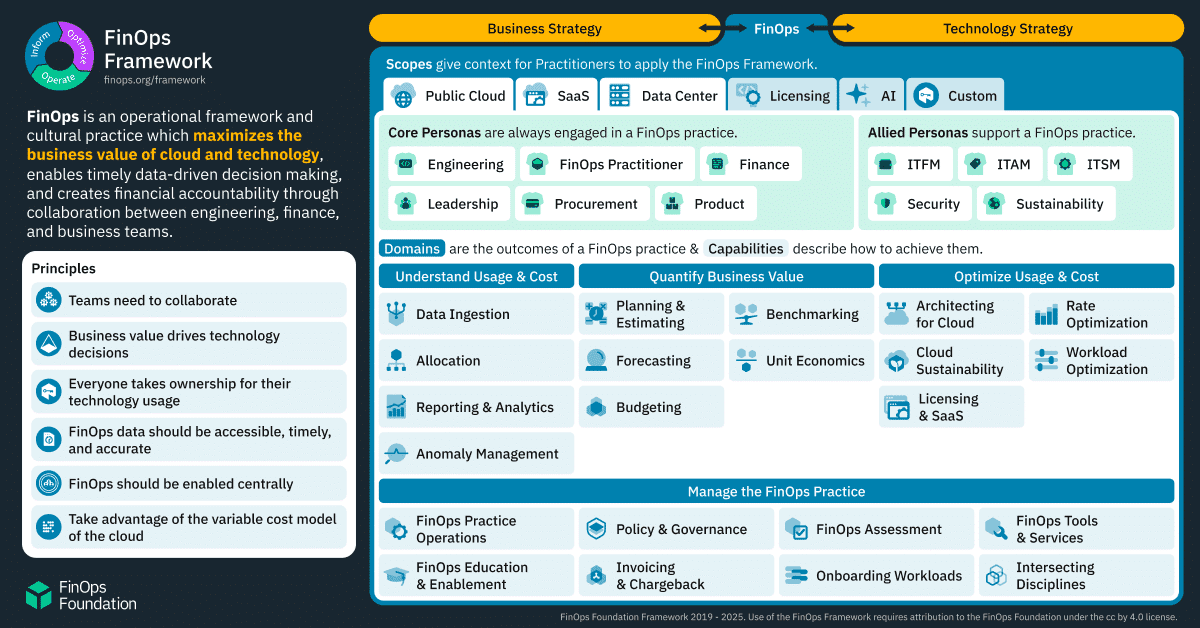
FinOps: Making Cloud Costs Everyone's Job
FinOps makes cloud cost a shared responsibility between engineering, finance, and business teams. It applies the variable, on-demand nature of the cloud to financial accountability.
Model Interpretability vs. Explainability
Interpretability means a human can grasp a model's logic (e.g., a simple decision tree). Explainability is stronger: it's about why the model made a *specific* choice. This is key for debugging or justifying high-stakes decisions.
RBAC for MLOps: Who Can Do What?
RBAC assigns permissions to roles, not people. You create roles like 'Data Scientist' with specific permissions (e.g., access training data), then assign users to that role.

Azure Machine Learning: A Service on Microsoft's Cloud
Microsoft Azure is a general-purpose cloud platform for building applications. It provides the global infrastructure and tooling support upon which specialized services, like Azure Machine Learning, are built.

MLaaS: Your Machine Learning Lab in the Cloud
Machine Learning as a Service (MLaaS) provides the key ingredients for ML—data, compute, and expertise—as a cloud service. This lets teams build models for forecasting or spam detection without buying expensive hardware.

PaaS: The Managed Platform for Building Applications
PaaS gives you a ready-to-use development environment, handling the OS and middleware so you can just code. It's used to accelerate app development for web, IoT, or ML. The main footgun is vendor lock-in, making future platform migrations difficult.
We are hiring for this. Every open role lists the topics its interview covers, so you can prepare for the real thing rather than guessing.
See open roles