Advanced interview questions in Product Management, page 9
How would you apply Little's Law to optimize Kanban WIP limits?
Tests whether you can operationalize queueing theory in Kanban. A strong answer cites L equals lambda times W, fixes throughput, then solves for a WIP limit that yields a target cycle time.
How would you apply Little's Law to a Kanban system?
This tests your ability to use metrics for process improvement. A great answer defines Little's Law for Kanban (Cycle Time = WIP / Throughput), explains how reducing WIP shortens cycle times, and gives a numerical example.
Apply Little's Law to a Kanban system to optimize flow
Tests applying queuing theory to software delivery. Define Little's Law as WIP = Throughput × Cycle Time. Explain how reducing WIP limits directly shortens cycle time for a stable throughput.

Architect a 14-day Pro trial with abuse prevention
Tests stateful billing lifecycle and anti-abuse tradeoffs. Strong answers cover: idempotent trial state machine with scheduled expiry; retention on downgrade; progressive friction via device intel and rate limits; and behavioral monitoring.

What data pipelines and infrastructure feed a viral user acquisition model?
Tests causal attribution architecture. Great answers cover invite instrumentation with identity resolution, streaming pipelines that split organic and viral signups, and feature stores for network-state features.
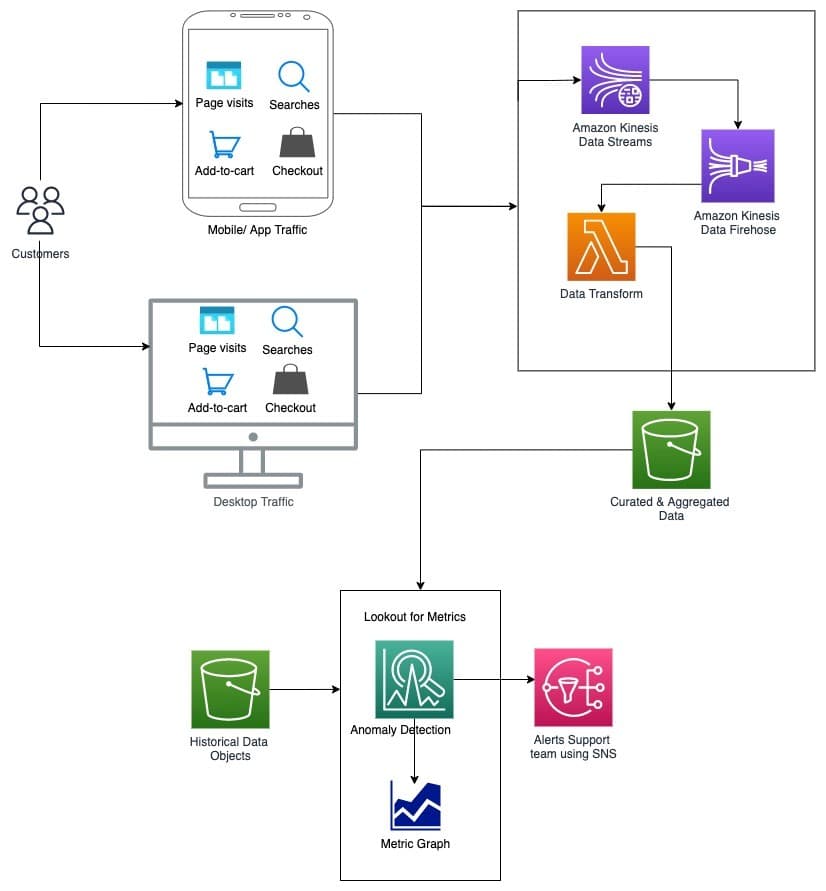
Design a system to detect sudden add-to-cart drops in real time
This tests streaming pipeline design and seasonality-aware anomaly detection. Outline Kafka or Kinesis ingestion, windowed aggregations, and ML baselines tuned to hourly and weekly trends. Red flag: static thresholds that ignore daily patterns.
Design a Real-Time Anomaly Detection System for E-commerce Events
This tests your ability to design a real-time data pipeline and apply ML to a business problem. Outline a streaming architecture (e.g., Kinesis), processing, and storage.
Design a real-time anomaly detection system for 'add to cart' events
Tests real-time data pipeline design and nuanced anomaly detection. A good answer outlines ingestion (Kinesis), processing (Lambda/Flink), seasonal modeling for 'a drop', and alerting (SNS).

Design an experiment and logging to link API latency to engagement
Causal inference and data integration. Randomly inject latency for a treatment group with a control at baseline, then join server trace IDs to client events via a shared request ID. Never confuse correlation with causation or miss join issues.
Correlate API Slowness with User Engagement
This tests your ability to design a controlled experiment and join disparate data. A good answer outlines an A/B test with an artificial delay, logging with shared IDs, and statistical analysis. A red flag is proposing a purely observational study.
Prove API Latency Affects User Engagement
This tests your ability to design a controlled experiment for a backend attribute. A great answer outlines an A/B test that artificially adds latency for a treatment group, details the necessary logging with shared IDs, and explains how to join and analyze…

What technical areas would you investigate in acquisition due diligence?
Tests strategic integration risk beyond code quality. Cover: architecture compatibility and tech debt; data model overlap and migration cost; security and compliance gaps; team retention; roadmap conflicts.
Describe a SAFe rule that hinders agility and how to mitigate it
Cite one rigid workflow pattern, show how it delays feedback, then propose a lighter cross-team substitute.
How would you handle a SAFe rule that hinders agility?
Tests your ability to pragmatically adapt process instead of just complaining. A great answer identifies a specific SAFe rule, explains how it can backfire, and proposes a concrete alternative that still achieves the original goal.
How can a SAFe rule hinder agility, and how would you mitigate it?
Tests your ability to pragmatically adapt process. First, name a specific SAFe rule and a scenario where it fails. Then, propose a mitigation that still achieves the rule's original goal, like alignment. A red flag is just complaining about bureaucracy.

Design a cross-product user journey data architecture
This tests portfolio-scale data platform design. A strong answer outlines streaming event ingestion, a unified identity graph, consent-aware PII vaults, and schema registries with data contracts.

Decompose a monolith for scaled agile teams
Tests aligning architecture to team boundaries during incremental monolith decomposition. Cover: bounded contexts with isolated data and sagas, backward-compatible versioned APIs, and replacing shared libraries with duplicated code or versioned SDKs.
Decomposing a Monolith: Technical Strategy
This tests your ability to create a practical, phased migration strategy from monolith to microservices. A strong answer defines service boundaries via Bounded Contexts, manages data with events, and uses an API Gateway for contracts.
Decomposing a monolith for scaled agile teams
Tests your grasp of domain-driven design and data consistency in a microservice migration. A good answer identifies bounded contexts, defines versioned APIs, and uses event-based patterns for data.

How would you adapt a growth model for network effects and k-factor?
Define K as invites x conversion; K over 1.0 explodes, yet K over 0.7 with fast cycle time still compounds; anchor at peak delight.
We are hiring for this. Every open role lists the topics its interview covers, so you can prepare for the real thing rather than guessing.
See open roles