Intermediate interview questions in Product Management
Pitfalls of using conversion rate as a checkout North Star?
Tests if you know over-optimizing conversion can degrade revenue quality or trust. Strong answers cite lower AOV or fraud risks, then list guardrails like refund rate, lifetime value, and checkout errors. Red flag: insisting conversion is the sole metric.
Pitfalls of 'Conversion Rate' as a North Star Metric
Tests your ability to see beyond a single metric. A good answer identifies how optimizing conversion can hurt revenue or UX, and proposes guardrails like Average Order Value, support tickets, and return rates.
Pitfalls of 'Conversion Rate' as a North Star Metric
This tests your ability to see beyond a single metric and understand its second-order effects. A strong answer identifies pitfalls like lower AOV, then proposes counter-metrics (AOV, return rate) and guardrail metrics (page load time).
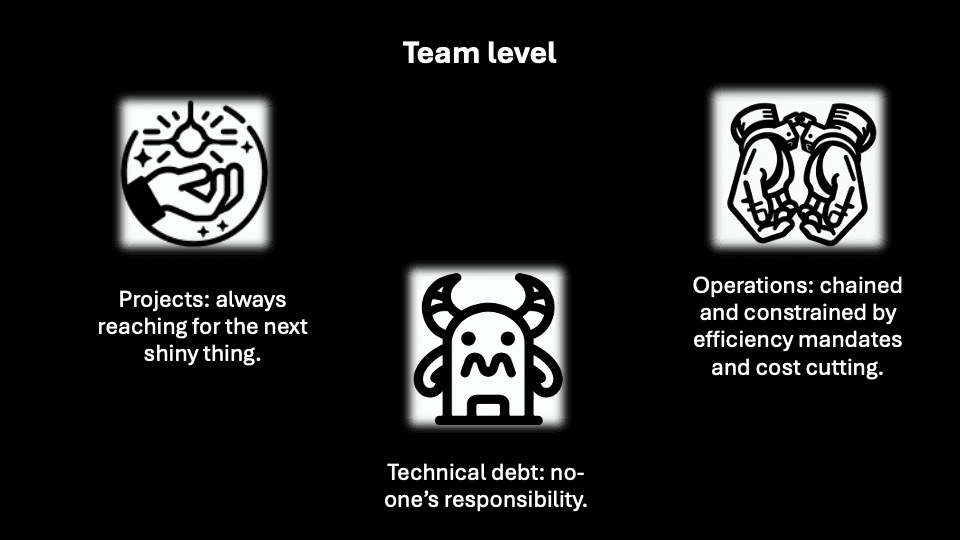
How would you frame a major refactoring proposal using product strategy?
Reframing tech debt as delivery risk, not engineering chore. Tie refactoring to velocity loss and firefighting; shift accountability from dev-vs-ops fights to product ownership.

How do you diagnose why a new feature's adoption is flat?
Tests structured analytics thinking across the adoption funnel. A strong answer maps discovery to habituation, segments cohorts, pairs behavior with feedback, and validates via experiments. Red flag: blaming UI without proving users know the feature exists.
How would you diagnose why a new feature isn't being adopted?
This tests your ability to diagnose a flat KPI. A great answer outlines a funnel (awareness, activation, usage) and combines quantitative data with qualitative insights from session replays. A red flag is proposing solutions without a diagnostic plan.
How would you diagnose a flat feature adoption KPI?
This tests your ability to create a diagnostic plan from a single lagging metric. A great answer outlines a funnel (Awareness > Activation > Usage), segments users, and combines quantitative data with qualitative feedback.

Propose a North Star Metric for a product you know
Definition; your product's metric; how value drives retention and revenue.

Describe RICE scoring and architect data pipelines for Reach and Effort
Define RICE; automate Reach via event streams with time windows; automate Effort from PM tool estimates with calibration.
How do you decide appropriate documentation levels without creating unnecessary overhead?
This tests balancing Manifesto values with operational reality. Strong answers define audience first, favor living docs over static artifacts, and calibrate depth to team topology and lifecycle stage. Red flag: using the Manifesto to justify no documentation.
Explain the North Star Metric and propose one for a product
Tests your ability to connect user value to business outcomes. A great answer defines the NSM, proposes one for a product (e.g., Spotify), and justifies how it links customer value to business success. A red flag is picking a vanity metric like DAU or revenue.
How do you decide the right level of project documentation?
This tests your pragmatism beyond literal Agile interpretation. A great answer defines docs as a product for a specific user, ties value to reducing future work, and proposes a tiered approach. A red flag is treating all documentation as pure overhead.
Explain the North Star Metric and propose one for a product
Tests your ability to link product strategy to a single metric reflecting customer value and business growth. Define the NSM, propose one for a product like Spotify, and justify it. A red flag is picking a vanity metric like DAU or a pure business metric.
How do you apply 'working software over comprehensive documentation'?
This tests your ability to balance velocity with maintainability. A great answer defines docs by audience and purpose (onboarding, ops), prioritizes "living" docs like tests, and uses a just-in-time approach. A red flag is treating this as "no documentation."

How do you design allocation logic to minimize concurrent A/B test interactions?
Compare mutual exclusion with layered randomization via layers and reservations; stress isolation vs throughput.
Explain Lean Muda and give three software lifecycle waste examples with mitigations
Tests mapping Lean waste to software with concrete countermeasures. A strong answer defines Muda as non-value-add work, cites three distinct types like waiting, defects, or overproduction, and pairs each with a specific practice.
Explain Muda (Waste) with three software development examples
Tests your ability to apply Lean's 'Muda' (waste) concept to software. A good answer defines Muda, then gives 3 examples like partially done work or extra features, with specific mitigations like WIP limits or YAGNI. A red flag is giving generic examples.
Explain the Lean concept of 'Muda' (Waste)
Tests applying manufacturing principles to software. Define Muda as non-value-adding work. Cite 3 software wastes like partially done work, extra features, or defects, and offer specific mitigations like smaller batches, YAGNI, or TDD.
How does Agile welcome changing requirements without chaos?
Whether you know that Agile embraces change only when supported by engineering discipline. Distinguish planned adaptability from reactive chaos by citing short feedback loops, evolutionary architecture, and continuous integration.
How would you structure an event schema for funnel and cohort analysis?
This tests analytical event modeling. Use an immutable log with one row per event; attach context user_id, session_id, campaign; use a wide atomic table plus extensible contexts for funnel and cohort queries without joins.
We are hiring for this. Every open role lists the topics its interview covers, so you can prepare for the real thing rather than guessing.
See open roles