Intermediate interview questions in Product Management, page 16
Why is team velocity a poor KPI for agile success?
Tests your grasp of agile principles and Goodhart's Law. Explain velocity is for forecasting, not performance. Detail dysfunctions like point inflation and ignoring quality. Propose outcome-focused alternatives like cycle time.

Explain cohort analysis for user retention and write a pseudo-query
Tests your ability to use precise metrics. A good answer defines a cohort, explains why it isolates variables better than aggregate data, outlines the calculation, and provides a clear pseudo-query.
Why is tracking team velocity as a KPI dysfunctional?
Tests if you know velocity is for planning, not performance. Explain it's easily gamed and measures output, not outcome. Propose metrics focused on value delivery and process improvement like cycle time.

Design a data model for feature adoption tracking
Tests dimensional modeling for high-volume events so PMs can query Feature A not B without complex SQL. A strong answer uses an event fact table plus a materialized user-feature summary. Red flag: a wide user table with boolean columns per feature.
Design a data model for tracking feature adoption
This tests your grasp of data warehouse star schemas for analytics. Outline a fact table for events and dimension tables for users and features, explaining how this structure enables fast, ad-hoc cohort analysis for a product manager.
Design a data warehouse model for tracking feature adoption
This tests your grasp of data warehousing star schemas for efficient behavioral analysis. A strong answer proposes a central events fact table linked to users, features, and time dimension tables.

Design an assignment service for an experimentation platform
This tests deterministic hashing and independence in randomization. A strong answer lists user ID, experiment salt, and allocations; uses salted hash for consistency; and warns that separate exposure and bucket hashes with mod can cause sample ratio mismatch.
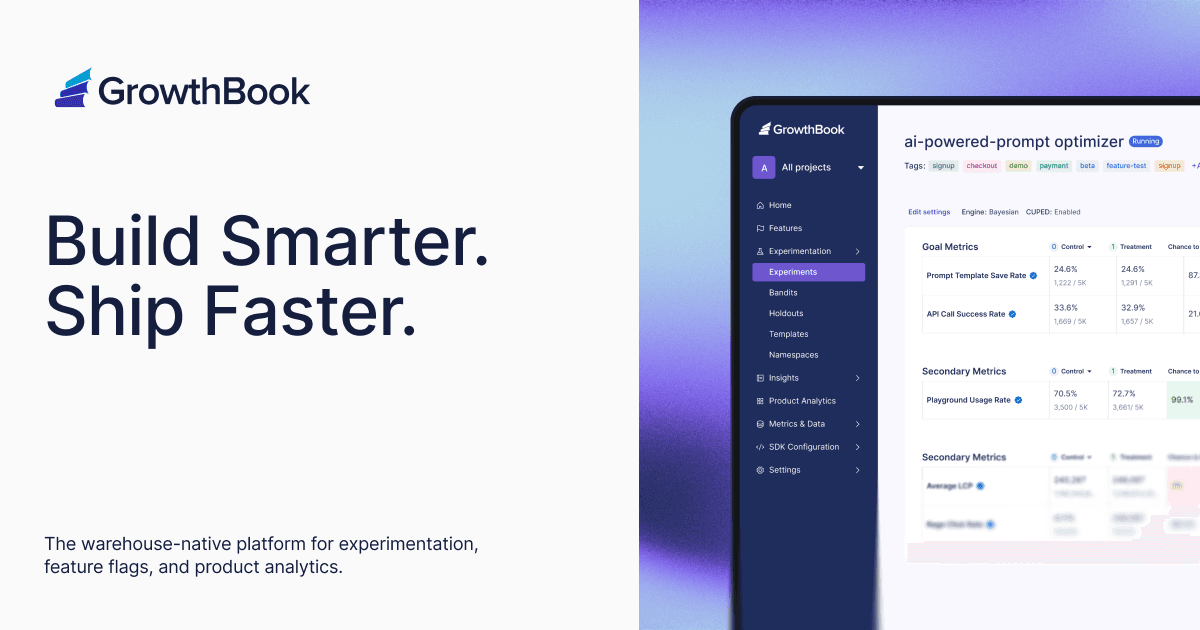
Should we build or buy an A/B testing platform?
This tests build-vs-buy judgment for experimentation infrastructure. Strong answers cover build for warehouse metrics and cache control; buy for proven stats and front-end speed. Red flag: answering with cost alone or assuming in-house is always superior.
Two senior developers clash on implementation, derailing sprint planning. Your role?
Park or timebox the debate, reframe positions into shared interests with structured dialogue, and drive to a decision or spike.

How do you resolve a heated technical debate between two developers?
Tests your ability to facilitate conflict, moving a team from argument to a structured decision. A great answer involves de-escalating, using a technique like conflict mapping to understand the core issue, and guiding the team to a resolution.
How do you facilitate a heated technical disagreement between two seniors?
Tests your ability to de-escalate conflict and guide a team to a data-driven decision. Acknowledge the issue, separate the people from the problem, use a structured process, and focus on shared goals. A red flag is immediately picking a side or escalating.
Quantify tech debt and pitch it to a PM
Quantify probability times impact, tie debt to velocity or incident cost, and propose scoped phased work.
Compare PostgreSQL versus a columnar warehouse for raw event data
Contrast row vs column storage, compression, and scan speed; note Postgres suits OLTP and point lookups while columnar stores excel at aggregations.
Explain backlog refinement: purpose, participants, and outcomes
Tests if you treat refinement as team-wide prep, not a solo PO task. Strong answers cite the full team and stakeholders, with outcomes being ready stories and estimates. Red flag: saying only the PO and Scrum Master attend or that it replaces sprint planning.
Explain backlog refinement: purpose, participants, and outcomes
Tests your grasp of continuous planning for predictability. A good answer defines the purpose (clarify, estimate, prioritize), participants (whole team + PO), and outcomes (a 'Ready' backlog). A red flag is describing it as a one-off pre-sprint meeting.
Explain a backlog refinement meeting's purpose, participants, and outcomes
Tests understanding of a core Scrum ceremony. A good answer defines the goal (clarifying future work), names participants (Dev Team, PO), and lists outcomes (estimated stories).
Describe artifacts and forums to align teams on API contracts and timelines
Tests API governance across teams. Propose: versioned OpenAPI specs in a shared catalog, weekly syncs, contract tests and mocks in CI, plus a joint staging environment. Red flag: Slack and meetings alone without versioned artifacts or automated validation.
Why do teams use story points instead of hours or days?
Define against a baseline; explain they absorb uncertainty so velocity stabilizes for planning.
Explain story points vs. time-based estimation.
This tests your grasp of Agile philosophy. A good answer defines points as relative effort (complexity, volume, risk), contrasts this with the pitfalls of time, and links it to predictable team velocity. A red flag is mapping points directly to hours.
Explain story points and why they're used over time-based estimates
Tests your grasp of relative vs. absolute estimation. Define story points as a relative measure of effort, complexity, and uncertainty. Explain they foster team consensus and provide a more stable velocity than time-based estimates.
We are hiring for this. Every open role lists the topics its interview covers, so you can prepare for the real thing rather than guessing.
See open roles