Intermediate interview questions in Product Management, page 9
How do you ensure retro ideas become action?
This tests your ability to drive change by treating process improvements as formal work. A great answer suggests adding the top retro item to the next Sprint Backlog, making it visible, accountable, and part of the team's commitment.

Design a pricing-page A/B test for $10 vs $15 plans
This tests sticky bucketing and revenue attribution. Hash user IDs to lock variants, persist assignments server-side, and join experiment logs to subscriptions via shared IDs. Red flag: client-side randomization that flickers or breaks billing context.

Write SQL to generate a monthly cohort retention table from raw events
Tests window functions and date truncation for cohort analysis. A strong answer finds each user's first month, counts returning users per period, and divides by cohort size. Aggregating all users without isolating acquisition month hides new-user churn.
How would you shift a Sprint Review from demo to working session?
Tests if you see the Sprint Review as empirical inspection and adaptation with stakeholders. Strong answers reframe it around the Sprint Goal and Increment, gather live feedback on the Product Backlog, and adapt ordering together.
How to query a monthly cohort retention table in SQL?
Tests your ability to translate a core business metric into a multi-step SQL query. A good answer finds each user's acquisition month, joins that back to their activity, and pivots the data into a cohort grid. A red flag is calculating aggregate retention.
How do you make a Sprint Review more than a demo?
Tests your understanding of Scrum's purpose beyond ceremony. A great answer outlines how an engineer can partner with the PO, structure the meeting for feedback, and ensure that feedback directly influences the backlog.
Generate a monthly cohort retention table from user events
This tests your ability to translate a business metric into a multi-step SQL query. A great answer defines cohorts by first activity, maps subsequent activity to period indices, counts distinct users, and pivots the result.
Shift a Sprint Review from a Demo to a Working Session
Tests your understanding of Sprint Review's purpose: inspection and adaptation. A great answer shows how an engineer can partner with the PO to frame the session around goals, solicit feedback on the Increment, and collaboratively update the Product Backlog.

How would you detect and mitigate free trial abuse?
Device fingerprinting, rate limits, progressive verification, and behavioral scoring; weigh precision vs false positives and effort.
A/B test shows 5% lift with imbalanced mobile traffic. What next?
This tests sample ratio mismatch and Simpson's paradox. A strong answer says the lift is confounded by platform, demands stratified analysis to isolate the true effect, and checks randomization. A red flag is accepting the 5% lift without questioning skew.
A/B Test Results with Skewed Traffic: What's Next?
This tests your ability to spot confounding variables. A good answer invalidates the results due to sampling bias, proposes segmenting the data by device to find the true effect, and suggests re-running the test with correct randomization.
An A/B test has imbalanced traffic. What do you do?
This tests your ability to spot confounding variables and Simpson's Paradox. A good answer first invalidates the aggregate result, then proposes segmenting by device to salvage insights, and finally investigates the root cause.

Propose a scalable entitlement architecture for complex rules
Tests separation of hot-path reads from async policy work. Great answers: edge-cache plan tokens; stream quota usage async; isolate rules in a microservice. Red flag: doing a DB lookup or sync quota check per request.

How would you validate that early Project creation drives retention?
Tests causal rigor on behavioral predictors. Good answer: define D30 retention and the 24-hour treatment; pull timestamps and covariates; cohort-compare with propensity matching; show lift with confidence intervals and propose an A/B nudge.

How would you design resumable multi-step onboarding state management?
This tests cross-device onboarding resume. A strong answer uses debounced server sync for cross-device resume with localStorage fallback, covers anonymous users, and handles conflicts. Red flag: pure client or server storage ignoring offline gaps or privacy.
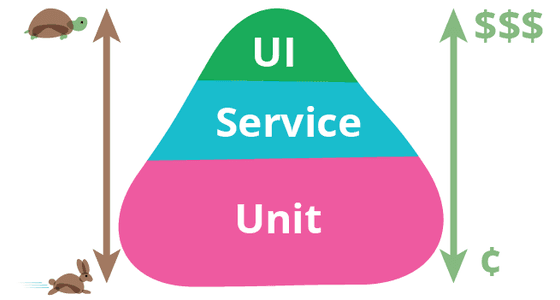
Explain the Test Pyramid and how it guides testing strategy
Favor fast unit tests, a middle service layer, and few UI tests as second defense.
Explain the Test Pyramid and how it guides your strategy.
Tests your grasp of balanced automated testing. Define the pyramid's layers (Unit, Service, UI), explain trade-offs like speed and cost, then apply it to a new service. A red flag is describing the layers without explaining the 'why' behind the shape.
Explain the Test Pyramid and its strategic use
Tests your grasp of balanced testing trade-offs. A good answer defines the Unit, Service, and UI layers, explains the cost/speed rationale, and applies it to a feature strategy. A red flag is describing the pyramid but not its strategic 'why'.

Design a role-based personalized onboarding system
Tests separation of content and logic for scalable personalization. Strong answer: CMS-backed rule engine, multi-channel delivery, event-driven triggers, and per-segment metrics. Red flag: hardcoding role-specific UI components in the client.
How do you balance emergent design with long-term architectural vision?
Tests reconciling emergent design with intentional architecture. Strong answers cite the architectural runway: just-enough infrastructure ahead via enablers, extended by teams incrementally. Red flag: claiming architecture is fully upfront or purely organic.
We are hiring for this. Every open role lists the topics its interview covers, so you can prepare for the real thing rather than guessing.
See open roles