All bites
The whole library, newest first. Filter by what you are here for, or pick a topic if you already know.
4330 bites
Page 179

Decompose a monolith for scaled agile teams
Tests aligning architecture to team boundaries during incremental monolith decomposition. Cover: bounded contexts with isolated data and sagas, backward-compatible versioned APIs, and replacing shared libraries with duplicated code or versioned SDKs.
Decomposing a Monolith: Technical Strategy
This tests your ability to create a practical, phased migration strategy from monolith to microservices. A strong answer defines service boundaries via Bounded Contexts, manages data with events, and uses an API Gateway for contracts.
Decomposing a monolith for scaled agile teams
Tests your grasp of domain-driven design and data consistency in a microservice migration. A good answer identifies bounded contexts, defines versioned APIs, and uses event-based patterns for data.
How can developers support the Product Owner in backlog refinement?
Developers surface risks, sizing, and dependencies; co-create trade-offs; and split items early.
How can developers partner with the Product Owner in backlog refinement?
This tests your understanding of the developer's role in maximizing value, not just executing tasks. A great answer covers questioning the 'why,' suggesting technical alternatives to meet business goals, helping split stories, and providing realistic sizing.
How can developers support the Product Owner in backlog refinement?
Tests your proactivity and partnership beyond just executing tasks. A great answer covers proactive technical analysis, suggesting ways to split stories for incremental value, and helping the PO quantify impact.
How should an EM facilitate reviews in a self-organizing team?
Tests separating feedback from pay, replacing individual ratings with systemic coaching. Cover: framing reviews as career development, biweekly 1:1s for meta-coaching, team raise pools, and obstacle removal. Red flag: stack ranking or hero worship.
How do you manage performance in a self-organizing team?
This tests your ability to shift from individual performance management to fostering team-based career development. A great answer reframes the goal, uses frequent 1-on-1s for coaching, and decouples raises from feedback.
How to manage performance reviews in self-organizing agile teams?
This tests your servant leadership mindset. Reframe "performance management" as "career development," use frequent 1-on-1s for coaching and obstacle removal, and separate compensation from feedback. Red flag: focusing on individual metrics or stack ranking.
Describe the difference between feature and component teams
Tests your grasp of how team structure affects value flow. A strong answer contrasts vertical slices with component ownership, noting feature teams shorten feedback while component teams create handoffs. Red flag: treating either as universally better.
Feature teams vs. component teams: pros and cons?
Tests your grasp of how team structure impacts value delivery. Define feature (vertical slice) and component (horizontal) teams. Contrast speed vs. reusability. Red flag: Calling one 'good' and the other 'bad' without discussing trade-offs.
Feature Teams vs. Component Teams: Pros and Cons
This tests your grasp of how team structure affects value delivery. A great answer defines feature (vertical slice, end-to-end) and component (horizontal, specialized) teams, then contrasts their trade-offs: speed vs. deep expertise.

Compare SAFe and LeSS from an engineer's view
Tests whether you see scaling frameworks as workflow design choices. Answers contrast SAFe's PI planning and RTE-managed dependencies with LeSS's single Sprint planning and team-driven resolution. Red flag: calling them interchangeable without citing autonomy.
SAFe vs. LeSS: Planning, Dependencies, and Autonomy
Tests your grasp of the trade-offs between coordination and autonomy in scaling frameworks. A good answer contrasts SAFe's top-down PI Planning with LeSS's bottom-up, team-focused approach.
SAFe vs. LeSS: Planning, Dependencies, and Autonomy
This tests your grasp of how org structure affects engineering work. Contrast SAFe's top-down, prescriptive nature (central PI planning) with LeSS's bottom-up, team-centric model (direct dependency management). A red flag is reciting buzzwords without context.
Why is velocity as a primary KPI destructive, and what's better?
This tests if you see velocity as a planning gauge, not a performance metric. A strong answer notes points are subjective, cites Goldratt on gaming, and proposes team-driven improvement instead. A red flag is claiming velocity works if averaged over time.
Why is team velocity a poor KPI for agile success?
Tests your grasp of agile principles and Goodhart's Law. Explain velocity is for forecasting, not performance. Detail dysfunctions like point inflation and ignoring quality. Propose outcome-focused alternatives like cycle time.
Why is tracking team velocity as a KPI dysfunctional?
Tests if you know velocity is for planning, not performance. Explain it's easily gamed and measures output, not outcome. Propose metrics focused on value delivery and process improvement like cycle time.
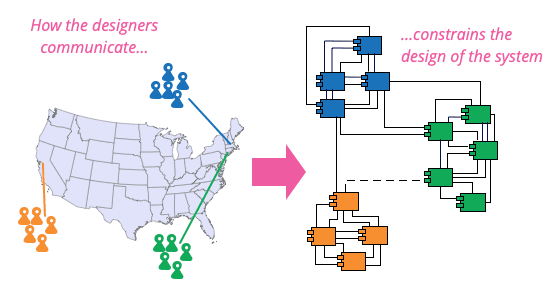
How would you apply Conway's Law to design team structures for microservices?
Map bounded contexts to cross-functional teams; use APIs as contracts; split by decoupling boundary.
How would you apply Conway's Law to design team structures?
This tests applying organizational theory to technical strategy. A great answer defines the law, explains the 'Inverse Conway Maneuver' by structuring teams around business capabilities, and avoids imposing an architecture without changing team structure…