Advanced interview questions in Agile & Scrum, page 4
How would you apply Little's Law to optimize Kanban WIP limits?
Tests whether you can operationalize queueing theory in Kanban. A strong answer cites L equals lambda times W, fixes throughput, then solves for a WIP limit that yields a target cycle time.
How would you apply Little's Law to a Kanban system?
This tests your ability to use metrics for process improvement. A great answer defines Little's Law for Kanban (Cycle Time = WIP / Throughput), explains how reducing WIP shortens cycle times, and gives a numerical example.
Apply Little's Law to a Kanban system to optimize flow
Tests applying queuing theory to software delivery. Define Little's Law as WIP = Throughput × Cycle Time. Explain how reducing WIP limits directly shortens cycle time for a stable throughput.
Describe a SAFe rule that hinders agility and how to mitigate it
Cite one rigid workflow pattern, show how it delays feedback, then propose a lighter cross-team substitute.
How would you handle a SAFe rule that hinders agility?
Tests your ability to pragmatically adapt process instead of just complaining. A great answer identifies a specific SAFe rule, explains how it can backfire, and proposes a concrete alternative that still achieves the original goal.
How can a SAFe rule hinder agility, and how would you mitigate it?
Tests your ability to pragmatically adapt process. First, name a specific SAFe rule and a scenario where it fails. Then, propose a mitigation that still achieves the rule's original goal, like alignment. A red flag is just complaining about bureaucracy.

Decompose a monolith for scaled agile teams
Tests aligning architecture to team boundaries during incremental monolith decomposition. Cover: bounded contexts with isolated data and sagas, backward-compatible versioned APIs, and replacing shared libraries with duplicated code or versioned SDKs.
Decomposing a Monolith: Technical Strategy
This tests your ability to create a practical, phased migration strategy from monolith to microservices. A strong answer defines service boundaries via Bounded Contexts, manages data with events, and uses an API Gateway for contracts.
Decomposing a monolith for scaled agile teams
Tests your grasp of domain-driven design and data consistency in a microservice migration. A good answer identifies bounded contexts, defines versioned APIs, and uses event-based patterns for data.
How should an EM facilitate reviews in a self-organizing team?
Tests separating feedback from pay, replacing individual ratings with systemic coaching. Cover: framing reviews as career development, biweekly 1:1s for meta-coaching, team raise pools, and obstacle removal. Red flag: stack ranking or hero worship.
How do you manage performance in a self-organizing team?
This tests your ability to shift from individual performance management to fostering team-based career development. A great answer reframes the goal, uses frequent 1-on-1s for coaching, and decouples raises from feedback.
How to manage performance reviews in self-organizing agile teams?
This tests your servant leadership mindset. Reframe "performance management" as "career development," use frequent 1-on-1s for coaching and obstacle removal, and separate compensation from feedback. Red flag: focusing on individual metrics or stack ranking.
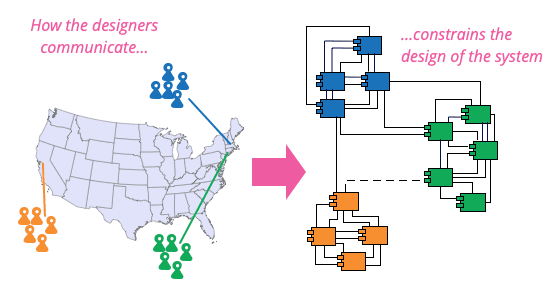
How would you apply Conway's Law to design team structures for microservices?
Map bounded contexts to cross-functional teams; use APIs as contracts; split by decoupling boundary.
How would you apply Conway's Law to design team structures?
This tests applying organizational theory to technical strategy. A great answer defines the law, explains the 'Inverse Conway Maneuver' by structuring teams around business capabilities, and avoids imposing an architecture without changing team structure…
How to apply Conway's Law to design team structures?
Tests if you can use Conway's Law proactively (the 'Inverse Conway Maneuver'). Outline: define the target architecture, then align small, autonomous teams to its components. A red flag is seeing the law only as a constraint, not a tool for intentional design.
Trade-offs: product teams vs project teams and funding model impacts
This tests funding impact on architecture. Contrast temporary project teams funded by scope versus product teams funded by problems; tie rolling budgets to ownership and refactoring. Red flag: claiming agile ceremonies fix org design while ignoring funding.
Trade-offs: Product-Based vs. Project-Based Teams
This tests your grasp of how funding models impact team ownership and code quality. Contrast project (temporary, build-only) vs. product (durable, continuous) teams, linking the latter to better knowledge retention and architecture.
Trade-offs: Product-Oriented vs. Project-Oriented Teams
This tests your understanding of how team structure and funding models impact long-term software quality. A great answer contrasts temporary, scope-funded project teams with durable, problem-funded product teams, highlighting the latter's benefits for…
We are hiring for this. Every open role lists the topics its interview covers, so you can prepare for the real thing rather than guessing.
See open roles