Interview questions in Design & UX, page 7
Structuring Storybook stories for visual states
One named story per state with explicit args, plus argTypes and controls.

What is the goal of contextual inquiry and what do engineers gain?
Tests grounding engineering in observed user behavior. Goal: watch users in their environment to uncover tacit work practices, workarounds, and mental models. Engineers learn system constraints, integrations, and reliability gaps.
Build a responsive feature grid with nested Auto Layout and component properties
This tests nested Auto Layout fluency for responsive grids. Strong answer: vertical section frame with wrapping horizontal row, cards with 280 px min widths, and component properties to swap content. Red flag: duplicating static artboards per breakpoint.
Design a system to suggest internal links for new articles
This tests large-scale retrieval design. A strong answer uses an offline embedding index for candidate retrieval and a real-time ranker scoring topical overlap and anchor fit. Red flag: scanning the full corpus per request or omitting index architecture.
Auto-generating component API docs from source
Extract types via react-docgen-typescript, surface in Storybook ArgsTable, enrich with JSDoc.

Your role and pitfalls as an engineer note-taker in interviews
Observe to leverage researcher expertise; pitfalls are skipping prep, academic framing, and inflexible features.
Create a button component with default, hover, and disabled variants
This tests Figma component variants and prototyping. A good answer: create a component set with a State property, build default, hover, and disabled variants, wire Change to with While hovering. Red flag: separate components instead of one variant set.
How would you use NLP to analyze top articles for semantic themes?
This tests practical NLP pipeline design for SEO. A strong answer covers preprocessing, NER with spaCy or BERT, topic modeling with LDA or BERTopic, and semantic similarity via embeddings.
Documenting component anti-patterns and don'ts
Paired do/don't examples, explain the why, enforce with lint rules.
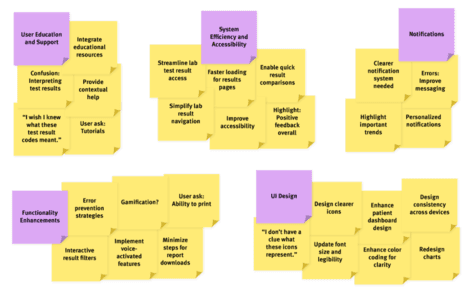
Translate qualitative insights into user stories and requirements
Clusters themes by frequency/severity, reframes pain points as user stories with clear AC, maps to technical spikes, prioritizes by impact.
What is the most efficient way to update a brand color globally?
This tests Figma variables versus styles for design system maintenance. Store the brand color as a variable, apply it across components, and edit the value once for global propagation. Red flag: manual updates or using a color style for a single raw value.
Design a content gap tool: data sources and core logic
Tests system design for SEO pipelines. Strong answers cite APIs (Ahrefs, Semrush, GSC), explain normalization, and frame logic as a left-anti-join on keyword plus geo and device filtered by rank. Red flag: dismissing API cost, rate limits, and freshness.
Measuring design system documentation effectiveness
Search-with-no-results, time-to-first-component, support-ticket deflection, tied to analytics and registry data.

How do you mitigate confirmation bias when a user validates your solution?
In the moment, probe for exceptions; in synthesis, triangulate and invite reviewers.

Super button versus composition: discuss trade-offs and scalability
Tests combinatorial explosion and API trade-offs in design systems. Contrast the super button's exponential growth with composition's explicit APIs and linear scalability, noting governance needs. Red flag: absolutism or ignoring type safety and tree-shaking.
Design a system to detect keyword cannibalization
Query-page-position data, intent clustering, and rank volatility.
Publishing a component to a private NPM registry
Configure package.json fields and scoped name, build dist, set registry auth, npm publish with access restricted.

How would you use a journey map to find technical root causes?
Map journey stages to logs and traces, find bottlenecks, propose API or data model changes.
Make a Figma button navigate from Frame A to Frame B
Tests hands-on Figma prototype workflow. Good answer: enter Prototype mode, select the Login button, drag the interaction noodle to Frame B, set trigger to On Click and action to Navigate To.

Design an algorithmic E-E-A-T scoring system
Tests turning subjective quality into signals. Split E-E-A-T into distinct feature families, combine structured metadata with unstructured NLP and graph signals, and calibrate against human rater labels. Red flag: one opaque score or CTR as trust proxy.
We are hiring for this. Every open role lists the topics its interview covers, so you can prepare for the real thing rather than guessing.
See open roles