More in MLOps & Infrastructure — page 13

Feature Backfilling: Populating Historical Data for ML
Feature backfilling computes a new feature's values for historical data. It's how you generate a complete training dataset after defining a new signal, like a user's 7-day purchase history. The footgun is using future data, causing data leakage.

Online vs. Offline Feature Serving: Two Speeds for ML Data
Offline serving provides large batches of historical data for model training; online serving provides low-latency features for live predictions. This dual system in a feature store prevents training-serving skew, ensuring model consistency from lab to…
Feature Hashing: The Hashing Trick for ML
Feature hashing turns features into vector indices without a lookup table, trading perfect accuracy for speed and memory. It's used for high-cardinality data like user IDs or in online systems.
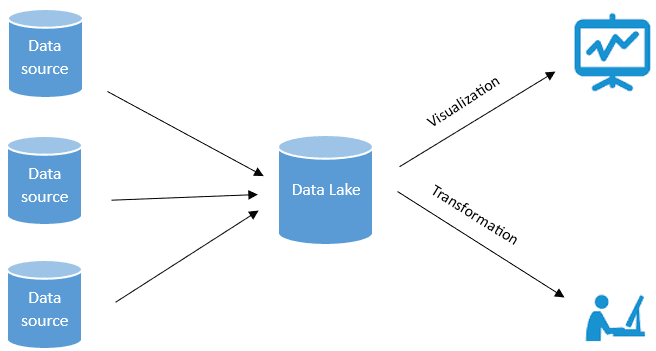
Data Lake: A Single Repository for Raw Data
A data lake is a central repository that stores vast amounts of raw data in its native format. It acts as a single source for analytics and machine learning, but without proper management it can become a useless "data swamp".
Data Augmentation: Getting More from Your Data
Data augmentation creates 'new' training data by making small, realistic changes to your existing data. It's used to fight overfitting in ML models when a dataset is small, teaching the model to generalize rather than memorize.

DVC: Git for Data and ML Models
DVC extends Git to version large data files and models without bloating your repo. It stores small pointer files in Git that reference large files in cloud storage.
Great Expectations: Unit Tests for Your Data
Great Expectations brings unit testing to your data, letting you assert what a dataset should look like. It validates data within a pipeline, preventing bad data from corrupting models or reports.
Data Schema Evolution: Changing Your Data's Blueprint
Schema evolution is like updating a building's blueprint while it's occupied. You must change your data's structure without breaking apps or losing data. It's key for adding features that need new DB columns.
ELT: Load Raw Data, Transform in Place
ELT flips the data pipeline: load raw data first, then use the data warehouse's own power to transform it. It's used in ML feature pipelines. The footgun is assuming it's ETL; with ELT, the transformation logic is coupled to the warehouse's SQL engine.
Data Labeling: Teaching Machines What to See
Data labeling gives raw data meaning so a machine learning model can learn. It's used to prepare datasets for tasks like object detection in images or sentiment analysis in text. The footgun: low-quality labels directly limit your model's performance.
Data Lake vs. Data Warehouse: Raw vs. Refined Data
A data lake is a vast pool of raw data; a data warehouse is a library of refined data ready for analysis. Lakes store everything for future ML or data science; warehouses power BI reporting on clean metrics.
ML Metadata: The Logging Layer for ML Pipelines
ML Metadata is the logging layer for your ML pipeline, tracking every dataset, hyperparameter, and model version. It's crucial for debugging failed runs by tracing a model back to its exact data.
Data Drift vs. Concept Drift: When Models Go Stale
Your ML model's accuracy decays when the real world no longer matches its training data. This is drift. It happens when user behavior changes (concept drift) or input data distributions shift (data drift).
Continuous Training: CI/CD for ML Models
Continuous Training (CT) is a CI/CD pipeline for models, not code. It automatically retrains and redeploys models to fight performance decay from changing data, a problem known as 'data drift'. The footgun is deploying a new model without validating it first.
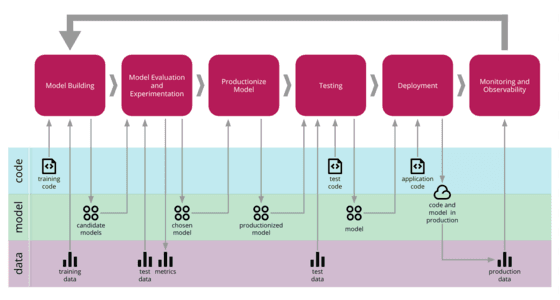
CD4ML: Automating ML from Data to Deployment
CD4ML extends CI/CD to manage ML's three axes of change: code, data, and models. It automates the entire lifecycle, enabling reliable updates for systems like sales forecasting.
Data Versioning: Git for Your Datasets
Think of data versioning as Git for datasets. It tracks changes to your data, allowing you to reproduce ML experiments or roll back to a previous state. The footgun is using regular Git, which chokes on the large binary files common in ML.
ML Experiment Tracking: Your Model's Lab Notebook
Think of it as a lab notebook for your models, logging every parameter and result. It's essential when tuning hyperparameters or comparing architectures, preventing you from losing track of what worked.

MLOps vs. DevOps: More Than Just "DevOps for ML"
Think of MLOps as DevOps extended for machine learning. While DevOps automates code deployment, MLOps also handles the unique lifecycle of data and models, including retraining and monitoring for performance decay.