Advanced concepts in Product Management, page 5

Principal Component Analysis (PCA)
PCA finds the most informative axes in your data, letting you compress many features into a few "principal components." Use it to visualize high-dimensional datasets or preprocess features for machine learning, but beware: the components are hard to interpret.
Double-Loop Learning: Question the 'Why', Not Just the 'How'
Double-loop learning means questioning the 'why' behind your work, not just fixing the 'how'. Instead of only correcting errors, you challenge the underlying goals. This is crucial in retrospectives when a team realizes their entire approach was flawed.
Time Series Decomposition: Separating Signal from Noise
Time series decomposition breaks a metric into its core parts: long-term trend, repeating seasonal patterns, and random noise. This helps you understand *why* a metric changed—was it a real shift or just the usual holiday rush?
Actionable Agile Metrics: Predicting 'Done'
Stop guessing 'done' and start forecasting with data. Actionable Agile Metrics use historical flow data—like cycle time and throughput—to answer 'When will it be done?' for customers who need predictability.
Theory of Constraints: Your Bottleneck Defines Your System
A system's output is limited by its single biggest bottleneck, just as a chain is only as strong as its weakest link. Use it to increase throughput in manufacturing or software delivery by focusing all improvement efforts on that one constraint.
Minimum Marketable Feature (MMF): Ship Value, Not Parts
An MMF is the smallest piece of functionality that provides real value to a customer. Use it to break down large projects into valuable, incremental releases. The footgun is confusing it with an MVP (for learning) or slicing it too thin to be useful alone.
The Hybrid GTM Model: PLG Meets Enterprise Sales
A hybrid go-to-market model blends a self-serve product with a sales team, letting users start on their own and bringing in sales for big deals. B2B SaaS uses this for efficiency, but the footgun is creating friction if the handoff isn't seamless.
Entitlements: Use Feature Flags for Permanent Access Control
Entitlements use permanent feature flags to control long-term access, like a bouncer for your app's VIP section. This is how you manage premium tiers or special user permissions, ensuring the right customers always see the right features.
Bayesian Inference: Updating Beliefs with Data
Bayesian inference formalizes learning from experience, updating your belief in a hypothesis as you gather evidence. It's used in A/B testing and medical diagnostics. The footgun is that a poor initial belief (the prior) can skew your conclusions.
Demand Generation: Creating Your Sales Pipeline
Demand generation creates the market for your product. It's the marriage of marketing programs and a structured sales process, driving awareness for complex B2B or B2G sales.
ANOVA: Comparing Group Averages by Analyzing Spread
ANOVA checks if group averages are different by comparing the spread *between* groups to the spread *within* them. It's used to see if three ad campaigns yield different click-through rates.

Product-Led Growth (PLG): When the Product Sells Itself
Product-Led Growth (PLG) makes the product its own salesperson. Instead of a sales team, the product's features and user experience drive acquisition and expansion.
Statistical Power: Detecting Real Effects in Your Tests
Think of statistical power as your experiment's sensitivity. It's the probability of detecting a real effect, like a true lift in an A/B test. The main footgun is running a low-power test, which will likely miss a real improvement and lead you to discard good.

Strangler Fig Pattern: Replace Legacy Systems Safely
The Strangler Fig pattern lets you replace a legacy system by gradually growing a new one around it, eventually choking out the old code. It's used for modernizing critical systems where a "big bang" rewrite is too risky, routing traffic feature by feature.

Partner Enablement: Getting External Partners to Sell Your Product
Partner enablement removes friction for your external sales channels. It equips resellers and distributors with the training, tools, and content they need to sell your product effectively, especially when they also represent competitors.
Survival Analysis: Predicting When, Not Just If
Survival analysis predicts *when* an event like user churn will happen, not just *if*. It's used to model customer lifetime or hardware failure rates. The key mistake is using simple averages, which are skewed by users who haven't churned yet (censored data).
Bootstrapping: Quantifying Uncertainty with Resampling
Bootstrapping estimates uncertainty by resampling your own data. It's used to find confidence intervals for complex stats like medians where no simple formula exists. The footgun: it can't fix a biased sample, only reveal the uncertainty within it.

Contract Testing: Test Interfaces, Not Integrations
Contract testing ensures services work together without slow integration tests. It's a formal agreement where a 'consumer' defines its needs, and a 'provider' proves it can meet them.
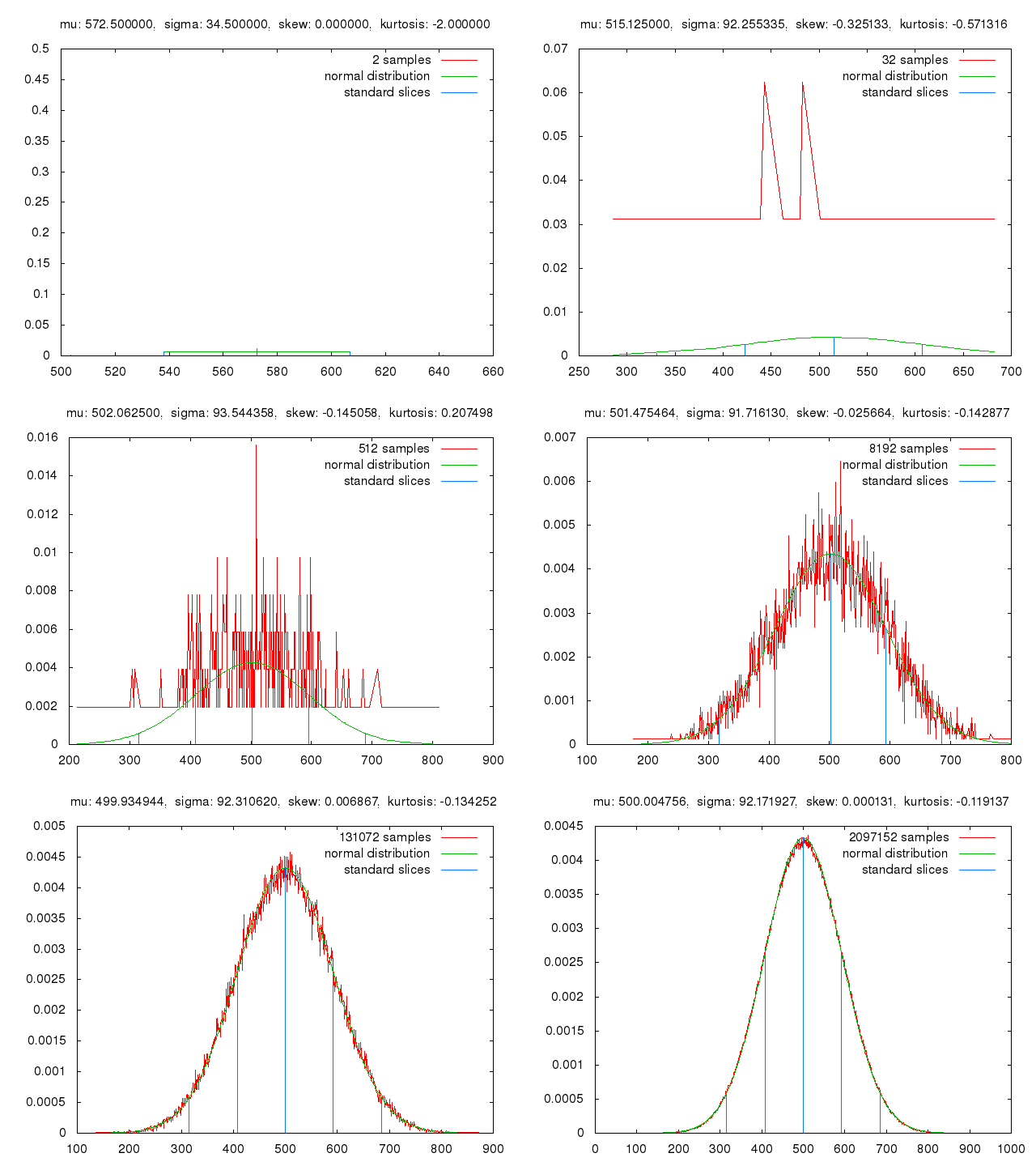
Forecasting with Monte Carlo Simulation
A Monte Carlo simulation forecasts outcomes by running thousands of 'what if' scenarios with random inputs. Use it to model complex systems like user growth with variable conversion rates.

The Multiple Comparisons Problem
Running many statistical tests on one dataset is like buying many lottery tickets; your chance of a "winning" false positive increases with each test. This happens in A/B tests with many metrics.
We are hiring for this. Every open role lists the topics its interview covers, so you can prepare for the real thing rather than guessing.
See open roles