Easy interview questions in Product Management, page 6
What is the output of a Sprint Retrospective, and what happens next?
This tests if you create actionable outcomes, not just vent. The output is a plan to improve quality and effectiveness, with the most impactful items added to the next Sprint Backlog. A red flag is calling the output just 'notes' with no plan for integration.
How would you design the backend check for a report quota?
Tests reliable quota enforcement without race conditions. A strong answer uses atomic counts or DB constraints, validates at the service layer, and surfaces a clear 4xx. A red flag is a non-atomic SELECT-then-INSERT pattern.
How would you determine if Feature X causally drives higher retention?
Tests causal inference intuition for product metrics. Great answers propose a randomized holdback or instrumental variable, control for user intent, and estimate a local average treatment effect.
Is Feature X Causal for 20% Higher Retention?
This tests your ability to separate correlation from causation. A great answer first identifies confounding variables (e.g., power users), then proposes an A/B test to isolate the feature's true effect, and finally suggests quasi-experiments if a test isn't…
Is 20% higher retention from Feature X causal or correlational?
This tests your ability to distinguish correlation from causation. A great answer questions the data, identifies confounding variables (e.g., power users), and proposes a randomized A/B test as the gold standard to prove causality.
How would you instrument a 4-step onboarding wizard?
Track Step Started and Step Completed with step_index and flow_variant; tie via distinct_id.

How do you determine if a user is 'new' for a setup guide?
This tests whether you separate account age from user state for onboarding. Good answers compare created_at (brittle) with a persistent flag (idempotent) and consider milestones. A red flag is using a timestamp as a permanent new proxy without managing reruns.
Describe the Red-Green-Refactor cycle in TDD. What is each step's purpose?
This checks if you understand TDD as a design discipline, not just testing. A strong answer maps Red to a failing test defining the interface, Green to minimal passing code, and Refactor to cleaning both codebases without changing behavior.
Describe the Red-Green-Refactor cycle in Test-Driven Development
This tests your grasp of TDD's core loop and its design benefits. Outline the cycle: Red (failing test), Green (minimal code to pass), and Refactor (clean up). Mention creating a test list first. A red flag is ignoring the critical Refactor step.
Describe the TDD Red-Green-Refactor cycle
This tests your grasp of TDD's core loop and its design implications. A good answer defines Red (failing test), Green (minimal code to pass), and Refactor (improve structure).
Mean or median for API response times?
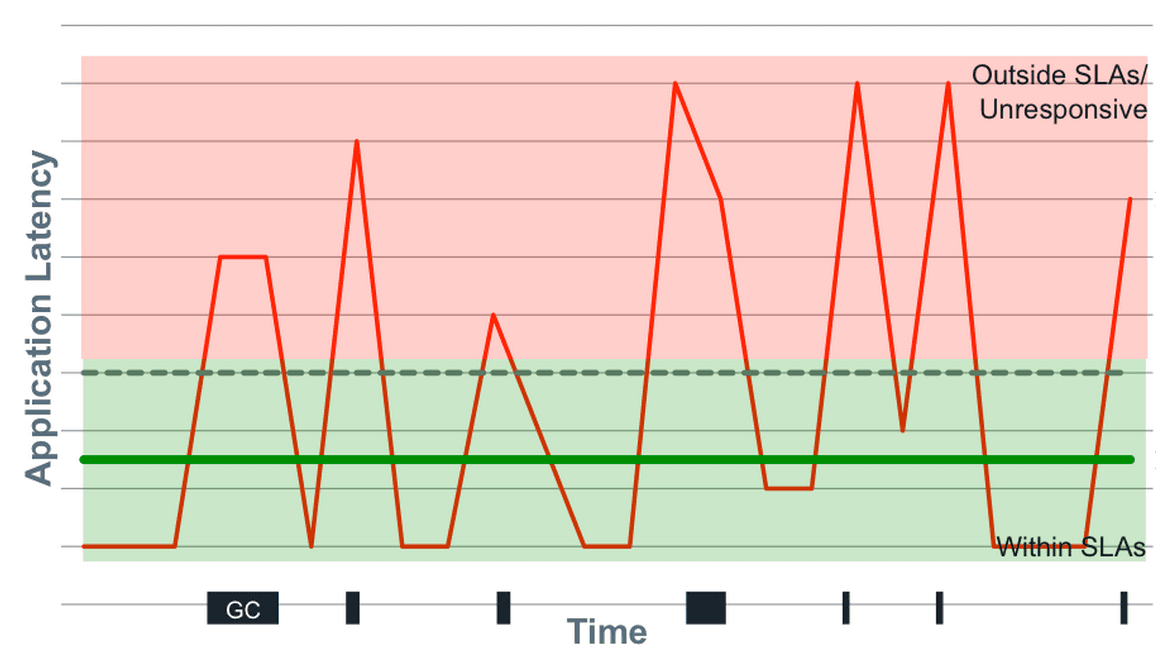
Tests if you know latency is skewed and outlier-sensitive. Pick median over mean because hiccups distort the mean, but note median hides tail latency. Advocate for p95, p99, and max. Red flag: defending mean as representative or ignoring tail behavior.
Mean vs. Median for API Response Times?
Tests your understanding of non-normal distributions like latency. Choose median as it's robust to outliers that skew the mean. Then, state that even median is insufficient; percentiles (p99, max) are crucial for capturing the full user experience.
Mean vs. Median for API Response Times?
Tests if you know latency data has outliers. A good answer chooses median because it's robust to extremes. Explain that mean gets skewed by a few slow requests (e.g., GC pauses), hiding the typical user experience.

KPIs for a new registration form and technical instrumentation
Tests pairing outcomes with instrumentation. Pick a conversion KPI and a field-level friction KPI, then explain client-side events correlated with server logs while scrubbing PII. Red flag: relying solely on frontend analytics or vanity metrics.
What does a p-value of 0.03 mean at alpha 0.05?
0.03 means 3% chance of data this extreme if the null (no effect) holds; since 0.03 < 0.05, reject the null.
What does a p-value of 0.03 mean in an A/B test?
This tests your grasp of statistical significance and ability to make a data-driven decision. A great answer defines p-value, compares it to alpha (0.03 < 0.05), and concludes to reject the null hypothesis. A red flag is misstating the p-value's definition.
What does a p-value of 0.03 mean in an A/B test?
Tests your practical statistical literacy. A good answer defines the p-value (3% chance of this result if the null is true), compares it to alpha (0.03 < 0.05) to reject the null, and decides to ship.

Describe the end-to-end data flow for tracking a 'Share' button click
Payload carries event type, user ID, timestamp, device, content; client batches with retry; backend validates and lands in a partitioned store.

Describe the data model and backend logic for a daily login bonus.
This tests streak state machines and calendar edge cases. A strong answer stores last_login_utc and streak_count, uses UTC day buckets, resolves timezones per user tz, and needs no leap-year logic.

How do outcome-oriented goals change implementation and testing?
Tests whether you engineer for measurable behavioral change, not just shipping. Strong answers cover baselining, telemetry, small experiments, and user-data validation. Red flag: treating the goal as a PM issue and focusing only on on-time delivery.
We are hiring for this. Every open role lists the topics its interview covers, so you can prepare for the real thing rather than guessing.
See open roles