Interview questions in Product Management, page 20
A/B Test Results with Skewed Traffic: What's Next?
This tests your ability to spot confounding variables. A good answer invalidates the results due to sampling bias, proposes segmenting the data by device to find the true effect, and suggests re-running the test with correct randomization.
How to Handle Poor Quality in a 'Successful' Sprint?
This tests your commitment to transparency and the Definition of Done. A great answer involves being honest about technical debt in the Sprint Review, then strengthening the DoD in the Retrospective. A red flag is hiding the problem from stakeholders.
An A/B test has imbalanced traffic. What do you do?
This tests your ability to spot confounding variables and Simpson's Paradox. A good answer first invalidates the aggregate result, then proposes segmenting by device to salvage insights, and finally investigates the root cause.
How to Handle Poor Quality with Happy Stakeholders?
This tests your commitment to Scrum's Transparency pillar. A great answer involves being honest about unsustainable quality in the Sprint Review, proposing a plan (e.g., 20% capacity for tech debt), then using the Retrospective to fix the root cause.

Propose a scalable entitlement architecture for complex rules
Tests separation of hot-path reads from async policy work. Great answers: edge-cache plan tokens; stream quota usage async; isolate rules in a microservice. Red flag: doing a DB lookup or sync quota check per request.

How would you validate that early Project creation drives retention?
Tests causal rigor on behavioral predictors. Good answer: define D30 retention and the 24-hour treatment; pull timestamps and covariates; cohort-compare with propensity matching; show lift with confidence intervals and propose an A/B nudge.
How would you validate a feature's conversion impact given self-selection bias?
Tests causal inference for opt-in features. Strong answers use quasi-experiments like propensity matching or diff-in-diff to compare similar users and verify pre-trends. Red flag: a raw t-test between adopters and non-adopters ignoring selection bias.
Describe the Red-Green-Refactor cycle in TDD. What is each step's purpose?
This checks if you understand TDD as a design discipline, not just testing. A strong answer maps Red to a failing test defining the interface, Green to minimal passing code, and Refactor to cleaning both codebases without changing behavior.
How would you validate a feature's success, correcting for self-selection?
This tests your ability to separate correlation from causation. A great answer identifies self-selection bias, proposes a quasi-experimental method like Propensity Score Matching to create a control group, and then compares outcomes.
Describe the Red-Green-Refactor cycle in Test-Driven Development
This tests your grasp of TDD's core loop and its design benefits. Outline the cycle: Red (failing test), Green (minimal code to pass), and Refactor (clean up). Mention creating a test list first. A red flag is ignoring the critical Refactor step.
How would you validate a PM's claim about feature success?
This tests your grasp of causal inference vs. correlation. A great answer acknowledges self-selection bias, proposes a quasi-experimental method like Propensity Score Matching to create a synthetic control group, and then compares outcomes for the matched…
Describe the TDD Red-Green-Refactor cycle
This tests your grasp of TDD's core loop and its design implications. A good answer defines Red (failing test), Green (minimal code to pass), and Refactor (improve structure).

Design real-time usage-based billing data architecture
Tests whether you can guarantee exactly-once billing at scale without data loss. Strong answers cover idempotent Kafka ingestion, ClickHouse aggregation, reconciliation, and audit trails. Red flag: claiming exactly-once instead of at-least-once dedup.

How would you design resumable multi-step onboarding state management?
This tests cross-device onboarding resume. A strong answer uses debounced server sync for cross-device resume with localStorage fallback, covers anonymous users, and handles conflicts. Red flag: pure client or server storage ignoring offline gaps or privacy.

Describe data architecture for fast multi-dimensional slicing and pre-computation trade-offs
Tests analytical architecture trade-offs between latency and cost. Strong answers propose a hybrid pipeline: columnar warehouse for flexible exploration plus pre-aggregated OLAP cubes for sub-second dashboards.
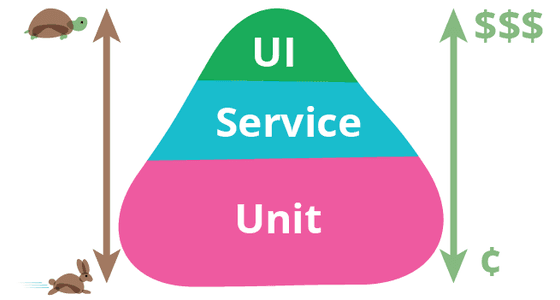
Explain the Test Pyramid and how it guides testing strategy
Favor fast unit tests, a middle service layer, and few UI tests as second defense.
Design a Fast, Multi-Dimensional Analytics Dashboard
This tests your grasp of data warehousing trade-offs for analytics. A great answer compares OLAP cubes (fast, pre-computed) vs. columnar DBs (flexible, real-time), then proposes a hybrid model.
Explain the Test Pyramid and how it guides your strategy.
Tests your grasp of balanced automated testing. Define the pyramid's layers (Unit, Service, UI), explain trade-offs like speed and cost, then apply it to a new service. A red flag is describing the layers without explaining the 'why' behind the shape.
How would you architect a fast, multi-dimensional analytics dashboard?
This tests your grasp of analytics architectures and trade-offs between pre-computation and real-time querying. A great answer clarifies needs, then proposes a hybrid model using an OLAP cube for core metrics and a columnar store for ad-hoc queries.
Explain the Test Pyramid and its strategic use
Tests your grasp of balanced testing trade-offs. A good answer defines the Unit, Service, and UI layers, explains the cost/speed rationale, and applies it to a feature strategy. A red flag is describing the pyramid but not its strategic 'why'.
We are hiring for this. Every open role lists the topics its interview covers, so you can prepare for the real thing rather than guessing.
See open roles