Interview questions in Product Management, page 30
How would you capture UTM parameters for attribution?
This tests your grasp of the data lifecycle from capture to persistence. A good answer covers client-side parsing, cookie storage, and linking anonymous data to a user record upon sign-up. A red flag is forgetting to persist the data server-side.
How would you apply Little's Law to a Kanban system?
This tests your ability to use metrics for process improvement. A great answer defines Little's Law for Kanban (Cycle Time = WIP / Throughput), explains how reducing WIP shortens cycle times, and gives a numerical example.
How would you capture and persist UTM parameters for attribution?
Tests your grasp of state management and data persistence for analytics. A good answer covers capturing UTMs with JS, persisting them in a cookie, and associating them with a user record on the server during a conversion event.
Apply Little's Law to a Kanban system to optimize flow
Tests applying queuing theory to software delivery. Define Little's Law as WIP = Throughput × Cycle Time. Explain how reducing WIP limits directly shortens cycle time for a stable throughput.
How would you instrument and query P95 API latency by region?
This tests white-box latency instrumentation and safe cardinality for percentile aggregation. Strong answer: emit histograms by region, query P95 with histogram_quantile or a log percentile, and keep trace IDs in logs only.

Architect a 14-day Pro trial with abuse prevention
Tests stateful billing lifecycle and anti-abuse tradeoffs. Strong answers cover: idempotent trial state machine with scheduled expiry; retention on downgrade; progressive friction via device intel and rate limits; and behavioral monitoring.

What data pipelines and infrastructure feed a viral user acquisition model?
Tests causal attribution architecture. Great answers cover invite instrumentation with identity resolution, streaming pipelines that split organic and viral signups, and feature stores for network-state features.
What is a Scrum of Scrums purpose and what technical info is shared?
Multi-team sync for blockers, dependencies, API changes, integration risks; not a status meeting.
How would you measure P95 latency by geographic region?
Tests your ability to translate a business need into a concrete observability implementation. A good answer involves instrumenting the API with a histogram metric, adding a region label via GeoIP, and querying with histogram_quantile.
What is a Scrum of Scrums, and what do you share there?
Tests your understanding of scaling agile and representing your team's technical risks. A good answer defines it as a coordination meeting, not a status report, and focuses on sharing/receiving info on cross-team dependencies and blockers.
How would you measure P95 latency by geographic region?
Tests your ability to design a practical metrics pipeline, considering instrumentation, data types (metrics vs. logs), and aggregation. Instrument the API with a histogram metric and a region label, then query using histogram_quantile.
What is a Scrum of Scrums and what's shared there?
This tests your understanding of scaling Agile. A good answer defines it as a coordination meeting for multiple teams, focusing on sharing inter-team blockers, dependencies, and integration points, not just status.
Shared component library versus per-product builds
Shared libraries cut duplication and enforce consistency but add coupling, versioning, and a coordination tax; per-product code is fast but drifts.
Purpose of a shared Definition of Done for multi-team products
This tests empirical transparency across teams building one Increment. A shared DoD forces cross-team integration and testing before Sprint end. Letting teams keep separate DoDs hides integration debt and breaks transparency.

What data and approach for a simple 30-day DAU forecast?
Tests forecasting from sessionized logs without overengineering. Cite timestamped events, a 30 min session rule, and a regression baseline with day-of-week, recent totals, scored with MAE. Red flag: deep learning before a baseline or ignoring privacy hashing.
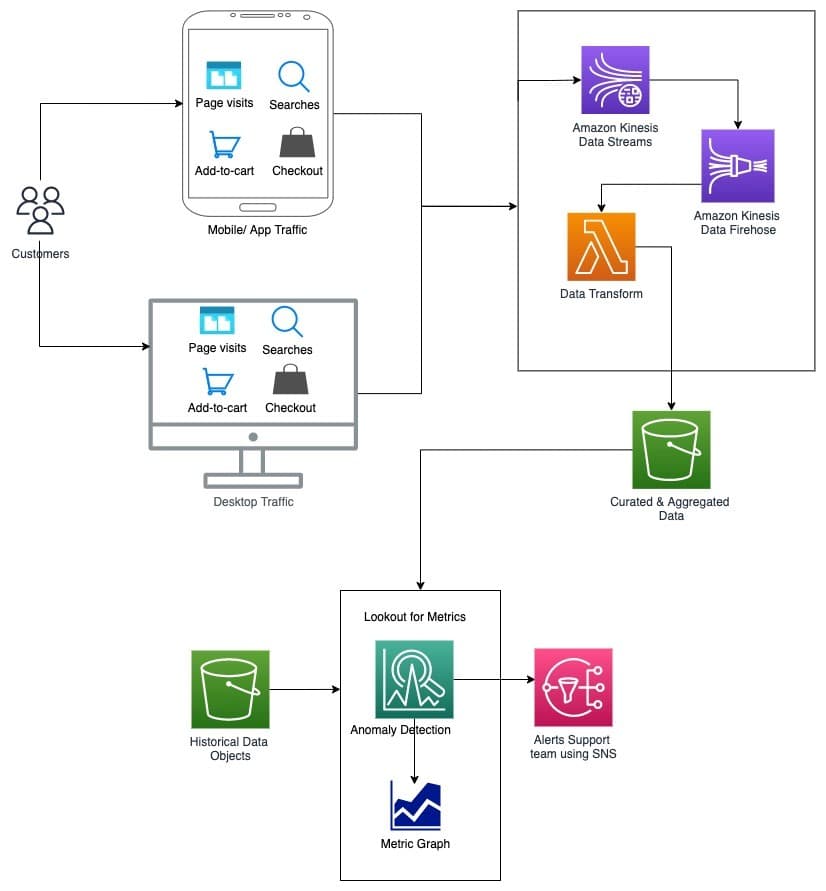
Design a system to detect sudden add-to-cart drops in real time
This tests streaming pipeline design and seasonality-aware anomaly detection. Outline Kafka or Kinesis ingestion, windowed aggregations, and ML baselines tuned to hourly and weekly trends. Red flag: static thresholds that ignore daily patterns.
Design a Real-Time Anomaly Detection System for E-commerce Events
This tests your ability to design a real-time data pipeline and apply ML to a business problem. Outline a streaming architecture (e.g., Kinesis), processing, and storage.
What is the purpose of a shared 'Definition of Done'?
Tests your ability to ensure quality and transparency across multiple teams. A shared 'Definition of Done' is a formal description of quality for the integrated Increment. It ensures all work is combinable and shippable.
Design a real-time anomaly detection system for 'add to cart' events
Tests real-time data pipeline design and nuanced anomaly detection. A good answer outlines ingestion (Kinesis), processing (Lambda/Flink), seasonal modeling for 'a drop', and alerting (SNS).
Purpose of a Shared Definition of Done for Multiple Teams
This tests your ability to maintain quality and transparency across multiple teams. Explain that a shared Definition of Done ensures a consistent quality standard for a usable, integrated Increment, impacting testing by requiring integration and end-to-end…
We are hiring for this. Every open role lists the topics its interview covers, so you can prepare for the real thing rather than guessing.
See open roles