Advanced everything in Product Management, page 13

How would you identify and elevate your team's primary constraint?
This tests systems thinking over local optimization. A great answer outlines the 5 steps: identify the constraint (e.g., long queues), exploit it, subordinate other processes, elevate it, and repeat. A red flag is jumping straight to hiring or buying tools.
Principle of Charity: Argue the Strongest Case
The Principle of Charity means engaging with the strongest possible version of a colleague's argument, not the weakest. Use it in design reviews to find the best idea, not just to win the debate. The footgun is straw-manning an idea to easily knock it down.
Executive Presence: The Ability to Inspire Confidence
Executive presence is the ability to inspire confidence in your team, peers, and superiors. It's the 'X-factor' that gets you chosen for senior roles and high-stakes projects.
Principled Negotiation: Focus on Interests, Not Positions
Principled negotiation avoids a battle of wills by focusing on shared interests, not rigid positions. It's a method for finding mutually acceptable agreements in conflicts. Use it in business deals or team disagreements.
Trust and Safety: The Immune System of Online Platforms
Trust and Safety is an online platform's immune system, protecting users from harmful content, abuse, and fraud. It's critical for moderating social media and preventing e-commerce scams.

Platform Strategy: Solving the Chicken-and-Egg Problem
A platform isn't a product; it's an environment where groups create value for each other. This strategy is key for marketplaces (Uber) or ecosystems (iOS) where value grows with users.
Platform Envelopment: Eat or Be Eaten
Platform envelopment is when a large platform absorbs a competitor's market by bundling its core features, often for free. This is common in tech, like an OS adding a feature that makes a standalone app obsolete.
Portfolio Balancing: Don't Bet Everything on One Project
Portfolio balancing treats your projects like an investment portfolio, diversifying bets. It's used to allocate engineers between new features, tech debt, and R&D. The footgun is only funding short-term wins, starving long-term health and innovation.
Product Ecosystem Strategy: Competing Through Collaboration
A product ecosystem strategy builds a network of collaborating and competing partners around a core offering, making the whole more valuable than any single part. It's the model behind app stores and smart home devices.

Partner Enablement: Getting External Partners to Sell Your Product
Partner enablement removes friction for your external sales channels. It equips resellers and distributors with the training, tools, and content they need to sell your product effectively, especially when they also represent competitors.

Product-Led Growth (PLG): When the Product Sells Itself
Product-Led Growth (PLG) makes the product its own salesperson. Instead of a sales team, the product's features and user experience drive acquisition and expansion.
Demand Generation: Creating Your Sales Pipeline
Demand generation creates the market for your product. It's the marriage of marketing programs and a structured sales process, driving awareness for complex B2B or B2G sales.
Minimum Marketable Feature (MMF): Ship Value, Not Parts
An MMF is the smallest piece of functionality that provides real value to a customer. Use it to break down large projects into valuable, incremental releases. The footgun is confusing it with an MVP (for learning) or slicing it too thin to be useful alone.
Theory of Constraints: Your Bottleneck Defines Your System
A system's output is limited by its single biggest bottleneck, just as a chain is only as strong as its weakest link. Use it to increase throughput in manufacturing or software delivery by focusing all improvement efforts on that one constraint.

Roadmap Commitment Levels: Now, Next, Later
Agile roadmaps replace fixed timelines with commitment levels: 'Now' (in progress), 'Next' (planned), and 'Later' (potential ideas). This structure communicates decreasing certainty, allowing teams to adapt without breaking promises.
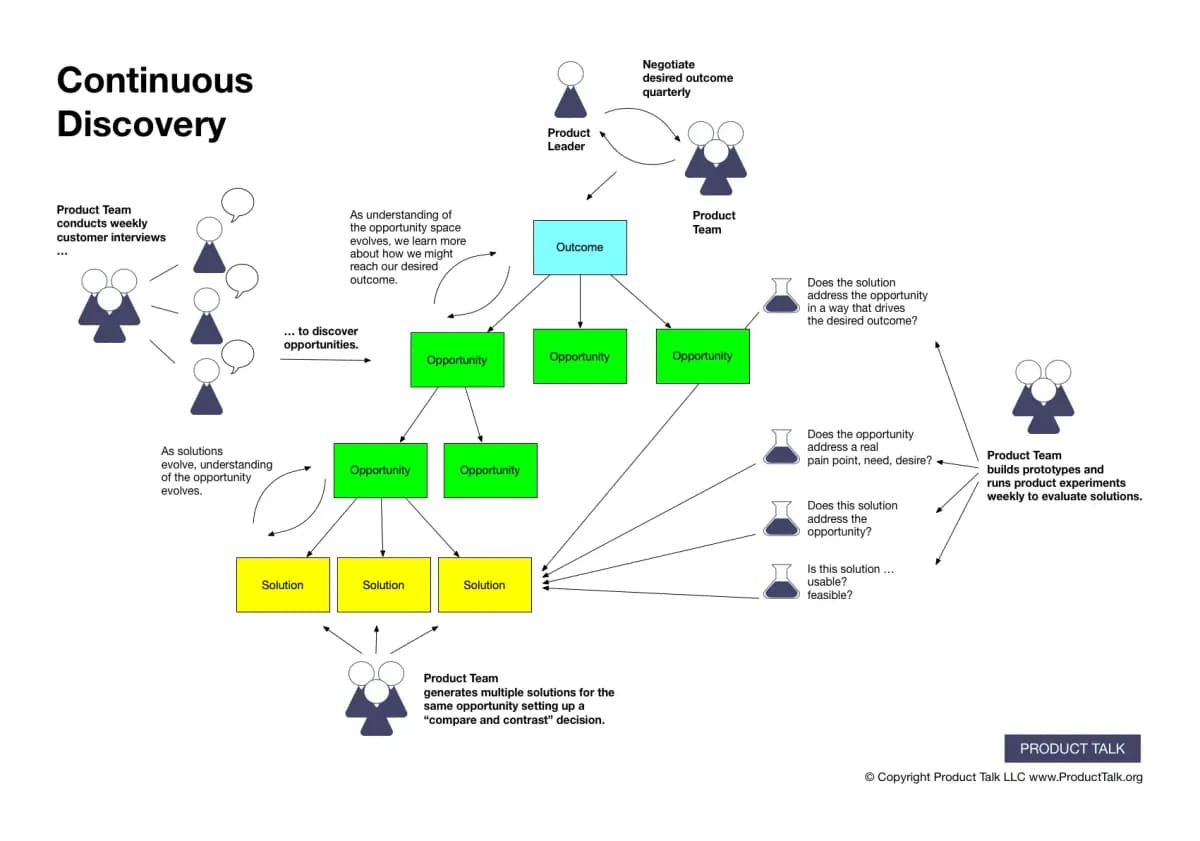
Continuous Discovery: Talk to Users Weekly, Not Yearly
Continuous discovery means small, weekly chats with customers, not a big upfront research phase. It's for teams building products that are never 'done,' like Netflix or your SaaS app. The footgun is treating discovery as a project, leading to stale insights.
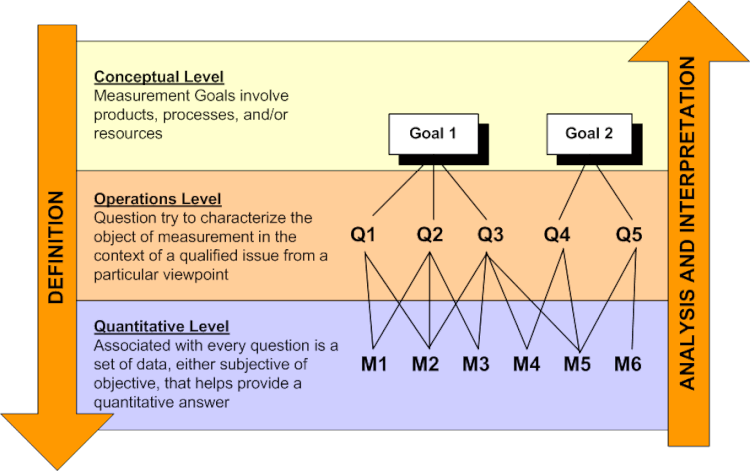
Goal-Question-Metric: Measure What Matters, Not What's Easy
GQM is a top-down framework for defining metrics. You start with a Goal, ask Questions to clarify it, then define Metrics to answer them. This avoids the common trap of collecting vanity metrics that don't reflect true software quality or business goals.

Van Westendorp Price Sensitivity Meter
The Van Westendorp Price Sensitivity Meter is a market research technique for determining consumer price preferences. It's used to help set product prices by surveying potential buyers about their perceived value and willingness to pay.
LTV to CAC Ratio: Is Your Growth Profitable?
The LTV to CAC ratio measures if you make more money from a customer than you spent to get them. It's the core health metric for a subscription business, used to judge marketing efficiency. A ratio above 3:1 is often healthy.

Unit Economics: Is Each Customer Profitable?
Unit economics asks if you make or lose money on a single customer or sale. It's used in SaaS to compare customer lifetime value (LTV) to acquisition cost (CAC). The footgun is defining the 'unit' poorly, hiding that each new customer costs you money.
We are hiring for this. Every open role lists the topics its interview covers, so you can prepare for the real thing rather than guessing.
See open roles