Advanced concepts in Product Management, page 6
ATDD: Aligning Code with Business Needs Before You Build
Acceptance Test-Driven Development (ATDD) is a communication framework where business, developers, and testers write acceptance tests together *before* coding begins. This ensures everyone understands the requirements.
Causal Impact: Measuring Effects Without an A/B Test
Causal Impact estimates an intervention's effect by modeling a 'what if' counterfactual. It's used to measure lift from a new feature or ad campaign when a clean A/B test isn't possible.
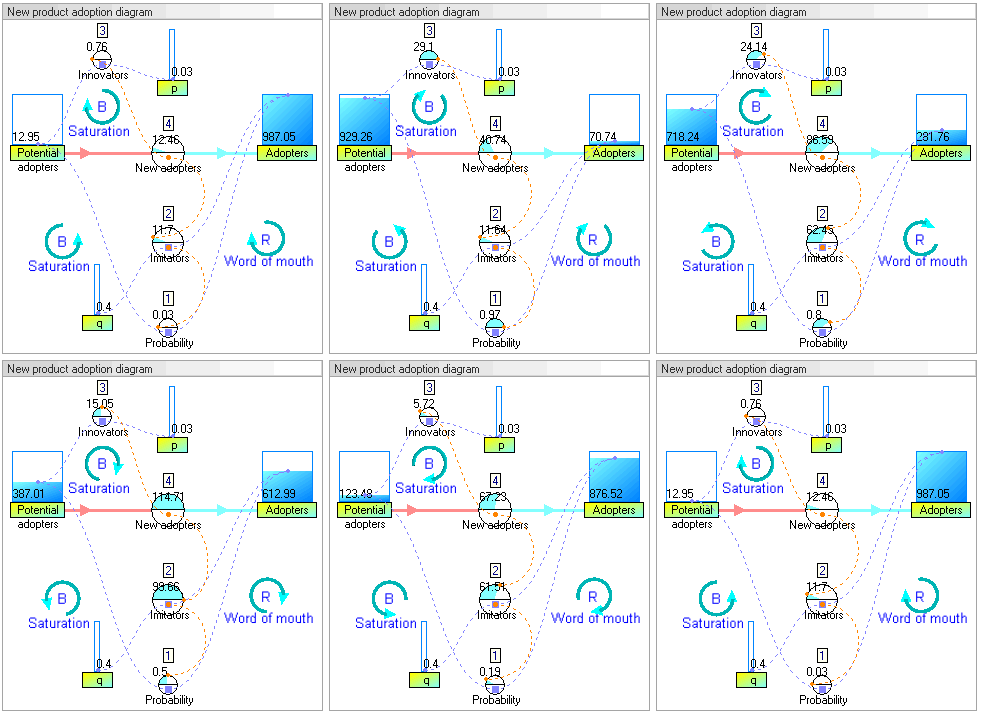
System Dynamics: Modeling with Stocks, Flows, and Feedback
System Dynamics models the world as interconnected stocks (like users) and flows (like signups), governed by feedback loops. Use it to understand why growth stalls or why hiring lags behind need.

Metrics Layer: The Dictionary for Your Data
A metrics layer is the central dictionary for your company's numbers, defining what "Revenue" or "Active User" means once for everyone. It ensures teams and AI agents get consistent answers from a single source of truth, preventing conflicting reports.
Product Ecosystem Strategy: Competing Through Collaboration
A product ecosystem strategy builds a network of collaborating and competing partners around a core offering, making the whole more valuable than any single part. It's the model behind app stores and smart home devices.
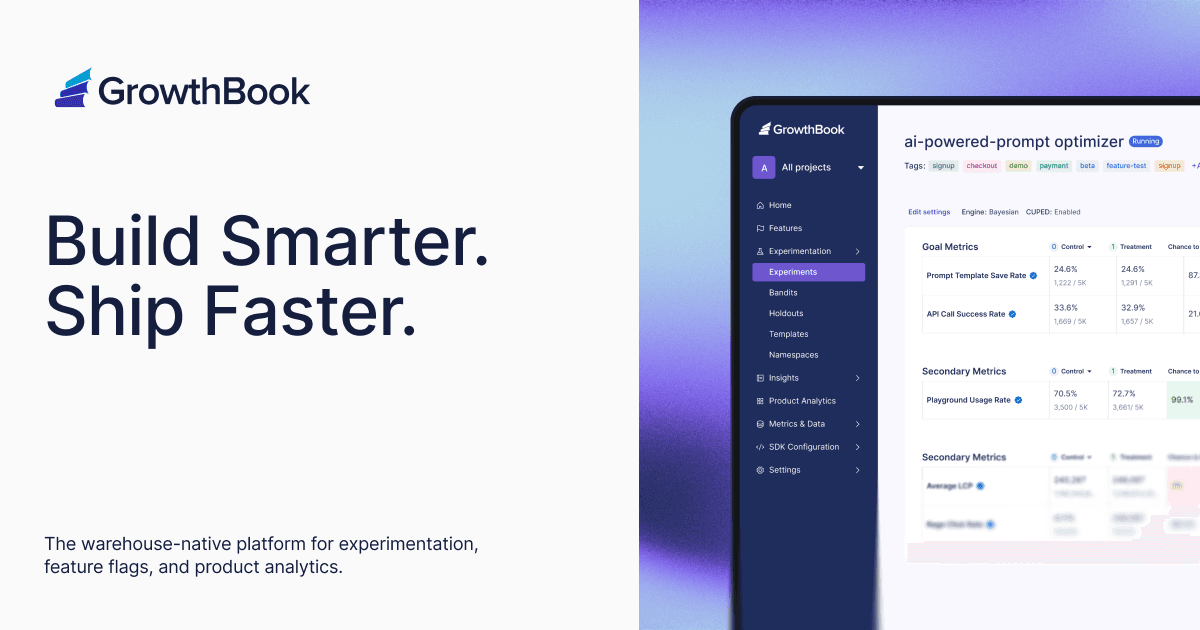
What is an Experimentation Stats Engine?
A stats engine is the brain of an A/B testing platform, turning raw data into reliable 'which version won?' decisions. It powers tools that analyze feature rollouts, ensuring statistical rigor.
Portfolio Balancing: Don't Bet Everything on One Project
Portfolio balancing treats your projects like an investment portfolio, diversifying bets. It's used to allocate engineers between new features, tech debt, and R&D. The footgun is only funding short-term wins, starving long-term health and innovation.

Multi-Armed Bandit: The Explore vs. Exploit Trade-off
A multi-armed bandit algorithm balances exploring new options with exploiting the current winner, like a gambler trying slot machines to find the best payout.

Dual-Track Agile: Discovery Before Delivery
Dual-Track Agile runs two parallel streams: a Discovery track to quickly validate ideas and a Delivery track to build releasable software. It prevents waste by testing concepts with cheap prototypes before writing code.
Isolating Impact with Difference-in-Differences (DiD)
Difference-in-Differences (DiD) isolates an intervention's true effect by comparing a treatment group's change over time to a control group's. This reveals if a new feature truly boosted engagement, not just rode a general upward trend.

Pretotyping: Build The Right It, Not Just It Right
Pretotyping tests if anyone wants your product before you build it, ensuring you build 'The Right It.' Use it to validate market demand with minimal resources, gathering real data. The footgun is confusing it with prototyping, which tests implementation.
Regression Discontinuity Design (RDD)
RDD finds a natural experiment at a cutoff point, like a test score threshold for a scholarship. By comparing people just above and below the score, you can estimate the program's effect. The footgun is assuming this local effect applies to everyone.
Product-Market Fit: Why Market Trumps Team and Product
Product-market fit is when a great market pulls a viable product out of a startup, not when a great product creates a market. You'll know you have it when customers are beating down your door.
Instrumental Variables: Isolating True Cause and Effect
Instrumental Variables (IV) isolate true causality when a key variable is tainted by hidden factors. An IV is a "clean" substitute that influences your cause without directly touching your effect, letting you measure the true relationship, free from…
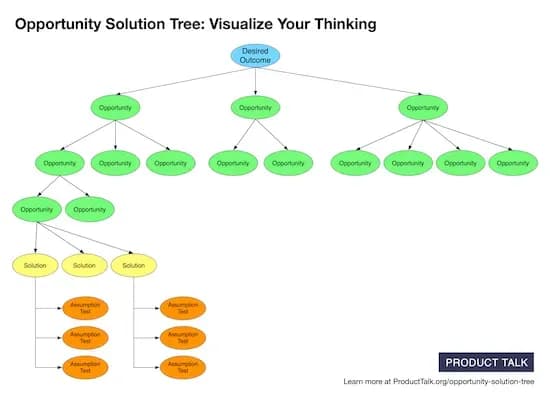
The Opportunity Solution Tree: Connecting Outcomes to Solutions
An Opportunity Solution Tree is a visual map connecting a business goal to the customer problems you could solve to achieve it. Product teams use it to explore paths to an outcome, ensuring features address real user needs.
Propensity Score Matching: Mimicking an A/B Test
Propensity Score Matching (PSM) mimics a randomized trial with observational data by finding a "statistical twin" for each subject. It's used to estimate a feature's impact when a true A/B test isn't possible. The footgun is assuming it removes all bias.

Growth Squads: Centralized vs. Decentralized
A growth squad is a trade-off between speed and cultural change. A centralized team optimizes for velocity with dedicated members, while a decentralized (embedded) team spreads the growth mindset by borrowing staff.
The Traditional Career Ladder: A Single Path Up
The traditional career ladder is a single, vertical track for promotion, moving from entry-level to executive. It's common in large, established organizations with well-defined roles. The footgun is its rigidity, forcing experts into management to advance.
Platform Envelopment: Eat or Be Eaten
Platform envelopment is when a large platform absorbs a competitor's market by bundling its core features, often for free. This is common in tech, like an OS adding a feature that makes a standalone app obsolete.
Little's Law: Why Adding More Work Slows You Down
Little's Law shows that average task completion time is proportional to the work in progress (WIP). For a stable team, Cycle Time = WIP / Throughput. It's used in Kanban to predict delivery times. The footgun is adding more WIP to go faster; this always.
We are hiring for this. Every open role lists the topics its interview covers, so you can prepare for the real thing rather than guessing.
See open roles