More in Product Management — page 35
Explain backlog refinement: purpose, participants, and outcomes
Tests your grasp of continuous planning for predictability. A good answer defines the purpose (clarify, estimate, prioritize), participants (whole team + PO), and outcomes (a 'Ready' backlog). A red flag is describing it as a one-off pre-sprint meeting.

How do you resolve a heated technical debate between two developers?
Tests your ability to facilitate conflict, moving a team from argument to a structured decision. A great answer involves de-escalating, using a technique like conflict mapping to understand the core issue, and guiding the team to a resolution.
Trade-offs: Product-Based vs. Project-Based Teams
This tests your grasp of how funding models impact team ownership and code quality. Contrast project (temporary, build-only) vs. product (durable, continuous) teams, linking the latter to better knowledge retention and architecture.
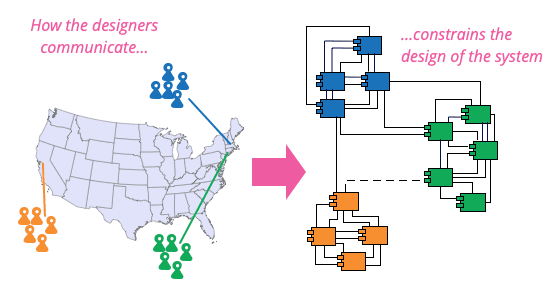
How would you apply Conway's Law to design team structures?
This tests applying organizational theory to technical strategy. A great answer defines the law, explains the 'Inverse Conway Maneuver' by structuring teams around business capabilities, and avoids imposing an architecture without changing team structure…
Why is team velocity a poor KPI for agile success?
Tests your grasp of agile principles and Goodhart's Law. Explain velocity is for forecasting, not performance. Detail dysfunctions like point inflation and ignoring quality. Propose outcome-focused alternatives like cycle time.

SAFe vs. LeSS: Planning, Dependencies, and Autonomy
Tests your grasp of the trade-offs between coordination and autonomy in scaling frameworks. A good answer contrasts SAFe's top-down PI Planning with LeSS's bottom-up, team-focused approach.
Feature teams vs. component teams: pros and cons?
Tests your grasp of how team structure impacts value delivery. Define feature (vertical slice) and component (horizontal) teams. Contrast speed vs. reusability. Red flag: Calling one 'good' and the other 'bad' without discussing trade-offs.
How do you manage performance in a self-organizing team?
This tests your ability to shift from individual performance management to fostering team-based career development. A great answer reframes the goal, uses frequent 1-on-1s for coaching, and decouples raises from feedback.
How can developers partner with the Product Owner in backlog refinement?
This tests your understanding of the developer's role in maximizing value, not just executing tasks. A great answer covers questioning the 'why,' suggesting technical alternatives to meet business goals, helping split stories, and providing realistic sizing.

Decomposing a Monolith: Technical Strategy
This tests your ability to create a practical, phased migration strategy from monolith to microservices. A strong answer defines service boundaries via Bounded Contexts, manages data with events, and uses an API Gateway for contracts.
How would you handle a SAFe rule that hinders agility?
Tests your ability to pragmatically adapt process instead of just complaining. A great answer identifies a specific SAFe rule, explains how it can backfire, and proposes a concrete alternative that still achieves the original goal.

Estimating Cross-Team Initiatives in PI Planning
This tests your ability to lead multi-team estimation. A good answer covers decomposing work, bottom-up team estimates, mapping dependencies, and synthesizing a risk-assessed plan. A red flag is a single top-down estimate that ignores team capacity.
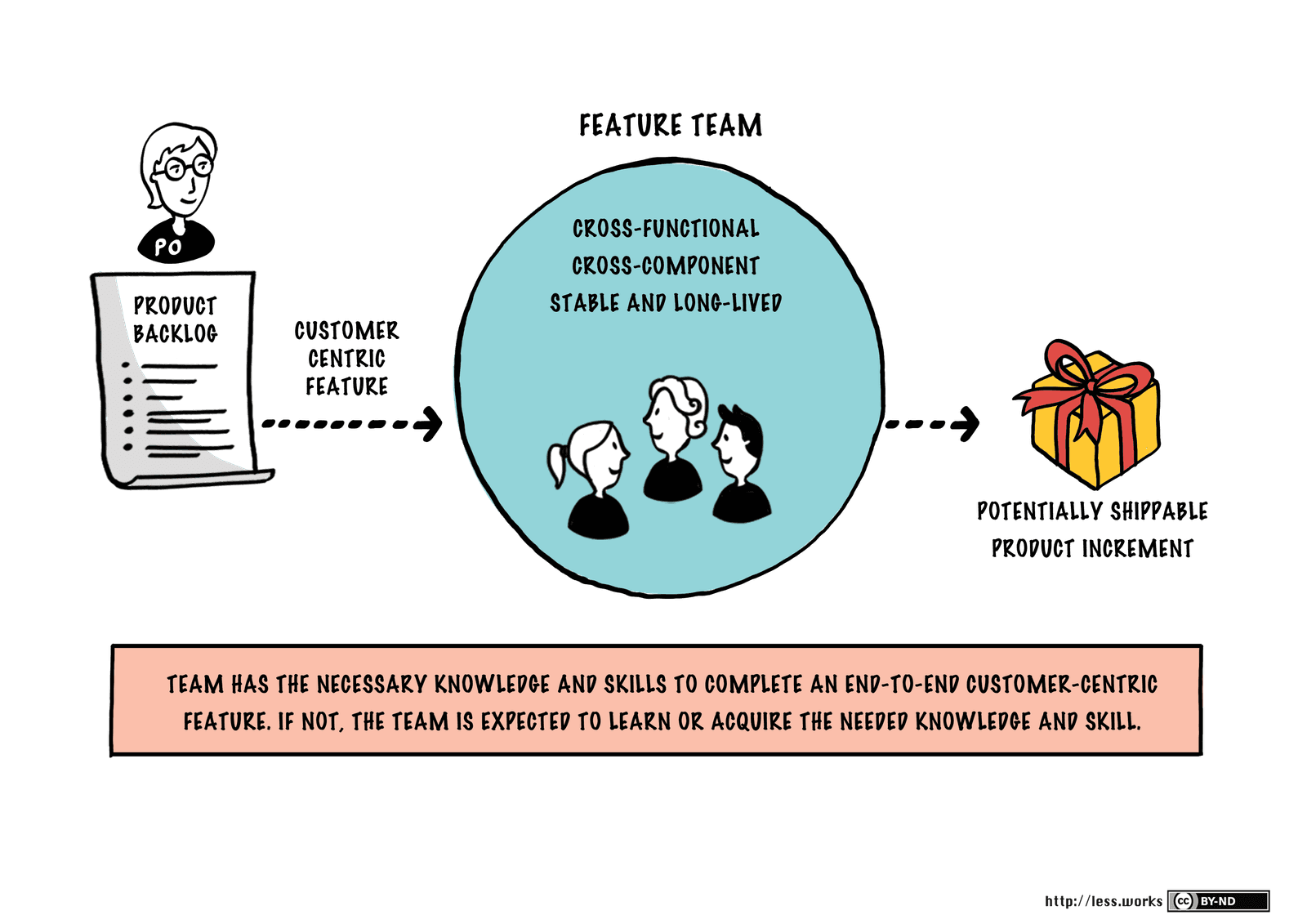
Technical Prerequisites for LeSS Feature Teams
Tests if you can link agile structure to technical architecture. A great answer covers codebase design for shared ownership, a fast CI pipeline for frequent integration, and a robust automated testing strategy.
What is the purpose of a shared 'Definition of Done'?
Tests your ability to ensure quality and transparency across multiple teams. A shared 'Definition of Done' is a formal description of quality for the integrated Increment. It ensures all work is combinable and shippable.
What is a Scrum of Scrums, and what do you share there?
Tests your understanding of scaling agile and representing your team's technical risks. A good answer defines it as a coordination meeting, not a status report, and focuses on sharing/receiving info on cross-team dependencies and blockers.
How would you apply Little's Law to a Kanban system?
This tests your ability to use metrics for process improvement. A great answer defines Little's Law for Kanban (Cycle Time = WIP / Throughput), explains how reducing WIP shortens cycle times, and gives a numerical example.
Diagnosing a Widening Code Review Band in a CFD
This tests data interpretation and problem-solving. A great answer defines the bottleneck, hypothesizes causes (capacity, PR size), proposes diagnostics, then offers solutions. A red flag is blaming individuals or jumping to a single, unverified solution.
Investigating Variable Sprint Velocity: Technical Root Causes
This tests your ability to diagnose team issues with data, not anecdotes. Propose technical hypotheses like flaky tests or merge conflicts and link them to metrics like CI/CD failure rates or PR cycle time. A red flag is blaming individuals or poor estimation.
Design and Implement an Upstream Kanban Process
Tests your understanding of managing demand vs. capability. A great answer defines Upstream Kanban as a pre-commitment filter, outlines board stages and policies, and explains how vetting work improves downstream predictability.

Diagnosing a Widening CFD 'Testing' Band
Tests your ability to interpret a CFD and propose data-driven experiments. A widening 'Testing' band means work enters faster than it leaves. Diagnose with experiments (e.g., tracking test failures, environment downtime) before proposing solutions.