More in Product Management — page 59
VRIO Framework: Finding Your Competitive Advantage
The VRIO framework is a checklist to see if a resource is a true competitive advantage. Use it to analyze internal assets like patents or expert teams. The footgun is stopping at "Valuable"—a true moat must also be Rare, Inimitable, and Organized.
Resource-Based View: Win With What You Uniquely Have
The Resource-Based View argues a firm's unique internal resources, not market position, create sustainable advantage. It's used for long-term strategy and M&A. The footgun is overvaluing resources that competitors can easily buy or copy.
Barriers to Entry: The Moats Around a Business
Barriers to entry are the 'cover charge' for a market that new players must pay, but incumbents didn't. They're the moats protecting a business, seen in regulated industries or with strong brand loyalty.
Sustainable Competitive Advantage: Building a Moat
A sustainable competitive advantage is a structural 'moat' that makes your business hard to copy. It's seen in network effects (social media), high switching costs (enterprise software), or economies of scale (Amazon).

Sales Battle Cards: Frame Your Competition, Don't Just Attack Them
A sales battle card is a one-page cheat sheet that frames your competitor's product for a different audience, not just lists its flaws. Sales teams use it to steer conversations toward your strengths.

Network Effects: Value Grows with Users
A product with network effects is like a telephone: its value grows as more people join. This powers social media, marketplaces, and communication tools. The main pitfall is the 'cold start problem'—attracting the first users to an empty, valueless network.
Switching Costs: The Moat Around Your Product
Switching costs are the gravity holding users to a product—the sum of all financial, mental, and effort-based pain of leaving. This is why bundled services are sticky. The footgun is creating costs that feel like traps, which destroys long-term trust.
Competitor Teardown: Reverse-Engineering Product Strategy
A competitor teardown reverse-engineers a product to reveal its underlying strategy, not just its features. PMs use it to understand how rivals solve user problems and inspire new ideas.
Competitive Intelligence: Turning Market Data into Strategy
Competitive intelligence turns public data about your market into a strategic map of what might happen next. It's used when pricing products or planning campaigns. The biggest mistake is confusing it with simple competitor tracking; true CI analyzes the *why*.
Perceptual Mapping: Charting How Customers See Your Brand
A perceptual map charts your brand's position based on customer views, not your own. It's a reality check on how you're perceived against competitors on axes like price vs. quality. The biggest footgun is mapping based on internal beliefs, not customer data.

The Competitive Matrix: Visualizing Your Strategic Edge
A competitive matrix is a map of your market, plotting your product against rivals on key axes like price and features. Use it to spot market gaps, justify new features, or refine pricing.

Thematic Analysis: Finding Patterns in Qualitative Data
Thematic Analysis finds patterns in qualitative data, like sifting user interviews for recurring ideas. It's about interpreting meaning, not just counting words. Use it on feedback to understand needs.
Ethnography: Uncover Needs Users Can't Articulate
Ethnography uncovers user needs by observing them in their natural environment, not just asking questions. It reveals what people *do*, not just what they say. Use it for early discovery to find needs users can't articulate.

Focus Groups: Understanding the 'Why' Behind User Reactions
A focus group is a guided conversation to uncover the 'why' behind user opinions, not just what they are. It's used to gauge reactions to new products or understand shared experiences.
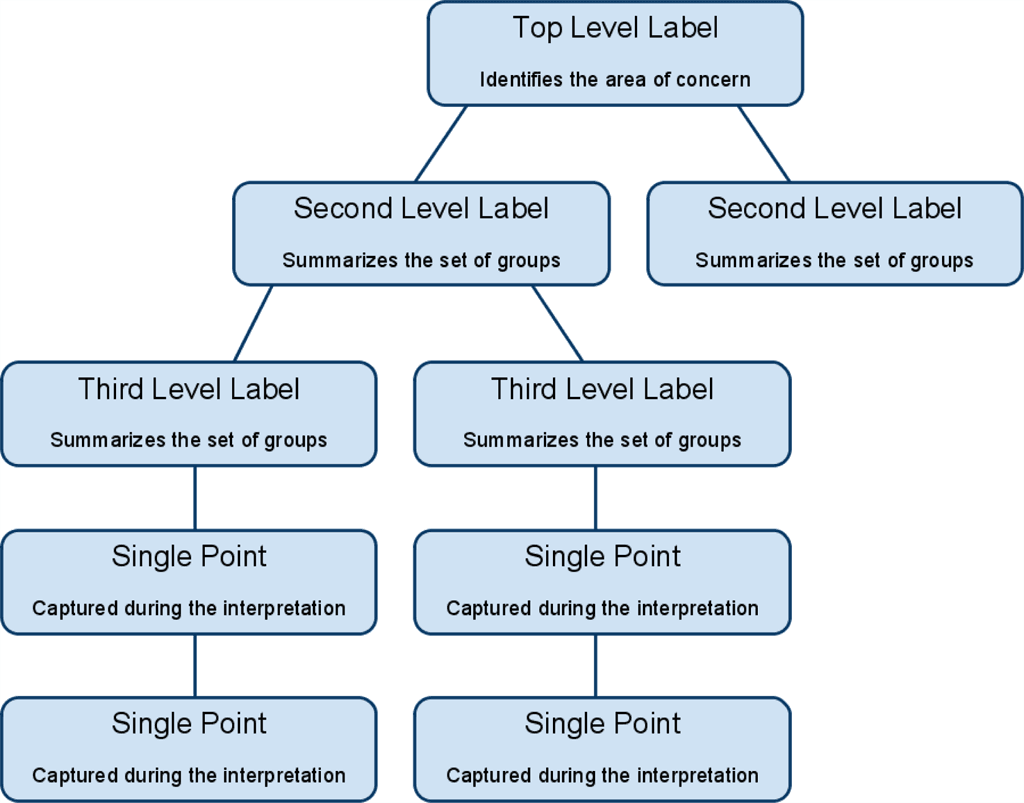
Affinity Diagramming: Finding Structure in Chaos
Affinity diagramming turns a pile of raw ideas into organized themes by grouping them based on natural relationships. Use it after brainstorming to find patterns. The biggest mistake is debating ideas instead of focusing on the connections between them.

Generative vs. Evaluative Research: Define Problems vs. Judge Solutions
Generative research defines problems by asking, "What should we build?" Evaluative research judges solutions by asking, "Did we build it right?" The footgun is using evaluative methods for discovery, which just optimizes a solution for a problem nobody has.
Diary Study: Capturing User Behavior Over Time
A diary study captures user habits by having them log experiences over time. It's used to understand routines or decision-making in a user's natural environment, without the high cost of a field study. The footgun is relying on self-reported data.
Contextual Inquiry: Watch Users in Their Habitat
Go to the user's environment to see what they *actually* do, not just what they say they do. It's used in early discovery to uncover unstated needs by observing real workflows. The footgun is 'helping' the user, which pollutes the observation.

How Might We: Frame Problems, Not Solutions
“How Might We” questions turn research insights into broad prompts for brainstorming. Use them after user research to frame design challenges before ideating. The biggest footgun is embedding a solution in the question, which kills creativity.
Problem Statement Framing: Define the 'Why' Before the 'What'
Don't just solve the problem, solve the *right* one. Problem framing forces you to deeply understand a user's need before building. It's the first step in product development, ensuring teams don't build something nobody wants.